Showing posts with label dog. Show all posts

Wednesday, September 17, 2014

Why is my Dog Lunging on the Leash?

Do you own a dog that does not act "normal" when he sees another dog on leash? 
Learning good emotional control takes practice
Many dogs do not have good coping skills to greet another dog when confined by a leash.    
You may describe this type of dog as fearful, hyper vigilant, aggressive, reactive, out of control, barks all the time, rude, pushy, anxious or even clingy.  Dogs who exhibit these behaviors are cruelly labeled and often given up on, but the truth is that these behaviors are your dog's way of begging for some help.  If your dog is displaying these emotions he is clearly not a calm dog, and therefore not a balanced or content dog.  Unbalanced dogs are riddled with emotions they cannot control, which make them difficult to live with and own, but these are the dogs that need us the most.....


With effective behavior modification programs, these anxious reactive dogs can thrive in our homes and communities.  Having a plan to keep them safe, predictable exercise routines, desensitization tools, healthy nutrition, doggie Zen and possibly medication, these dogs will love us unconditionally.  Just look in there eyes and help them feel safe, always..

If you have taken on the task to raise a dog with fearful reactive behaviors, know you are not alone.  I personally have three dogs who each have different levels of fears and often use distance cues with humans and dogs.  I understand your stress of owning an unbalanced dog....  Even my family members have called them names, not truly understanding my dogs level of stress. I feel an enormous amount of empathy for these animals as I see in their body language how much more worried they are then other dogs.  I have spent hours counter condition their fears to various stimuli and I work very hard to have a plan each time I take them in public so I can set them up
Thinking through arousal...
for success.  I manage for safety, continually counter condition their fear emotions to positive ones so they know what to do in different situations and cherish each calm moment we have together.  My two females came to me with bite histories and have each received their Canine Good Citizen Certification from two different trainers.  One has gone on to be Therapy Dog International Certified, so do not lose hope and celebrate each small daily success!  


Using the right balance of tools, your dog will one day be able to think through his arousal so you can reward him and not be frustrated with him.

Thursday, January 30, 2014

Preventing Dog to Dog Aggression

Protect your dog from becoming aggressive by knowing where he is and who his playmates are.  The topic of leash aggression arises so often, I feel the need to address it often in my blogs.  For dog trainers it is very clear why we do not let our dogs greet unknown dogs while on leash. I want my dogs attention on ME when I have him on a leash.  I prefer he not pull my shoulder off my body when on leash, so I never let him greet other dogs when on leash and guess what?  He does not ask anymore because he knows the rule structure. In my opinion, the BEST reason to avoid letting your dog greet unknown dogs while on leash is to keep him or her safe.  Once your dog gets into a scuffle while on leash, just the site of a dog while on leash can become very scary for your pup.
tight leash is nearly un avoidable.
We have all seen or heard stories of two dogs greeting on leash and it ends badly.  Let's think about it, when dogs greet off-leash they are able to circle, sniff and have the freedom to move away if one dog becomes stiff and worried.  When on-leash we often tighten the leash, which makes the dog feel trapped because it cannot flee the environment. As a result, the constrained dog may send the other dog a distance cue like a hard eyed stare, a lip curl or a low growl.  Depending on the social skills of the other dog, this may turn into an unwanted scuffle. 
If you want your dog to have good social skills and avoid aggression, let him have an opportunity to socialize and play with other GOOD dogs. Start with an AKC STAR Puppy class, teach your dog leash manners throughout his adolescence and set up off-leash playdates with dog-friendly dogs that you know he enjoys playing with and who have owners that you are comfortable with.
Social dogs can relax in the presence of other
dogs even while being on a leash.
A large part of my business is helping dog owners understand why their dog is jumping and snarling when on a leash in the presence of another dog.  This behavior is done by your dog because he has learned that it keeps him/her safe.  Dogs that have been traumatized by another dog, or multiple dogs, learn that their best defense is a good offense.  If this behavior works for them, why would they need to change? Being safe simply feels good.

I do understand your dog needs daily exercise to get him through his adolescence. If your dog plays well with the neighbors dog, then your dog is already social! Walking on-leash together is a great way to learn leash manners around other dogs. Or, hire a dog-walker who only brings one dog to your session and watch how your dog interacts with that dog.  Your dog-walker will help him learn leash manners and prevent any unwanted behaviors from being reinforced.  Many dogs are surrendered because they can no longer cope with being on a leash in society.  Who's to blame?  These dogs were not born dog-aggressive. Rather, it is learned by putting them in environments that are out of control and scary.  So please know who your dog is playing with, and if the play is appropriate.  We can all agree that aggression breeds more aggression, so please know
who your dog's friends are!

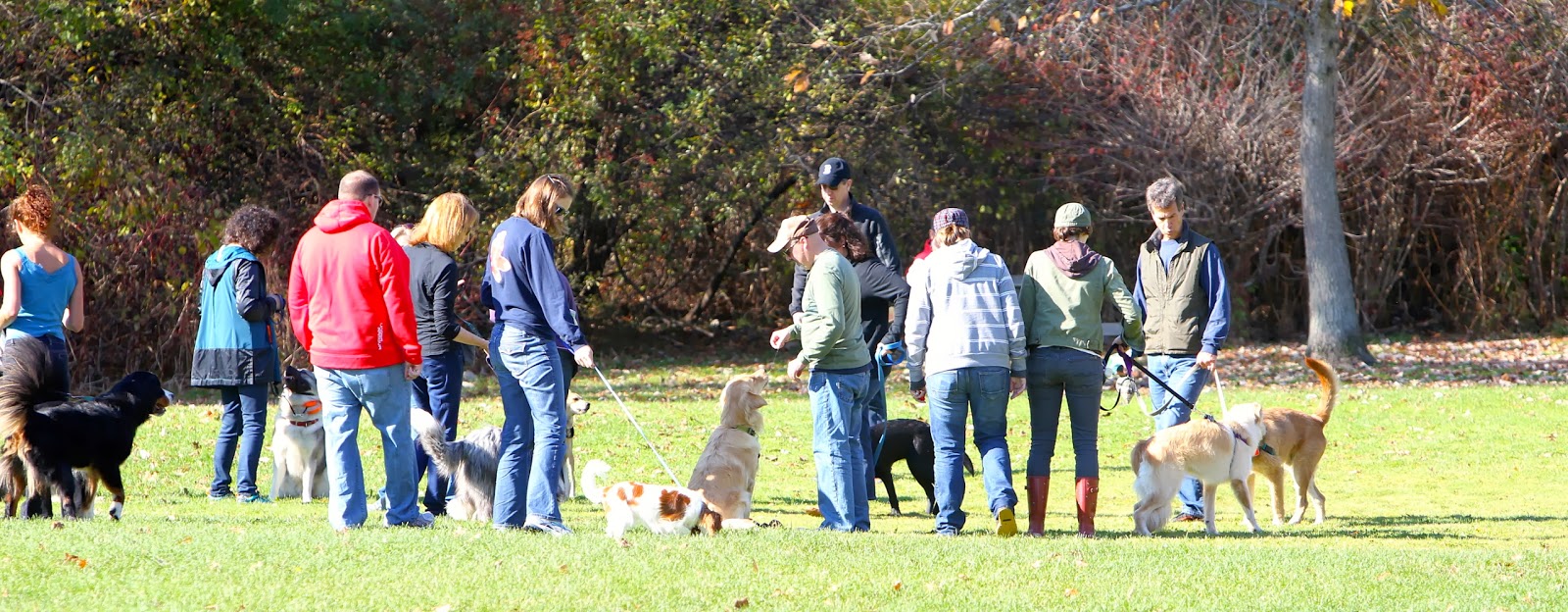
In the photo to the right, my Outdoor Adventure Class is open to dog friendly dogs.  Dogs that have good emotional control, dogs that can sit and watch a dog go by without demanding to get to it, and dogs that are not overly pushy.  If your dog is demanding to say "hello" to every dog that goes by, think about why that behavior is developing and where it is being reinforced.   I hope to see you and your dog in a training class, while on-leash and enjoying each other's calm company!

Saturday, January 11, 2014

New Year! New Puppy?

If you are enjoying the beginning of 2014 with a soft cuddly new puppy, then congratulations!!  As the owner of a new puppy, you have some responsibility to the puppy and to those who come in contact with your new puppy.  While you must certainly be enjoying the new puppy smells, sounds and soft fur, you may also be a bit tired from late night potty trips outside, managing all the winter gloves and hats that puppies love to chew on,  and you may possibly have a few scratches from your pups needle sharp teeth.

First, it is very normal for your puppy to mouth you as that is how dogs gain information about things near them.  If you have ever watched two dogs play, they often use their mouth during the interaction.  The primary puppy behaviors you need to teach your puppy? 1.  Not to bite humans, called "bite inhibition" 2. Potty training, for your own sanity.  3. Calm behaviors, as everyone loves a pup with good emotional control  4. Socialization to a variety of places, people and dogs in a positive way. Finally, prevention of guarding and becoming overly mouthy, as these two behaviors can lead to an unwanted bite.

There are numerous Certified Pet Dog Trainers who can help you teach your pup appropriate behavior to succeed in a human home.  Using Positive Reinforcement Communication and lots of patience, you will eventually have a wonderful family dog.  To find a Certified Pet Dog Trainer in your area, investigate this link: CCPDT Certification for Pet Dog Trainers

 I have 3 basic rules that I use often with new puppy owners:
Socialized dogs, enjoy life enrichment activities
1. Manage your pup so it is not practicing any unwanted behaviors. For example, use a crate or x-pen to contain your pup if you can not watch him.  This is not only for his safety, but so he does not learn how good it is to chew on your favorite boots.
2. Reward your dog all day long for appropriate behaviors.  Example, if you are going to let your pup out of his crate, then put your hand on the latch, if your puppy is calm open the crate and reward with freedom.   If however he climbs on the door and barks at you. Take your hand off the latch and wait.  When your puppy is calm or sitting, then you can open the door, if he tries to bolt out, close the door quickly, and wait until he sits or is calm, then reward with freedom!
3. Show your puppy what it is you prefer he do and reinforce it with something.  For example, if your puppy bites on your hand, remove your hand and quickly replace it with a toy.  Move the toy around on the floor and praise your puppy when he chases, and mouths the toy.  If he bites your hand or arm let him know it hurts and replace it with a toy.

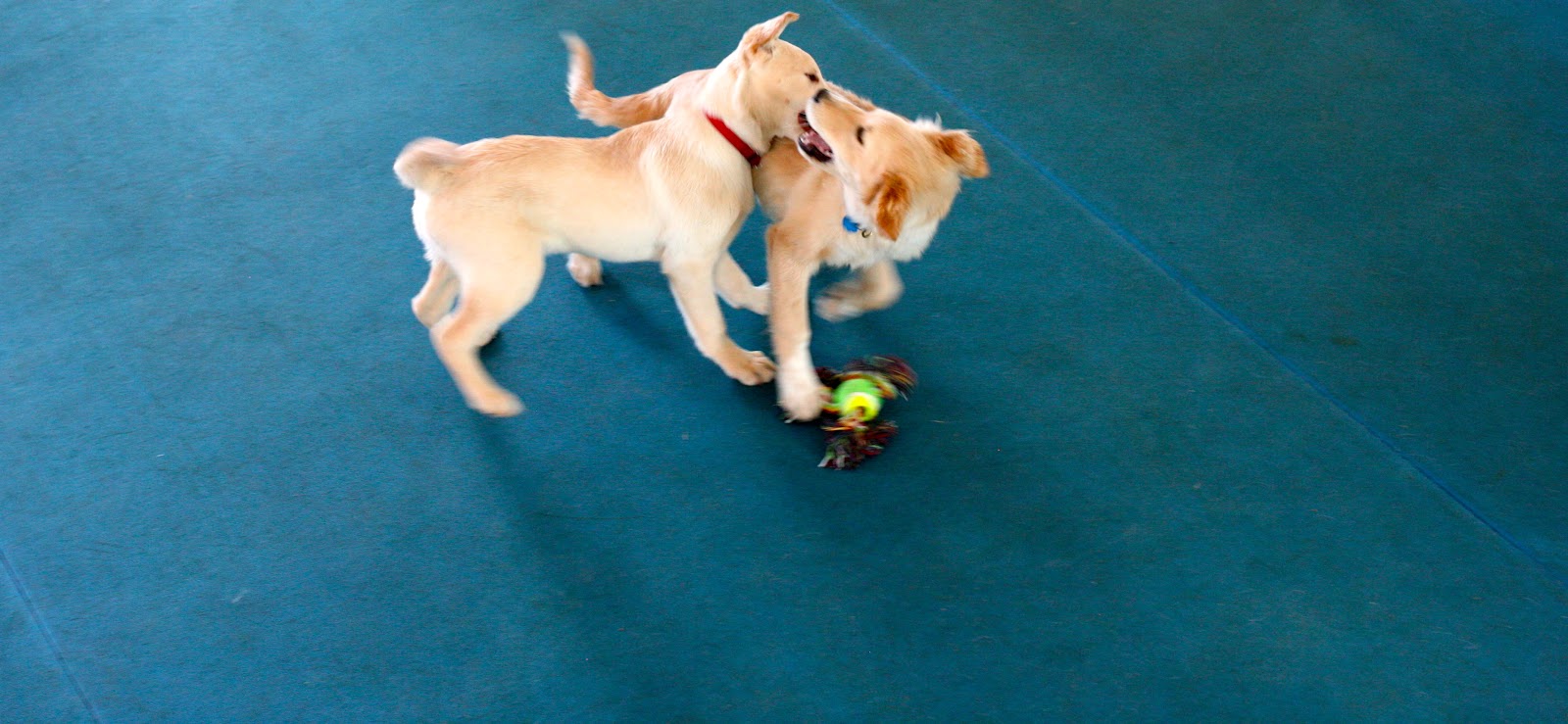
Keep in mind your puppy has been using his mouth to play with his siblings for weeks, so he is conditioned to do so.  It is your job to help him learn good bite inhibition and socialize him well with new places, people and allow him to play with other puppies to help him learn good social skills.

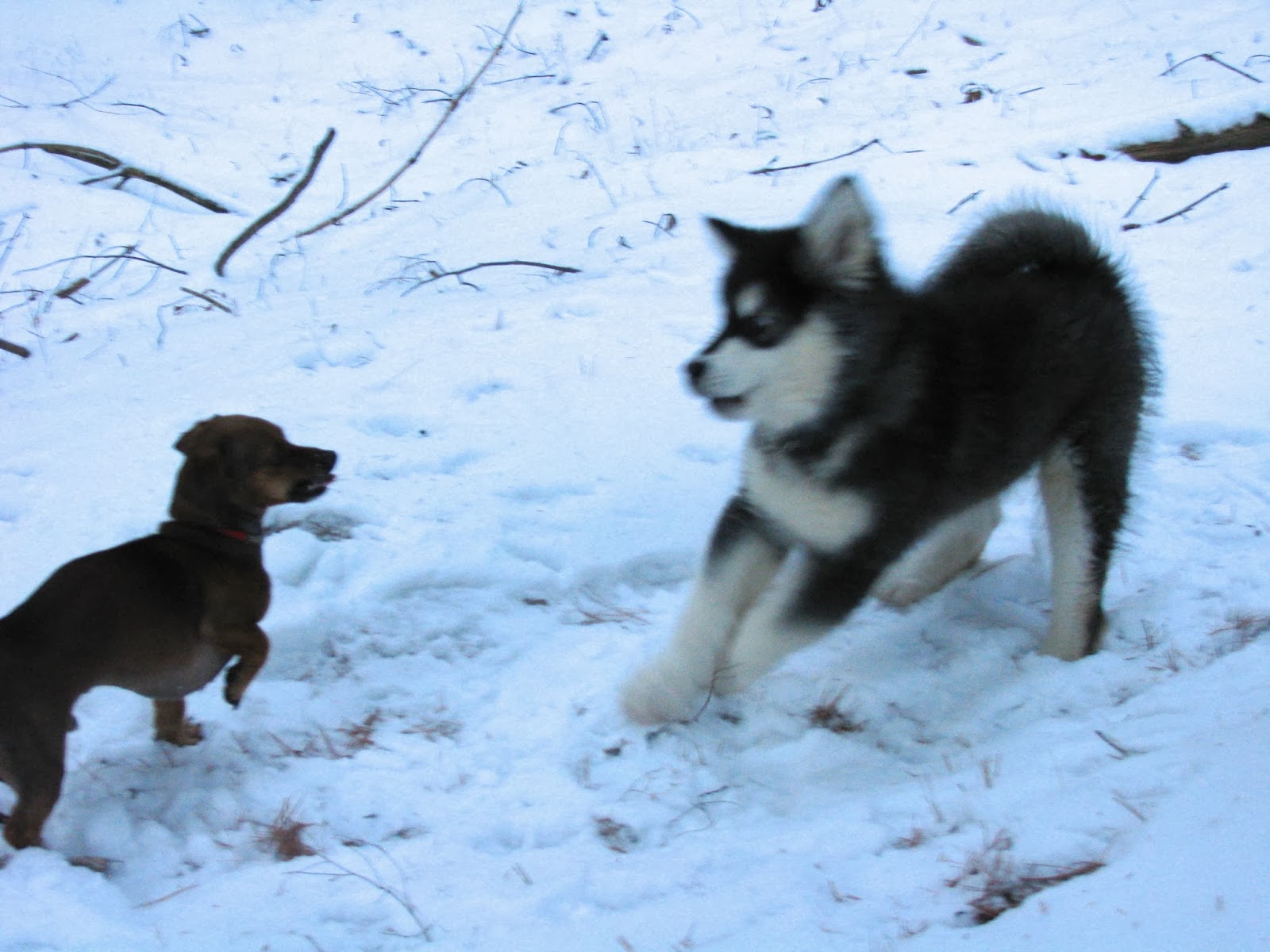
In this photo to the right, the 13 week old Malamute started to bark at the 4 year old Dachshund.  This Dachshund is not happy about having to potty in 10 degree weather and so is not interested in playing.  He signals this to the pup by closing his mouth, freezing his body, making direct eye contact and then begins to give a low growl directed at the puppy.  The young pup quickly began to back away and go look for another playmate.  Helping this Malamute have good social skills is important as we do not want him to grow in to a large bully.

To ensure your puppies behavior is shaped to be a calm family pet, consider a puppy socialization class taught by a professional!  CBC Puppy Class Schedule

Monday, November 25, 2013

Pets for Vets Program Launched here in Portland, Maine

I am happy to announce that Portland, Maine has an official Chapter for the Pets for Vets Program and I am the official trainer of the canines for this wonderful program.  I will be assessing, training and matching dogs with Veterans in need of a companion dog.

Tom Targett, Chapter Director is to be recognized and thanked for his dedication in getting this Portland Chapter off and running.  Tom is an ideal Director as a returning Veteran himself and his understanding and love of dogs.

Our mission at the Pets for Vets program is to help support veterans while providing a second chance for shelter pets by rescuing, training and pairing them with veterans right here in our community who could benefit from a companion animal.

I am pleased to inform you that we will be introducing our first match early in December!  I am not sure who is more excited about this upcoming match?  Tom, my self or our Veteran, we are all simply joyful to be a part of this first match!

Each Monday from November 18 to December 10, from 6 – 8 p.m. Pets for Vets, Maine Chapter will be near the Santa photo area at the Maine Mall in Portland.

For further information about our new Portland, Maine Chapter, contact:
Thomas Targett -  tomt521@aol.com
http://pets-for-vets.com/category/northeast/portlandme/pme-news/

Saturday, November 2, 2013

Good Things Happen...

When I introduce a new rule structure to my dogs or to my clients dog, I make sure good things happen when the dog performs the wanted or desired behavior. We can all agree that consequence
drives behavior in all of us, but I really want you to think of the consequence as a positive and rewarding one.  It is not just that I believe it works, it is scientifically proven that if a dog does a behavior and what follows is rewarding, the behavior will be repeated.  This repeated behavior performed several times per day and continued over a few weeks becomes a desired habit.  Is that not what we all are trying to do?  Shape our dogs behavior into good habits?

Here are a few examples you might want to try:

1. Good things happen when you are on your mat! 
Good things happen when you go to a mat,
these two are chewing on stuffed kongs.
Simply have your dog near you with a handful of treats and your dog's mat.  Lay the mat on the floor and when your dog sniffs it, looks at it or step on it, say "yes" and drop a treat or two between his paws.  Ask your dog to get off the mat, pick it up and walk a few steps with it in your hand.  Repeat the process of laying the mat down and rewarding your dog for moving onto the mat.  You can initially walk around the mat and stop while facing your dog with the mat between you two.  When he steps onto it, say "yes" and reward generously.  Initially, put the mat away between sessions and play this game a few times per day.  When you see your dog get excited that you are about to lay the mat down, add a cue like "go to your mat" just before you lay the mat down.  Once your dog is walking on the mat quickly, wait on the "yes" and see if your dog offers you a sit, then say "yes" and reward.  Eventually your dog will offer you a down and then you can jackpot this behavior.

To maintain this behavior of "go to your mat" you will want to randomly reward your dog when you see him go to his mat without being asked.  This can be a good massage, kong time, bone time, yummy treat or a good scratch, whatever your dog finds rewarding.  I use this each morning as we enter the kitchen, each of my dogs will move towards their mat and I will eventually feed them while they are on their mat waiting patiently.  I no longer ask them to go to their mat, they know going to their mat predicts they will get fed, which is rewarding to them and nice for me not to have 12 paws under my feet!
How does your dog feel when he looks at you?
2. Good things happen when you look at me!
Training your dog to perform a simple behavior is nearly impossible without first having your dog's attention.  If your dog is not quick to look at you, teach your dog that looking at you is ALWAYS followed by a reward.
Again, begin with a handful of your dogs yummy treats and your dog near you, maybe on a leash if necessary.  Say your dog's name, and when he looks at you say "yes" and toss him a treat.  Wait a few seconds and repeat, saying his name, and marking the moment his head turns towards you and rewarding.

Another game that works well to get your dogs attention is to simply sit in a chair with some treats in hand.  Toss a treat on the floor and when your dog eats the treat he will most likely look at you to see if more food is flying.  When he looks your way, say "yes" and toss another over his head.  When he eats the treat he will come near you again and you can smile and say "yes" when he looks at you and repeat the process.  Your dog will learn that looking at you predicts Good things happen, and will repeat the behavior.

If you are reading this Blog, then I assume you have a dog or are thinking about getting a dog.  My hope is that you are a positive influence in training your dog and not one who feels they need to dominate a dog.  Consider how effective science-based training is, and how your dog "feels" when you are training.  I hope your dog feels good when you are near, when he looks at you and when you reach to touch him.  If not, read more of my blog to learn how to train your dog while also having a happy, healthy and trusting relationship.

Friday, March 29, 2013

Staying Positive

I recently attended a Behavior Clinic where we taught our dogs new behaviors using a technique called shaping which is where we rewarded our dogs for making the slightest attempt at the behavior we wanted.

What I LOVED about this training seminar was that everyone was happy, smiling and really positive as they changed their dogs behavior.  Yes, that is right, we were getting new behaviors and everyone was happy!

Maisey's mom is always smiling and rewarding her!
So why is it when you teach your dog a trick like paw, high five, or roll over you get super excited when they make the right choice, "YES",  click, click "YES" as if one marker is not enough? Many of us repeat the marker due to our excitement!  The dogs clearly get that they did something right because our feedback to them is exactly that: "positive and rewarding."  Many of you can't stop there, you need to go show someone how smart your dog is, so you repeat the cue, your dog does the behavior and you again, shrill with "Yes" "Good Dog" and shower him with positive and rewarding feedback. 

You must be smiling by now because you know this to be true!  So, I want you to use the same positive feedback to reward your dog the next time you
Maisey's dad has a soft tone, loose leash and
 is smart to tell her what she is doing right!
are working with him.  The way I see it, behavior is behavior, and, although you may feel the need to be serious when asking for a specific behavior, your dog just knows you are tense and not as much fun.  So, I ask you to be more fun, smile and make a big deal when your dog does any small behavior you like.  I do think you will see a softer, happier dog that will be able to focus on you longer because you are relaxed, fun and rewarding to be with!

Can you still change your pitch while training?  Yes, but make the "positive" much more exciting and rewarding!

Sunday, March 24, 2013

My Dog is Fearful

Many dogs are afraid of other dogs, men, strangers, children, loud trucks, bikes, scooters, skate boards, odd scents, noises, and many more stimuli.   I have spent the last 10 years helping my own dogs and many others live happier, less stressful lives.  The first thing you need to realize is that you are not alone! Many many dog owners are feeling just as you are.  While we are all at different stages of conditioning our dogs to feel better about certain stimuli, we all have similar fears and stressors.  Staying positive is essential! Right now, think about all the behaviors your dog has learned recently.  You know your attitude effects your dog, so stay positive! And remember: you are not alone!

Here are a few things to consider:
  1. Seek out a Certified Trainer who has experience with insecure, anxious and fearful dogs, as they will have a better understanding of what you and your dog are feeling.  Find someone who has current testimonials or good references so you know they are using Positive methods.
  2. Avoid expecting a specific goal, or anxiety will creep in when you fear you may not reach this goal.
  3. Instead, set simple goals that you and your dog can meet together every moment, every day, week by week and be happy with these small steps.
  4. Be honest with yourself right now that your dog will never be the "perfect" dog. It is okay, you will still love and protect him or her because he needs you to.
  5. Think of the advantages of owning a shy or fearful dog:  
  • He gives you unconditional love because he is worried about others.
  • He only needs to be by your side to be content with life.
  • His love is without strings attached.
  • There are no pressures to earn titles, win ribbons or be the best.
  • You will never lose him, as he is too worried about going too far away. 
  • You will learn more about dog behavior than your neighbor.
  • He will not pull you to greet everyone.
These are just a few but there are many advantages to owning a shy or fearful dog.  Sure, it can be scary at times! Just remember your dog is not acting this way to make your life miserable. Rather, he is coping the best way he knows how and is begging for some help!

As an example of a positive training attitude,  the photo below shows a handsome dog to the far left that is fearful of people, yet he is able to give nice eye contact to his owner.  When we began with this boy, we were happy when he could simply offer a quick glance at his owner when strangers were near by. After months of positive conditioning, he is much more comfortable as you can see in this photo.

I can assure you that his owner was thrilled with each small progression he made at gaining confidence, and was happy to reward him for looking at her even for 1 second when 50 feet away!  We slowly progressed, and while he will never be a therapy dog, does that really matter?  What sets this owner apart?  Her expectations are reasonable, and, when not met, she is still okay with the outcome!  Why?  Because she knows when her dog does fall back into an old, unwanted behavior it is because we pushed him too far too fast.


So please, set your criteria such that you and your dog can succeed together! Otherwise you will be disappointed and your frustration will simply make your anxious dog even more stressed. Keep your training sessions relaxed, and positive. Don't push your dog beyond what he or she can handle comfortably, or else the negative experience will just set you both back. Stay patient, stay positive and celebrate all the small successes along the way. You and your dog will be much happier as a result!


Tuesday, March 19, 2013

Have a Plan When Changing Behavior


When a dog is repeatedly frightened by the same stimuli, and is not ever given a chance to think and feel differently about this stimuli, you will likely see the same reaction long term to this stimuli whenever it presents itself.

Pablo looks at me with dogs
in the distance
Systematic Desensitization and Counter Conditioning is the process of learning to think and feel differently about a particular stimuli.  Remember it is the feeling or emotion that is going to drive the behavior you see in your dog.  Stopping the behavior by a shock, will obviously make the dog stop the behavior to avoid the shock, but does nothing to help the dog feel any better about the scary stimuli and often times will make the dog react stronger the next time.

Have a plan!  Spring is a time when people and children will be out and about not only a lot more, but at predictable times.  Skate boards, bikes, scooters and motorcycles will all be zipping by very soon.  If these are things your dogs gets aroused and barks or lunges at, then let's make a plan!

Think about rewarding your dog for staying calm when he hears the trigger, be sure your dog is definitely going to practice a new behavior.  How?   Be far enough away from the stimuli and have high enough motivation that your dog can not fail!  Once you start getting a new behavior, you realize your dog can change his habits, he just needs you to set him up for success and be sure he can stay under threshold so his old habit does not appear.

When your dog is under threshold or far enough away from the scary stimuli that he is able to think about the stimuli and how he feels, you know you are making progress!

So, if given the chance, would your dog would run across the street and bark at the neighbor child on his scooter? If the answer is, "Yes", then start with your dog down the street each day at the optimal time, and reward your dog for looking or just alerting to the neighbor as he comes out.  Each day use high value rewards and get just five feet or so closer to the neighbor.  Over time, your dog will realize that the presence of the neighbor predicts him getting his treat; hence his emotion to the neighbor appearing will be very different in just a few training sessions.

Please do not try to get closer every day, but stay the same distance so your dog can feel safe.  Going too fast is a common problem and will most likely force your dog to use an old unwanted habit.

Finally, I recommend you always end on a good moment when things are calm and going smoothly so when you begin the next time, you and your dog will have a good feeling about training in this location.