Showing posts with label Guarding. Show all posts

Wednesday, November 26, 2014

5 Body Postures, A Dog is Asking For Space

If humans better understood dogs body language then we would have less dogs resorting to a bite when they feel stressed or threatened.  We see several cues that this scared boy does not want to be touched.  Signals that are asking for distance are often very subtle.

Level 1 distance Cues:
1. Dogs body is leaning away from the approaching hand.
2. Dogs paw is raised in a submissive manner.
3. Head is moving away asking for increased distance.
4. Eyes are avoiding the stranger
5. Mouth is closed, rather than open and relaxed.

Dogs often ask for distance in the only way they know how, but if the scary hand keeps coming, your dog may resort to a level 2 distance cue like a Growl, lip curl or show of teeth with a rigid body.  I HOPE your dog growls rather than bites. Hence, do not punish the growl as it is an effective distance cue.  When the dog is punished for growling, but is still afraid of that hand coming as it predicts pain, he may bite to protect himself.  

Have you heard of someone who was bitten by a dog in the face while they were attempting to pet him or rub his belly?  It is probable the dog used some distance cues before he resorted to a bite. Unfortunately, it is likely the human did not understand the signals and continued forward until the dog felt so threatened he did not have time to use a more moderate level one or level two response.

Dogs that are fearful or have been threatened by a previous human will be on guard and defensive.  Canine behaviors asking for distance are far better than an attack with a bite, so please do not punish them. Rather, simply remove the approaching stimuli. Can you teach a dog a level 1 distance cue like a look away? Absolutely, but it takes time and patience -- and it is well worth the effort!


Sunday, December 29, 2013

Once a guarder, always a guarder?

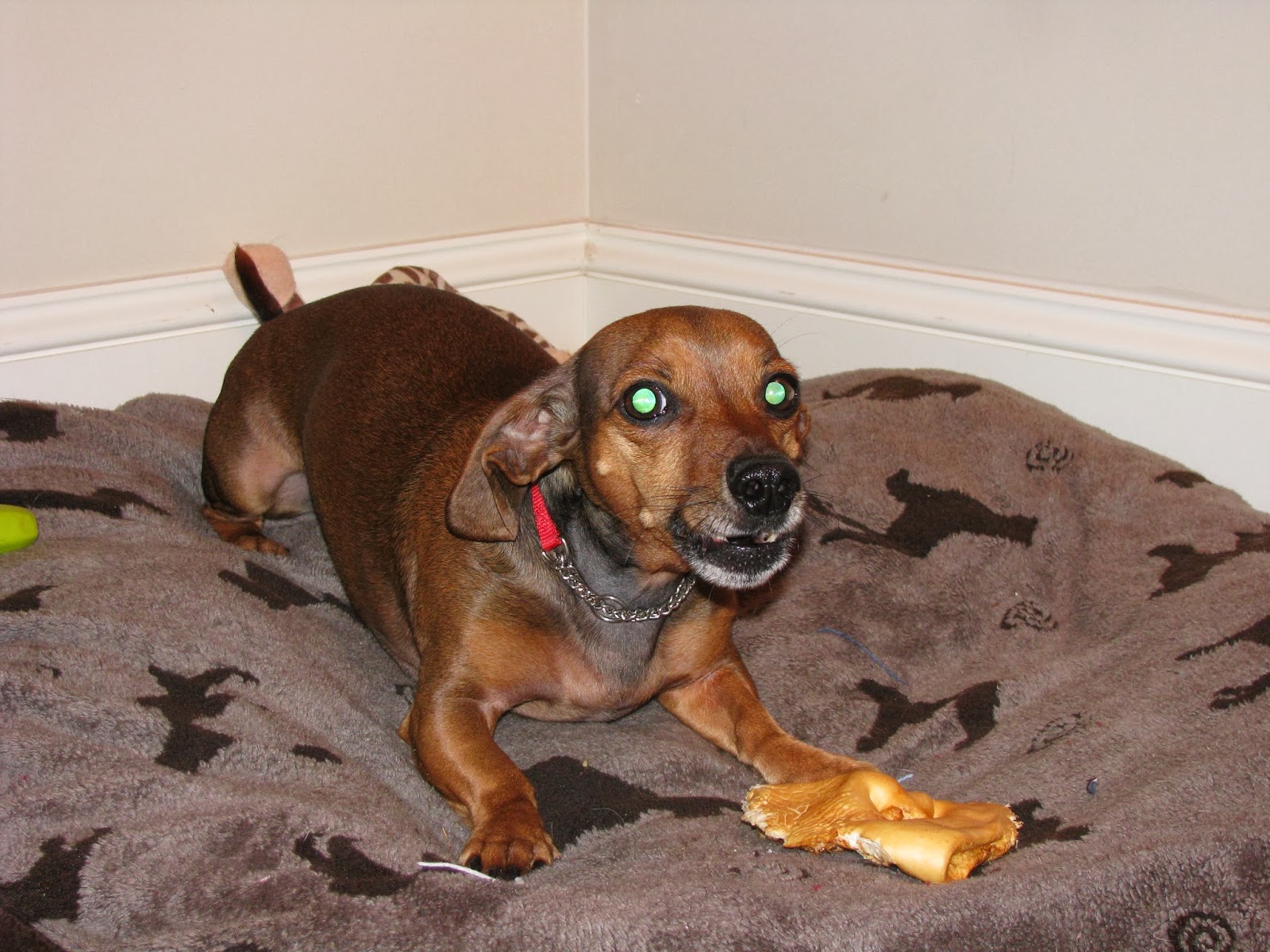
Go away!

Zeke, my foster dachshund, was surrendered because he continually fought with another dog in his home.  This was particularly sad because he was given up by the family who adopted him as a pup. It was the only home Zeke was familiar with.  On the other hand, if Zeke was fighting with another dog in the home, did he feel safe in that home?  Why did he constantly want on his owners lap?  Was he guarding her, or was it that he felt safest when near her?  Why did he guard his crate?  Again, was it his or was it that he felt safe there? What made this behavior rewarding to Zeke?

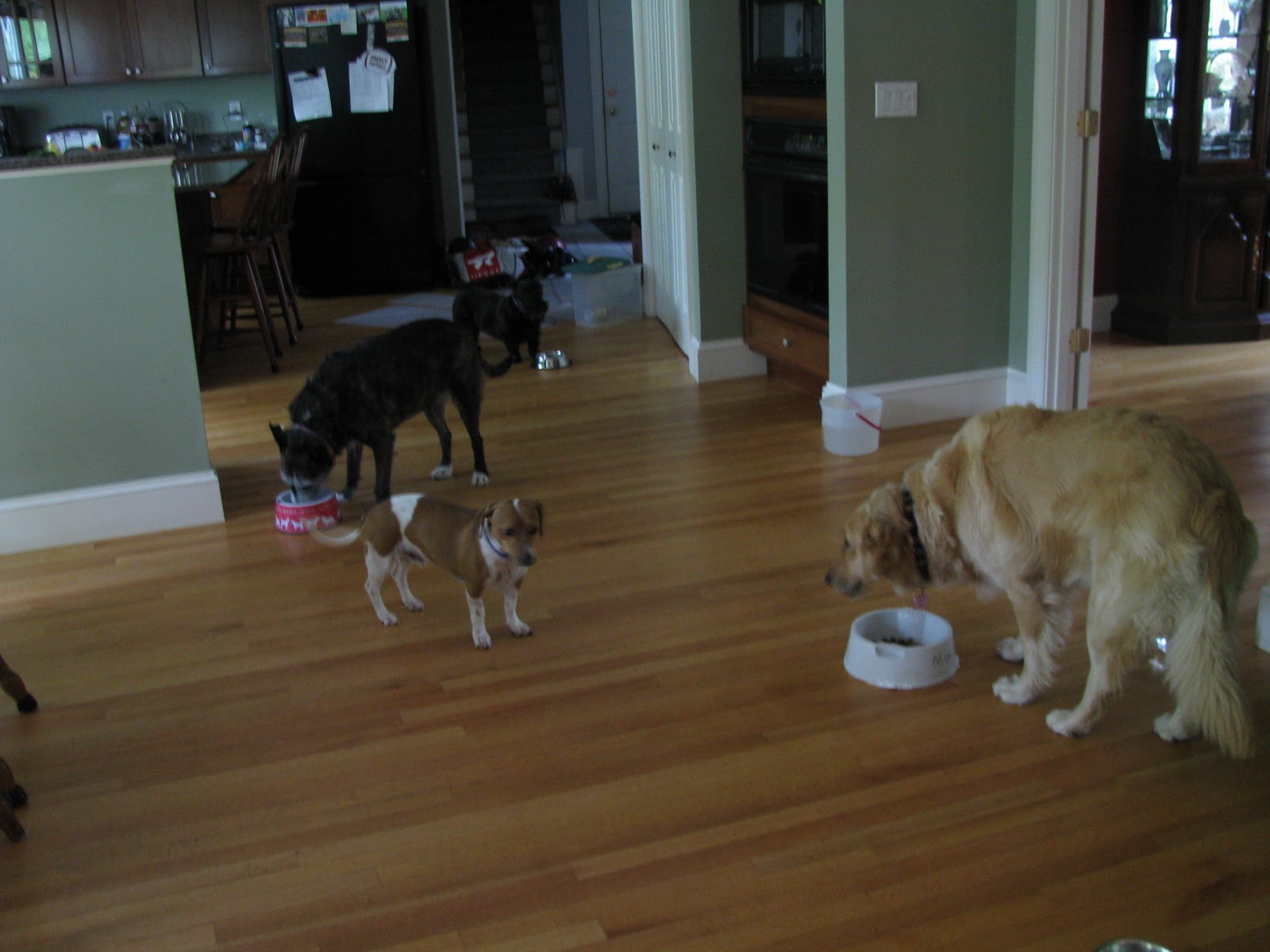
I am pleased to inform you that after less than 3 weeks, Zeke has developed a trusting relationship with my three dogs.  Why is that important?  Because many dogs that guard are also fearful and defensive.  Once I reduced his fear, he now moves through the house with bones and toys in each room, and he no longer chases my dogs away from them or even gives them the "look".  They have walked past toys and bones so many times (and there are plenty to go around!), so guarding is not rewarding anymore.

I am warning you!

That does not mean he may not fall into old habits in his new home, but it does mean that I personally believe Zeke's underlying habitual guarding behavior stems from very poor social skills with both people and dogs.  Developing a trusting relationship with dogs in the home, and devaluing the objects he found high value, have been a successful plan for Zeke.


When Zeke, the Dachshund, would show his teeth at my dogs to gain access to more food I was holding, I walked him away and gave his share to my dogs.  I waited about 2 minutes and repeated this exercise of feeding everyone some chicken.  When Zeke focused on me and ignored my dogs, showing no distance cues at them, I rewarded him with chicken. Hence, he learned good social skills always gets rewarded in my home.

Tuesday, December 17, 2013

Canine Body Language Seminar
Presented by
Judy Moore ACDBC
Associate Certified Dog Behavior Consultant


When:    Saturday, January 4, 2014
Where:   Poetic Gold Farm 
              7 Trillium Lane, Falmouth, ME 

Time:    10am- noon

Fees:    Dogs attending for evaluation $75
            Attendees for audit $25
  
who is the most worried here?
I'll will review how canines communicate with each other and how they try to communicate with us. You will learn to identify signs of canine stress and fear which can assist you in preventing unwanted behaviors such as a snap or bite.  Many dogs offer distance cues, however we as humans miss them; therefore many dogs resort to a level 3 bite because no one respected the level 1 or 2 distance cue.

 If you work with, own, or live with a dog who exhibits shy or skittish behavior, you will benefit from a basic understanding of how they "speak" to us with body language. 

Live Demo dogs and Q&A discussion included!


For more information or to attend contact Judy at Judyamoore@mac.com

Friday, December 6, 2013

Maine's frist Match!
Dog Training Seminar to Benefit
Pets for Vets
Topic: Object and Food Guarding
Speaker/Evaluator
Judy Moore, ACDBC, CPDT-KA of
Canine Behavior Counseling, LLC
held at
PoeticGold Farm, 7 Trillium Lane, Falmouth ME
Home at last!
Saturday, December 14, 2013 from 10am-noon

Do you own, foster, or work with dogs that growl when you approach them while eating or when on your bed, or when being held? This seminar will address techniques to devalue items your dog thinks are high value using a Positive Approach.

Registration options:
1. A limited number of spaces are available to attend with your dog and have him/her evaluated at the seminar the fee is $75.
2. To attend the seminar without your dog but with questions about your dogs behavior and the opportunity to learn the techniques through observation the fee is $25.

For more information or to attend email Judy at judyamoore@mac.com
20% of the proceeds will go to support the Pets for Vets Program
http://pets-for-vets.com/category/northeast/portlandme/

Friday, December 23, 2011

Guarding

Dogs are not born with guarding behaviors, but may learn at a very young age that guarding earns them valuable resources.  Think about a litter of 10 pups, with only 8 places to nurse, a pup may learn that they must be pushy or even assertive to eat.  I am not saying that all pups in large litters are more likely to be guarders, a good breeder will notice if one pup becomes too pushy and separate the group so this behavior is not practiced.

What I am saying, is that guarding a resource is a behavior that is learned through practice and having small successes over a period of time.  The dogs that learn to guard in my opinion are the smart dogs, while not acceptable in the family dog, you can't argue that they are thinking dogs.

Can a dog go from guarding items, food or even thresholds in one home to not guarding in another?  Many dogs learn that what worked in one environment, may not work or be necessary in another.  For example, if a worried dog stands and barks at you in a doorway and you turn and leave, this dog will certainly try this behavior again as it worked for him.  However, if you ignore his barks and walk right past him, he learns that standing his ground does not work and may try another behavior.  Depending on his confidence level, he may try to bite next time or he may offer an appeasing behavior like a body wag as if to say, "Okay, let's be friends."

If a small dog stands on mom's lap and growls at the approaching dog, when the approaching dog turns and walks away, the dog growling learns that this behavior works and will certainly use it again.  If however, this small dog begins to get stiff or stare at the approaching dog, the owner may choose to quickly plop the small dog behind the couch as a consequence, no emotion or words needed.  With the small dog on her lap again, she will offer her a treat and use verbal praise when she allows a pack member to approach.  Counter Conditioning new rules in the same environment, this small dog learns that when she guards, she loses the valuable resource and when she complies, she gets to keep her resource and gets a bonus treat too!  With consistent repetition and knowing what you are rewarding most dogs can learn not to guard items in old and new environments.

Monday, September 26, 2011

Appreciate the Warning

Dewey understands the golden's "look" and avoids a bite!
I recently met a young man who has been bitten several times, with a level 1 and level 2 bite from his dog.  In each case the dog was sitting on the couch by his wife when he approached.  Each time the dog growled, he said "no" to the dog and sat down anyway, and yes he got bitten.

Consider each time now that the husband comes near the couch, the wife gets anxious, afraid her sweet loving pooch will bite at her husband.  Her anxiety only becomes apparent to the dog when that "man" comes near.  If his approach predicts mom being afraid, then he will be afraid also.  It is the dogs natural instinct to make himself feel safe, and if a growl or bite works then he will use it!

Knowing the dog loved cheese, I recommended dad approached the couch, make no eye contact with the dog, and only toss a small piece of cheese near him and walk away.  We did this repetition several times until we saw the dog was actually happy about the man approaching.  Next we had the man approach, sit down treat the dog and then leave.  Again with several repetitions, the wife began to relax and see that the dog could be happy about her husbands approach and presence as long as it predicted something good!

The Point of this article is to change the reason the dog is growling, rather than just telling him to "No!" We do not modify aggression with aggression anymore, at least Positive Reinforcement Trainers do not because we are educated on changing the emotions of the dog.

Wednesday, December 31, 2008

Object Guarding

Because many dogs do steal and guard different items found in our homes, I wanted to give you some tips on what you can do. As object guarding in dogs can be frightening at times my first priority is to prevent anyone from getting bitten. Although object guarders typically guard bones, valued chew toys and forbidden objects such as plastic wrap, kleenexes, stolen laundry items and garbage on the ground. Some dogs are compulsive in nature to their guarding while others seem triggered by their owners sudden interest in taking the object away. It can be a difficult choice for an owner. Ignore the dog and allow him to pick up and even ingest all kinds of junk or increase the value of the item by showing great interest in taking it away from him.

The best solution for all object guarders lies in priming and practicing the problem scenarios in advance of an emergency. The dog needs to have done numerous exchange exercises in preparation for the one day he truly has something dangerous. If he is relaxed and confident when you approach he will relinquish his prize, but if he is tense and nervous, he will not. The below exchanges are to be performed only by an adult or supervised older children.

Basic object exchange exercises:
1. Give the dog an object that he is unlikely to guard.
2. Say “give” or “leave it” to the dog.
3. Take the object away from the dog.
4. Give a nice yummy treat from your pocket to the dog.
5. Give the same object back to the dog and repeat the exercise several times.

Do 5 or 6 sets, varying the time between repetitions, and then walk away. Do several sets of repetitions a day, varying the object each time. Note, only use low value items in the first few days. When you have a history of successful exchanges you can increase the value of the item you want the dog to relinquish. Remember the higher value item the dog has, the higher value your treat must be. For example, if you are trying to exchange a bone, try old cheddar cheese or turkey.

For severe guarding including any bite history try the following exercise:
Begin by offering the dog with an item a handful of bonus treats. This will teach the dog that when a hand comes near his mouth good things will happen! Offer Bonus treats several times a day until your dog begins to lift his head and wag his tail when you approach. Once your dog is not growling anymore, you may begin exchanges.

1. Do exchanges with objects of no interest, several sets of 5 a day for 3 days.
2. Do exchanges with a slightly more coveted object, again several sets of 5 a day for 3 days.
3. Try exchanges with hot objects, using extra special treats, several sets of 5 a day for 2 or 3 days.
4. Exchanges with low to mid-value objects the dog has spontaneously taken possession of do several in a row, then leave the dog with the item unless it is a Object Guarding in Dogs forbidden object. In this case give an extra handful of treats on the last trial and replace the object with a chew toy.
5. Exchanges with hot objects the dog spontaneously has taken possession of do several in a row for extra special reinforcers, then return the object to the dog or replace with an interesting chew toy.
6. Maintenance of exchanges are called “cold trials” when the dog has an object and only one reinforced repetition is done, then give the toy back or replace the forbidden object with a well liked chew toy.
7. These trials should be practiced for the day when you find yourself in an unplanned situation at the park, in your car or while visiting a friend.
8. While young children should not do exchanges, they should have the dog in a NIFF (nothing is for free) training program.

Common Unfortunate Situation in Guarding Dogs:
When the puppy is under the table with a forbidden object a human comes in, pulls him out and punishes him. The puppy learns that a human hand reaching towards him is very scary and possibly painful. The next time the puppy steals something because it is fun, he heads under the table for safety. The human comes in and offers a treat in his hand, the young dog remembers the punishment and refuses to come out. When the human tries to coax him out, dog whines because he is anticipating the punishment. The human reaches for the dog, the dog growls because he is afraid. The dog gets slapped or cuffed for growling, the dog learns that growling didn't make the scary human go away. The next time someone reaches under the table, the dog knows growling doesn't work but he is still very afraid so he tries biting! Wow, that worked, the human backed off quickly. The dog has now learned how to make the scary stimuli go away, bite!

The only way to change the dogs association with a hand coming at him is through POSITIVE REINFORCERS. Hence offer food from your hand as often as possible in a day. When the dog is guarding an item, in the beginning, the hand only offers or tosses yummy goodies, it doesn't take away until the dog is no longer afraid. This time table depends on how much consistent positive reinforcers are given!

My Favorite Guarding Resource Progression is by Jean Donaldson, Author of The Culture Clash