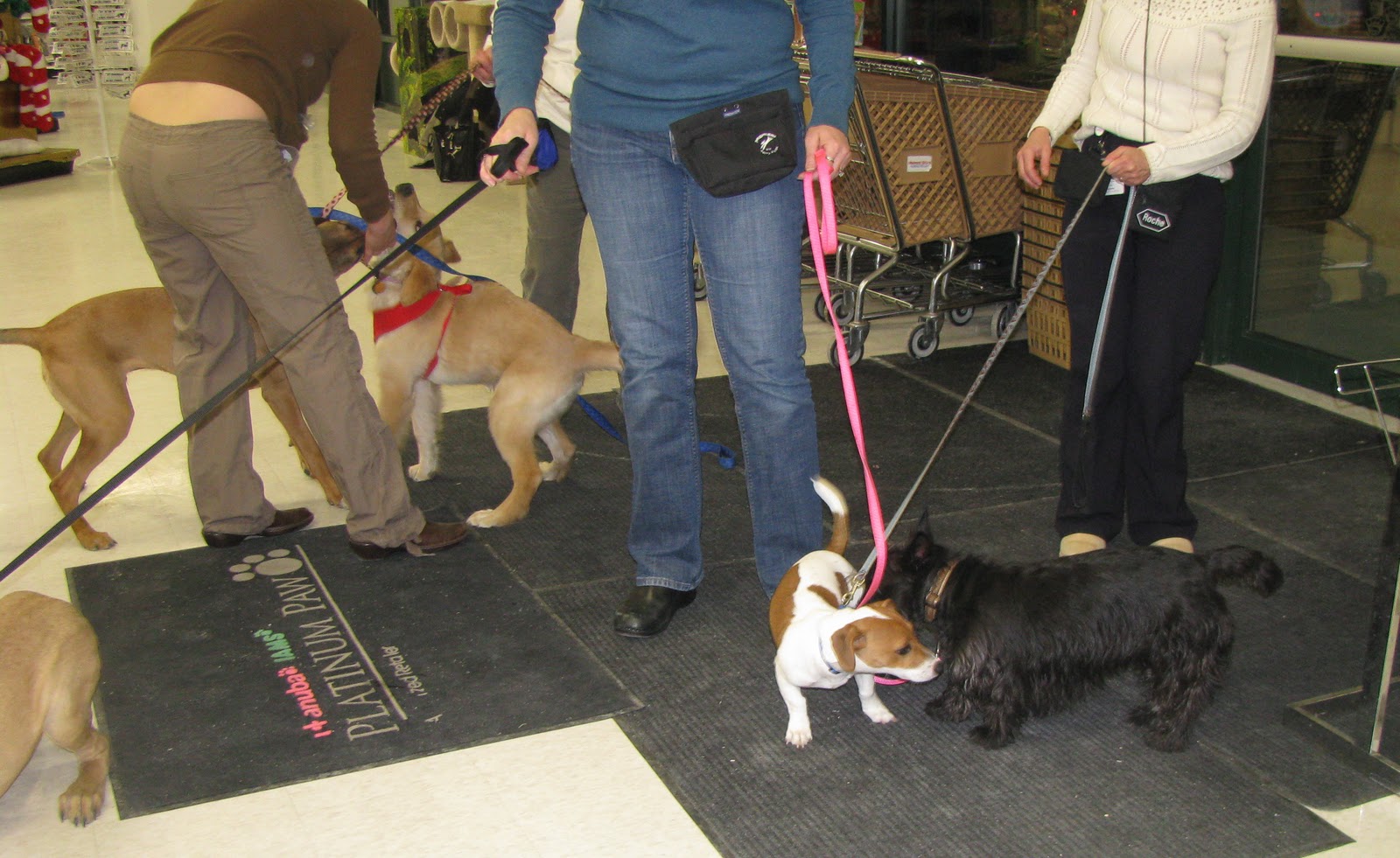
You have no doubt at one time or another thought your dog was ignoring you! With so much information out there about dog training it is somewhat confusing to decipher what your dog is really thinking!
I am hear to set the record straight on the Stubborn Dog!
The REALITY is, dogs in many ways are just like kids. Some dogs will pick up things much quicker than other dogs and some will take additional repetitions. Often in my classes I will see a dog with a “wide mouth pant”, or “stop and sniff the ground” or “look away” from his/her owner, this is my cue to help the owner with their timing or body language as the dog is clearly becoming confused and often stressed.
Often times dog fail to learn a cue because the owners TIMING is off, even the slightest second can reward a dog for dropping a toy instead of picking it up! I know I have made this mistake myself!
When trainers say “reward the behavior you want”, this means over time! Please do not expect your dog to become consistent after one training session. Many people do not realize that dogs do not generalize well. For this reason we need to have them practice their behaviors in many different environments with a variety of distractions so their behaviors become automatic or spontaneous.
Always consider the “dogs point of view”, is there something scary about the environment? Often our dogs are distracted by the sounds, smells, and movements around them so they may have missed a cue. Does the dog have a positive association with his surroundings? Is the dog feeling well? Often dogs will sit at an angle to alleviate hip discomfort. Is your dog in conflict? You may be calling your dog, but the big black German Shepherd at the other end of the room already gave your pup the “look”, should he go to mom/dad and risk a reprimand or just stay where he is as it is safe!
When Annie did not want to heel for me on a street walk recently, I stopped and looked at her, knowing she was not being stubborn, I realized I was caring a full doggie poop bag with her leash. As soon as I moved the poop to the other hand, she resumed her place by my left side!
Another example, a client’s Jack Russell would not get in to her car anymore. She just ran around the car and refused to jump in as she had done for months. I asked her to drive her car out of the car port and ask her girl to get in, with no hesitation the Jack Russell jumped in the car like always. We realized on occasion she was receiving a shock from the wet floor. She was convinced her dog was Stubborn until we solved the mystery!
Finally, consider what motivates your dog. A recent client just installed an invisible fence and the dog is enjoying FREEDOM, rolling in the grass, sniffing, digging, peeing, you get the idea. Do you think the dog will come in? Come in from this new amazing freedom, in this context “come” is obviously a negative to the dog! But, if you reward your dog for coming in the house with a game of tug, belly scratch or cheese for a while then “come” becomes a positive!
So the next time you start to say your dog is STUBB...., stop and really ask your self why your dog is behaving the way he/she is, I am sure you will find a real reason!
Bringing balance and joy to dogs and their owners... Contact Judy if you need tools to help train a new puppy, family dog, an aggressive, anxious, or reactive dog, using Positive Reward Based Training. Dogs that are territorial, fear aggressive or simply rude can all benefit from our Dog Training Programs. Unique classes are offered like Reform School, Control Unleashed, Outdoor Adventures, Human Directed Aggression, and Leash Lungers for reactive dogs.
Sunday, March 14, 2010
Tuesday, September 29, 2009
When pups ask "Why?"
Develop a lifestyle...
I say it all the time in class, “take your puppy everywhere you go” if possible. In order to get your puppy to be happy and balanced, you need to socialize him/her to the world we live in. But to get your puppy to respond to you here, there, and everywhere, she needs to be trained here, there, and everywhere! Train your puppy using many short sessions each day. A favorite author of mine, Ian Dunbar, says: “The secret is to totally integrate training into both your puppy's lifestyle and your lifestyle.” That is so true!
Like in Puppy class, ask your pup to perform many cues per day. For example, call your puppy for a body-position sequence (like a “Sit”, “Sit Stay") with variable length stays in each position whenever you go into the kitchen, go out to get the mail, sit in your favorite chair or go to the car. If you instruct your pup to perform a simple body-position sequence on every such occasion, you will easily be able to train your puppy many times a day without deviating from your normal lifestyle. Remember using the NIFF (nothing is for free) habit, not only teaches your pup to use polite manners, it also exercises his brain and helps remind him that you are his leader, not roommate!
Practice, Practice, Practice...
Helping your dog to see you as the calm confident leader will help him avoid many of the behavior problems people do not like. Such as door dashing, barking out the window, chewing on your arm and not coming when called. With this in mind, practice moving your dogs feet several times a day. This is a nice way of letting your pup know that you are in charge. Have your pup move out of your way rather than walking around him, ask him to move off his bed and have a seat yourself. Teach your dog to fetch your paper, his ball or toy! I often sit on the couch in the evening with my dogs (Sophie, my foster dog is against my leg as I type this
) But the key is that she asks politely to join me. When she comes and bounces up and down, I know she wants up, I ask her to “wait”, she sits and waits until I say “ok”, then up she comes! We expect our children to ask politely, why not teach our dogs to have polite manners as well? Another example, people automatically assume that it is bad to let your dog sleep on your bed. The truth is it is fine, as long as it is on YOUR terms. My Pablo will stand by my bed with his head resting on the mattress and wait for me to say “ok”. Sometimes I say, “get in your bed” followed by “good boy” he does what I ask without question. When this becomes your new lifestyle, your puppy will see no difference between playing and training. Fun times will have structure and rules they can live with and training will be fun!
Forming habits you can live with...
Practice short training sessions with quick sits, stays and emotional control moments into your puppy's walks and off-leash play times. Each quick sit is immediately reinforced by allowing the dog to resume walking or playing, which becomes the reward. Practicing emotional control with quick sits before each and every activity with your dog (like riding in the car, watching you fix their dinner, lying on the couch, and playing doggy games). For example, have your dog sit before you throw a tennis ball, before you put the leash on. Add duration to your cues of sit-stay with each repetition. Ask your dog to wait before he goes out the door, before he eats, or before he/she jumps out of the car.

Right from the start, make frequent little quiet moments part of your dog's daily routine. Remember, a puppy is not like an irritating child's toy. You cannot simply remove the batteries from a rambunctious adolescent dog. Instead you must learn how to "turn off" your dog. Learn to use walks and your puppy's favorite and most exciting games as rewards for settling down quietly and calmly.
Throughout the course of the day, have your puppy settle down for longer periods of time at home. For example, when watching the television, have your pup lie down on-leash, or in his bed, but during the commercial breaks, release the puppy for short, active play-training sessions.
When playing with your puppy, have him take a break every 30 seconds or so. To begin with, have the pup lie still for just two seconds before letting it play again. Use a release command, such as "Free Dog," "Ok", or "Let's Play." After 30 seconds, interrupt the play session again with a three-second quiet moment. Then try for four seconds. And then five, eight, ten, and so on. Alternate "Settle Down" with "Go Play" and with each repetition, it becomes progressively easier to get your puppy to settle down quickly.
Once your pup gets the picture, the exercise may be profitably practiced on walks. When walking round the block, periodically have your puppy settle down for just a few seconds before resuming the walk. An entertaining way to train is to instruct your pup to settle down every twenty yards or so, while you read this article! I hope you will read and re-read it many times!
Positive Reinforcement...
Puppies are easy to train. In fact, a young puppy will do just about anything you ask, especially when we use that sweet pitch as a reward! As the puppy grows into an adolescence, however, it begins to ask world-shattering questions, such as "Why?"
Just because your puppy has learned what "Sit" means, it does not necessarily mean she will sit when you request her to do so. Therefore, the most important ingredient of any educational program, weather for children or dogs, is "Why comply?" You must teach the relevance of complying. I believe, once you have taught your puppy the positive consequences of cooperating, she will eagerly want to behave!
Make it Fun...
First ask yourself, what does my puppy love? Make a list! Then institute a simple and effective rule: Nothing will be denied, nor withheld from the pup, but the puppy has to sit beforehand. It's just common canine courtesy, really. Nothing more than a puppy "please."
Does your puppy like to play Tug? Great! this is a fun game and will give your pup some indoor exercise! The key to this game is following the rules: Your pup must wait until you make eye contact and say “take it” before grabbing the tug toy. After some good tugging, look away, relax your arm and say “leave it”. If your pup doesn’t know this cue yet, offer a treat to reward him for letting go. After some practice, you will not need to reward with a treat.
In no time at all, your pup will learn the importance of complying with your wishes and will be only too willing, eager, and happy to oblige. Now your dog will want to do what you want it to do because you make her life fun and exciting! Positive Reinforcement is “heads-and-tails” above any adverse training programs!

Basically, you need to convince your pup that he or she is the trainer and you are the pupil! As Ian Dunbar says in his book, After You Get Your Puppy, your puppy needs to believe, "Sitting is the canine cue — the veritable key to the door — which makes my owners do anything I want. If I sit, they will open doors (how courteous). If I sit, they will massage my ears (how affectionate). If I sit, they will share the couch (how cooperative). If I sit, they will throw the tennis ball (how athletic). And if I sit, they will serve supper (how well-trained)."
Rewards...
The rewards of having a well mannered dog are endless! For starters, you can take your dog anywhere and not be stressed. Having a well behaved dog saves time as you can get through your day with less hassle, and you can be proud of you pup! Inviting friends over to the house is no longer dreaded as your pup has a new set of skills to show off! Jumping on Grandma is no longer an issue because your dog has learned to sit when ever he meets a new person. No sit, no reward, it is that simple!
So be a great dog owner and give your dog plenty of Reinforcement for well performed behaviors!
I say it all the time in class, “take your puppy everywhere you go” if possible. In order to get your puppy to be happy and balanced, you need to socialize him/her to the world we live in. But to get your puppy to respond to you here, there, and everywhere, she needs to be trained here, there, and everywhere! Train your puppy using many short sessions each day. A favorite author of mine, Ian Dunbar, says: “The secret is to totally integrate training into both your puppy's lifestyle and your lifestyle.” That is so true!
Like in Puppy class, ask your pup to perform many cues per day. For example, call your puppy for a body-position sequence (like a “Sit”, “Sit Stay") with variable length stays in each position whenever you go into the kitchen, go out to get the mail, sit in your favorite chair or go to the car. If you instruct your pup to perform a simple body-position sequence on every such occasion, you will easily be able to train your puppy many times a day without deviating from your normal lifestyle. Remember using the NIFF (nothing is for free) habit, not only teaches your pup to use polite manners, it also exercises his brain and helps remind him that you are his leader, not roommate!
Practice, Practice, Practice...
Helping your dog to see you as the calm confident leader will help him avoid many of the behavior problems people do not like. Such as door dashing, barking out the window, chewing on your arm and not coming when called. With this in mind, practice moving your dogs feet several times a day. This is a nice way of letting your pup know that you are in charge. Have your pup move out of your way rather than walking around him, ask him to move off his bed and have a seat yourself. Teach your dog to fetch your paper, his ball or toy! I often sit on the couch in the evening with my dogs (Sophie, my foster dog is against my leg as I type this
Forming habits you can live with...
Practice short training sessions with quick sits, stays and emotional control moments into your puppy's walks and off-leash play times. Each quick sit is immediately reinforced by allowing the dog to resume walking or playing, which becomes the reward. Practicing emotional control with quick sits before each and every activity with your dog (like riding in the car, watching you fix their dinner, lying on the couch, and playing doggy games). For example, have your dog sit before you throw a tennis ball, before you put the leash on. Add duration to your cues of sit-stay with each repetition. Ask your dog to wait before he goes out the door, before he eats, or before he/she jumps out of the car.

Right from the start, make frequent little quiet moments part of your dog's daily routine. Remember, a puppy is not like an irritating child's toy. You cannot simply remove the batteries from a rambunctious adolescent dog. Instead you must learn how to "turn off" your dog. Learn to use walks and your puppy's favorite and most exciting games as rewards for settling down quietly and calmly.
Throughout the course of the day, have your puppy settle down for longer periods of time at home. For example, when watching the television, have your pup lie down on-leash, or in his bed, but during the commercial breaks, release the puppy for short, active play-training sessions.
When playing with your puppy, have him take a break every 30 seconds or so. To begin with, have the pup lie still for just two seconds before letting it play again. Use a release command, such as "Free Dog," "Ok", or "Let's Play." After 30 seconds, interrupt the play session again with a three-second quiet moment. Then try for four seconds. And then five, eight, ten, and so on. Alternate "Settle Down" with "Go Play" and with each repetition, it becomes progressively easier to get your puppy to settle down quickly.
Once your pup gets the picture, the exercise may be profitably practiced on walks. When walking round the block, periodically have your puppy settle down for just a few seconds before resuming the walk. An entertaining way to train is to instruct your pup to settle down every twenty yards or so, while you read this article! I hope you will read and re-read it many times!
Positive Reinforcement...
Puppies are easy to train. In fact, a young puppy will do just about anything you ask, especially when we use that sweet pitch as a reward! As the puppy grows into an adolescence, however, it begins to ask world-shattering questions, such as "Why?"
Just because your puppy has learned what "Sit" means, it does not necessarily mean she will sit when you request her to do so. Therefore, the most important ingredient of any educational program, weather for children or dogs, is "Why comply?" You must teach the relevance of complying. I believe, once you have taught your puppy the positive consequences of cooperating, she will eagerly want to behave!
Make it Fun...
First ask yourself, what does my puppy love? Make a list! Then institute a simple and effective rule: Nothing will be denied, nor withheld from the pup, but the puppy has to sit beforehand. It's just common canine courtesy, really. Nothing more than a puppy "please."
Does your puppy like to play Tug? Great! this is a fun game and will give your pup some indoor exercise! The key to this game is following the rules: Your pup must wait until you make eye contact and say “take it” before grabbing the tug toy. After some good tugging, look away, relax your arm and say “leave it”. If your pup doesn’t know this cue yet, offer a treat to reward him for letting go. After some practice, you will not need to reward with a treat.
In no time at all, your pup will learn the importance of complying with your wishes and will be only too willing, eager, and happy to oblige. Now your dog will want to do what you want it to do because you make her life fun and exciting! Positive Reinforcement is “heads-and-tails” above any adverse training programs!

Basically, you need to convince your pup that he or she is the trainer and you are the pupil! As Ian Dunbar says in his book, After You Get Your Puppy, your puppy needs to believe, "Sitting is the canine cue — the veritable key to the door — which makes my owners do anything I want. If I sit, they will open doors (how courteous). If I sit, they will massage my ears (how affectionate). If I sit, they will share the couch (how cooperative). If I sit, they will throw the tennis ball (how athletic). And if I sit, they will serve supper (how well-trained)."
Rewards...
The rewards of having a well mannered dog are endless! For starters, you can take your dog anywhere and not be stressed. Having a well behaved dog saves time as you can get through your day with less hassle, and you can be proud of you pup! Inviting friends over to the house is no longer dreaded as your pup has a new set of skills to show off! Jumping on Grandma is no longer an issue because your dog has learned to sit when ever he meets a new person. No sit, no reward, it is that simple!
So be a great dog owner and give your dog plenty of Reinforcement for well performed behaviors!
Tuesday, July 21, 2009
10 Household Items That Can Poison Your Pet
While most of my topics are about training, I feel it is important that we are all aware of household toxins. There are actually many common household items which can be toxic for dogs and cats. Ingestion of just a small amount of some cleaning products, food, and plants can be fatal. Other toxins, exposed to paws and skin, can cause serious illnesses. Be sure to keep the following items away from your pet!
- Laundry Detergent including fabric softener sheets can cause digestive problems, irritation of the mouth and tongue, and even death.
- Mouse and Ant killer can cause enormous damage so take your pet to a vet immediately if you suspect your dog has been contact with this poison.
- Chocolate even in small amounts can be harmful to your dogs nervous system so never feed a dog any food containing chocolate.
- Ice melt on driveways and stairs can easily become stuck to paws and fur. When an animal cleans itself, ingesting the chemicals in the ice melt, there can be harmful reactions including skin irritations, seizures, and even death.
- Oleander, mistletoe, and lily plants are toxic to dogs and cats. Just one leaf from an oleander can kill a small pet. When discarding these plants, do not burn them. Inhaling the smoke can be harmful.
- Macadamia nuts contain a toxin that can wreak havoc on a dog’s digestive and nervous systems.
- Tylenol can be fatal if given to a dog or cat.
- Antifreeze is deadly for dogs, unfortunately the sweet smell does attract dogs.
- Avocados, raisons, grapes and onions all contain toxins that can cause kidney failure.
- Mouthwash contains boric acid, so never use this on your pet.
Thursday, May 28, 2009
Feedback - Why? When? How often?
When training our dogs, we often expect them to read our minds. Well, they can’t! But you can help them by offering feedback to them. What is feedback? It is a way of helping your dog know when he is doing something acceptable or not.
Good dog handlers offer their dog feedback on their behavior throughout the day. When you see your dog laying calmly on the floor, let them know you are happy with this behavior! Say, “good dog, what a good dog”, in a sweet voice.
If you have a puppy, you should be giving him feedback constantly! I mean if you are with him an hour, then offer feedback 50-60 times! For Example, when in puppy class I am always encouraging my clients to reward their puppy when ever they allow another puppy near them or begin to play with another pup. I want puppies to know that I am thrilled when they play well with another dog.
What if we have a bully in the class? I follow that bully around and say, “good dog, yes, good girl, what a good girl”, when she is nice, so the second she gets to rough, I am there to say, “uhuh, take a break” in a lower tone, then again as she eyes another playmate, I am again letting her know, that she is a “good girl, nice play, gentle, what a good girl”, all in a sweet voice.
Remember puppies need to play rough to learn how to resolve problems so having a bully is not a problem, it just means they need more Feedback!
How about when teaching your dog a new cue? When you first say “Stay” your dog has no idea what you mean. But if you reinforce the stay cue by saying “stay, good stay, that is a good stay”, in a sweet voice then offer a quick reward of food or affection. Your dog will surely learn quicker when you talk sweetly and repeat the behavior that he is doing the right. This type of Positive Feedback quickens the learning process with your dog.
So be a Great Dog Owner and give your dog lots of feedback!!
Good dog handlers offer their dog feedback on their behavior throughout the day. When you see your dog laying calmly on the floor, let them know you are happy with this behavior! Say, “good dog, what a good dog”, in a sweet voice.
If you have a puppy, you should be giving him feedback constantly! I mean if you are with him an hour, then offer feedback 50-60 times! For Example, when in puppy class I am always encouraging my clients to reward their puppy when ever they allow another puppy near them or begin to play with another pup. I want puppies to know that I am thrilled when they play well with another dog.
What if we have a bully in the class? I follow that bully around and say, “good dog, yes, good girl, what a good girl”, when she is nice, so the second she gets to rough, I am there to say, “uhuh, take a break” in a lower tone, then again as she eyes another playmate, I am again letting her know, that she is a “good girl, nice play, gentle, what a good girl”, all in a sweet voice.
Remember puppies need to play rough to learn how to resolve problems so having a bully is not a problem, it just means they need more Feedback!
How about when teaching your dog a new cue? When you first say “Stay” your dog has no idea what you mean. But if you reinforce the stay cue by saying “stay, good stay, that is a good stay”, in a sweet voice then offer a quick reward of food or affection. Your dog will surely learn quicker when you talk sweetly and repeat the behavior that he is doing the right. This type of Positive Feedback quickens the learning process with your dog.
So be a Great Dog Owner and give your dog lots of feedback!!
Wednesday, April 15, 2009
House Training
Puppies will want to pee and poop wherever they have done so before. Your job is to make sure your puppy learns to prefer the outdoors as a toilet – not your carpets!
I recommend you keep your puppy close to you or in a crate and show him where he should potty every 2 hours to start. Then gradually increase the time between trips out doors. If your puppy does have an accident, don't react. Any punishment will be unproductive and could even encourage your puppy to eliminate more often as a submissive gesture to your reaction. You can take away your puppies water about 7 PM and replace it with a few ice cubes.
Approximate Overnight Holding Limit = 1½ times the Daytime Holding Limit
Example: 3 month puppy can hold for 1½ x 4 = 6 hours overnight
Whenever you are unable to supervise your puppy with 100% attention, you need to place her in either a short-term or long-term confinement area.
Your puppy can be placed in a short-term confinement area such as a crate if she will be there for less than her holding limit. The purpose of the crate is to keep her out of trouble while you are unable to supervise her, and to help you house train her. The crate should be just big enough for her to be able to lie down on her side with outstretched limbs, stand up, and turn around easily. It should not be so big that she thinks there is enough space for a bedroom and for a toilet area! When you let her out of her crate you can bring her straight outdoors and reward her for doing her business in the right place.
For longer confinement periods a bigger area, with non-absorbent flooring, such as a bathroom, kitchen, or utility room, is needed. The long-term confinement area should have a bed or open crate at one end, and a pile of newspaper, a puppy pad or a strip of sod at the opposite end. Your puppy will naturally want to eliminate as far as possible from her bed. If the space you use for long-term confinement happens to have a door that leads to the outdoors, then place the toilet area near that door. This way, your puppy’s toilet area is as close as possible to where she should ultimately be heading to do her business. Fresh water and stuffed chew toys should also be plentiful, and should be placed near her bed.
Your Puppy will naturally have the urge to eliminate after a nap, a meal, a drink, exercise, excitement, or time spent in confinement. Give your puppy the opportunity to do her business outdoors at these times. When your puppy does her business in the right place offer her a treat, plenty of praise, a game or a walk. This will speed up her house training habits.
Punishing a puppy for house soiling after it has happened is abuse, not training. If you wait more than a few seconds after your puppy has eliminated before expressing your disapproval, your puppy will not know why she is being punished. If you catch your puppy about to pee or poop in the wrong place you can clap your hands and say “Ah-ah”, and swiftly scoop her up to the outdoors to continue. Punishing her after the fact just makes her anxious for you to return the next time as she will assume you will be aggressive every time you come home.
If you would like your dog to poop promptly when you take her out, then teach your puppy that a prompt poop is her ticket to a walk around the block. This will encourage her to poop as soon as you let her out – and will allow you to leave the stinky poop bag at the house, rather than having to carry it around for much of the walk. If you do the opposite, take her for a walk, and ending her walk as soon as she does do her business, she will learn to delay pooping!
Also, you must be consistent! If you train your puppy to poop while on a leash M-F, then you cannot expect her to poop on Sat. in the back yard off the leash. Our puppies do not generalize information that well, so if she is having accidents, you must consider her schedule and what you have taught her.
House Training Options:
Considering the use of Puppy Pads?
How about a Litter Box?
Advantages of Crate Training
I recommend you keep your puppy close to you or in a crate and show him where he should potty every 2 hours to start. Then gradually increase the time between trips out doors. If your puppy does have an accident, don't react. Any punishment will be unproductive and could even encourage your puppy to eliminate more often as a submissive gesture to your reaction. You can take away your puppies water about 7 PM and replace it with a few ice cubes.
Approximate Overnight Holding Limit = 1½ times the Daytime Holding Limit
Example: 3 month puppy can hold for 1½ x 4 = 6 hours overnight
Whenever you are unable to supervise your puppy with 100% attention, you need to place her in either a short-term or long-term confinement area.
Your puppy can be placed in a short-term confinement area such as a crate if she will be there for less than her holding limit. The purpose of the crate is to keep her out of trouble while you are unable to supervise her, and to help you house train her. The crate should be just big enough for her to be able to lie down on her side with outstretched limbs, stand up, and turn around easily. It should not be so big that she thinks there is enough space for a bedroom and for a toilet area! When you let her out of her crate you can bring her straight outdoors and reward her for doing her business in the right place.
For longer confinement periods a bigger area, with non-absorbent flooring, such as a bathroom, kitchen, or utility room, is needed. The long-term confinement area should have a bed or open crate at one end, and a pile of newspaper, a puppy pad or a strip of sod at the opposite end. Your puppy will naturally want to eliminate as far as possible from her bed. If the space you use for long-term confinement happens to have a door that leads to the outdoors, then place the toilet area near that door. This way, your puppy’s toilet area is as close as possible to where she should ultimately be heading to do her business. Fresh water and stuffed chew toys should also be plentiful, and should be placed near her bed.
Your Puppy will naturally have the urge to eliminate after a nap, a meal, a drink, exercise, excitement, or time spent in confinement. Give your puppy the opportunity to do her business outdoors at these times. When your puppy does her business in the right place offer her a treat, plenty of praise, a game or a walk. This will speed up her house training habits.
Punishing a puppy for house soiling after it has happened is abuse, not training. If you wait more than a few seconds after your puppy has eliminated before expressing your disapproval, your puppy will not know why she is being punished. If you catch your puppy about to pee or poop in the wrong place you can clap your hands and say “Ah-ah”, and swiftly scoop her up to the outdoors to continue. Punishing her after the fact just makes her anxious for you to return the next time as she will assume you will be aggressive every time you come home.
If you would like your dog to poop promptly when you take her out, then teach your puppy that a prompt poop is her ticket to a walk around the block. This will encourage her to poop as soon as you let her out – and will allow you to leave the stinky poop bag at the house, rather than having to carry it around for much of the walk. If you do the opposite, take her for a walk, and ending her walk as soon as she does do her business, she will learn to delay pooping!
Also, you must be consistent! If you train your puppy to poop while on a leash M-F, then you cannot expect her to poop on Sat. in the back yard off the leash. Our puppies do not generalize information that well, so if she is having accidents, you must consider her schedule and what you have taught her.
House Training Options:
Considering the use of Puppy Pads?
- Advantage - Portable and indoors
• Disadvantage – Dog may view any paper lying on the floor as fair game. This process can eventually lead to training outside, but adds an extra step.
How about a Litter Box?
- Advantage – Portable, indoors, doesn’t require going outside and dog doesn’t have to wait for someone to let her outside.
• Disadvantage – Daily cleaning of litter box, not a good choice for medium or large dogs.
Advantages of Crate Training
- Keeps puppy safe when you can not watch your puppy.
• Teaches puppy to keep his area clean.
• Should never be used as punishment but
• Should be used as a safe haven for your pet.
• Begin when you first bring your puppy home. Start with just a short time and increase the time as your puppy feels comfortable.
• Do lure your puppy in and out with treats so he enters on his own. Do not shove your puppy in and shut the door right away.
• Keep the crate in a place where your puppy can hear you talk to him.
Subscribe to:
Posts (Atom)