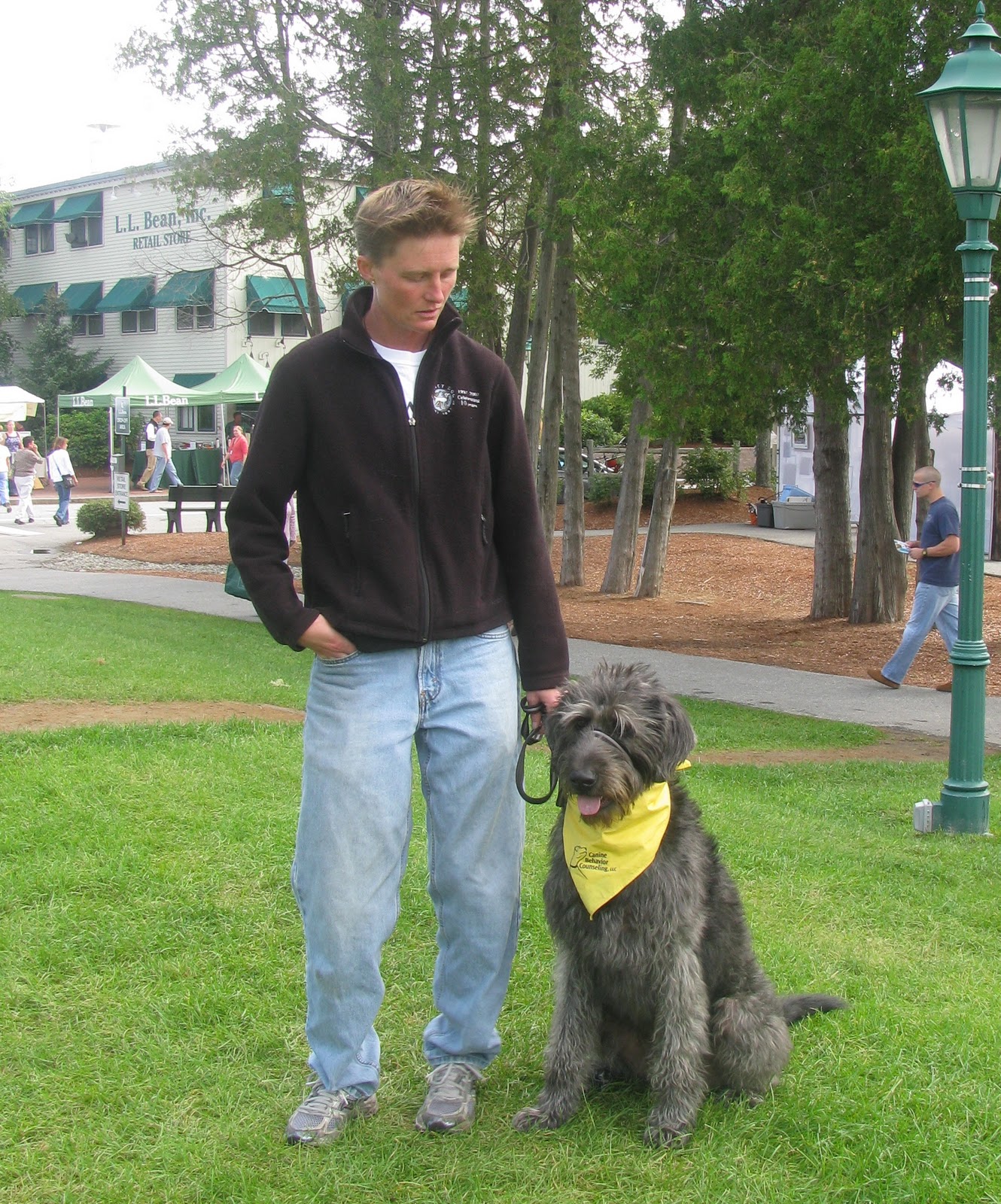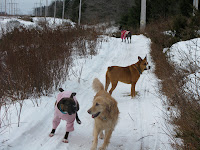
We are fortunate to live in an area where there are so many dog friendly beaches and dog parks! This is also a fun way to meet friends who are also crazy about their dog! In addition, dog parks are great places of high distractions, if you want to practice your dogs cues, this is a great place! Remember to focus on adding positive reinforcement to your training!
Here’s a great link with information on local “dog-friendly” parks:portlandonline.com
If however you share your life with a shy dog that sits between your legs or worse, growls and snaps at the other dogs while at the park, then the dog park is not for you. Hey, that is okay, not all dogs are social, that doesn’t make them a bad dog. There are many other options to exercise your dog than taking them to a dog park.
Walking our dogs in the winter takes a bit of extra effort for sure. I find it difficult to walk in the soft powder as I do not have snow shoes, but if you do and you have a medium to large dog, their is no better way than to earn your dogs love! Trail blazing on snow shoes or cross country skis is a fun way to exercise both you and your dog.
Another option, that I recommend is to find a snowmobile path. I love to head out on the snowmobile trails with my dogs as it makes for easy walking because the snow is packed down tight. Occasionally you will need a pair of spiked grips on your boots to help keep you from sliding, this is necessary when the temperature is below freezing. Because the trails are along the power lines, they are usually sheltered from the wind which makes the walk easier.
Going to the beach is a great way have fun with your dog. If your dog likes to fetch, you can walk along and play fetch for great exercise. If your dog is not as well trained as your would like and runs too far away from you, try using a long 30 to 50 foot light weight rope to keep your dog from wandering too far. If this makes your nervous, than consider taking my Outdoor Adventure Class!
Always keep in mind your dog’s needs such as wearing a sweater, booties and providing fresh water after your walks. Also, if you need to motivate your dog to stay near you, take two levels of reward with you. Either yummy treats or a favorite toy! Many dogs would rather play fetch with their owner than run off to smell another dog. This is normal and perfectly fine! Your dog is saying you are more fun and exciting than anyone else on the beach, how awesome is that!
Regardless of the location you choose, safety with your dog in the parking lot is a must! First use the leash to tether your dogs until you have them under voice control. Ask you dog to wait while you gather your belongings while your door is open. Practice will turn into habit for your dog and soon you will be able to leave the car door open with your dogs waiting nicely in side. Don’t take chances, always use a leash to be ultra safe when cars are nearby!
So I hope you are able to get out and enjoy the winter months with your dogs, they will love you for taking them with you! If you are just not a cold weather person, consider asking a neighbor or young teenager to walk your dog for you.
Until Spring have fun in the snow!
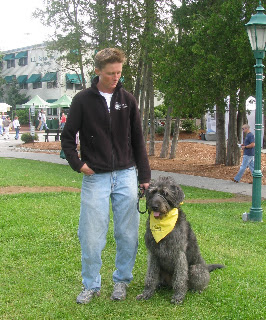
What is the American Kennel Club Canine Good Citizenship program?
This program focuses on teaching responsible dog ownership to owners, and certifies that their dogs have the training and behaviors needed to be reliable, well mannered members of our community. All dogs that have received their vaccinations are welcome to participate, regardless of their breed.
This Certificate is not a title and is non competitive, as dogs are not expected to perform with the same precision required in formal obedience. As part of the program, you are encouraged to communicate with your dog and praise him generously! Of course, you know I wouldn’t have it any other way!
The AKC Canine Good Citizen Test Requirements are as follows:
Test 1: Accepting a friendly stranger
Test 2: Sitting politely for petting
Test 3: Appearance and grooming
Test 4: Out for a walk (walking on a loose lead)
Test 5: Walking through a crowd
Test 6: Sit and down on command and Staying in place
Test 7: Coming when called
Test 8: Reaction to another dog
Test 9: Reaction to distraction
Test 10: Supervised separation
You can sign up and take the test without having previously taken the class, though it is encouraged. Either way, I am happy to help you and your dog earn this rewarding distinction! Call or E-mail me for details!
Fearful dogs avoid people or things that frighten them, may seem depressed or disinterested and sometimes lunge or do a barking display to make what they’re afraid of go further away. If you’ve decided to share your life with a shy dog, take heart. The following information can help you understand what he is feeling and give you ways to help him get better.
Many of you have met Pablo, my boxer/border collie mix. He is very fearful of all people, even children which is why I take him everywhere! I have people toss or hand feed him treats every week. I have even had strangers toss him treats in the car window when he was growling. This has helped tremendously as he doesn’t mind people passing by my car anymore! Pablo’s mother was also very fearful of people, so he is fearful because of his genetics. I always let strangers know he is in training and would appreciate not being stared at or petted.
Different Kinds of Shyness
The most common kinds of shyness in dogs are:
Social shyness, where the dog is fearful of unfamiliar people or certain kinds of people. Dogs like this are sometimes described
as “taking a while to warm up,” “one man dogs” or “protective.” They are usually fine with a certain person once they get to know them. Examples are dogs who are afraid of men or big men or men with beards, dogs who are uncomfortable around children, and dogs who bark at the sight of people with unusual gaits. Dogs can also be shy with other dogs.
Context fears, where the dog is afraid of certain kinds of situations. Examples are dogs who are afraid of going to the vet, panic during car rides, avoid traffic or are uncomfortable in new places.
Sound sensitivities, where the dog is afraid of sudden loud noises. These dogs flatten and try to escape when a car backfires, or pace and salivate during thunderstorms or fireworks.
Why Is He Like This?
Fear is very common in all animals. Although it’s possible that a fearful dog has suffered abuse or a bad experience, most of the time fears result from a combination of a genetic predisposition and some lack of experience, especially in the first months of life. For instance, a dog may have missed out on becoming socialized to certain kinds of people by simply not being around them enough when he was a puppy.
Will He Get Better?
Most fearful dogs can be helped to gradually improve. This is a long, slow process in most cases and requires patience. Shy dogs are not for everybody. They need caretakers who have compassion and perseverance.
What Can I Do?
The best thing for a fearful dog is to expose him to what frightens him but at a milder intensity and combined with a fun or positive association. So, a dog who is afraid of children might start to feel more comfortable if he regularly sees children but at a distance where
he doesn’t feel too worried. Then, if his guardian praises, pats him and gives him treats after the dog has noticed the kids, the dog might start to see the kids as good news: “Wow, great things happen to me when kids are around!”
A dog who is afraid of traffic would benefit from audio tapes of traffic sounds, time spent near quieter streets, all combined with games,
treats and happy talk from his guardian. As the dog improves, time can be spent on busier and busier streets. Dogs learn strongly from
association and positive reinforcement.
Should I punish my dog for growling?
No. When dogs growl, they are saying “I am scared, you are really freaking me out!” Just remain calm and offer your very scared dog a treat. If he is too afraid to eat a treat, then put some space between you and what ever the dog is afraid of until he is comfortable to eat a treat.
How Can I Help My Shy Dog Get Used to Visitors?
The best possible strategy is to let the dog go at his own pace. Any kind of pressure or coercion to make contact usually makes things worse. Let the dog hide if he needs to, investigate things and come to people when he feels ready. People can offer or toss treats but instruct them to not try patting the first time the dog comes to investigate them. This can be very hard for people to do, so remind them to keep their hands to themselves early on.
For more detailed information on how to make your shy dog feel safe in different situations contact me by phone or email! I am always happy to help owners understand why their dog may be acting aggressively and how to help them!
Because many dogs do steal and guard different items found in our homes, I wanted to give you some tips on what you can do. As object guarding in dogs can be frightening at times my first priority is to prevent anyone from getting bitten. Although object guarders typically guard bones, valued chew toys and forbidden objects such as plastic wrap, kleenexes, stolen laundry items and garbage on the ground. Some dogs are compulsive in nature to their guarding while others seem triggered by their owners sudden interest in taking the object away. It can be a difficult choice for an owner. Ignore the dog and allow him to pick up and even ingest all kinds of junk or increase the value of the item by showing great interest in taking it away from him.
The best solution for all object guarders lies in priming and practicing the problem scenarios in advance of an emergency. The dog needs to have done numerous exchange exercises in preparation for the one day he truly has something dangerous. If he is relaxed and confident when you approach he will relinquish his prize, but if he is tense and nervous, he will not. The below exchanges are to be performed only by an adult or supervised older children.
Basic object exchange exercises:
1. Give the dog an object that he is unlikely to guard.
2. Say “give” or “leave it” to the dog.
3. Take the object away from the dog.
4. Give a nice yummy treat from your pocket to the dog.
5. Give the same object back to the dog and repeat the exercise several times.
Do 5 or 6 sets, varying the time between repetitions, and then walk away. Do several sets of repetitions a day, varying the object each time. Note, only use low value items in the first few days. When you have a history of successful exchanges you can increase the value of the item you want the dog to relinquish. Remember the higher value item the dog has, the higher value your treat must be. For example, if you are trying to exchange a bone, try old cheddar cheese or turkey.
For severe guarding including any bite history try the following exercise:
Begin by offering the dog with an item a handful of bonus treats. This will teach the dog that when a hand comes near his mouth good things will happen! Offer Bonus treats several times a day until your dog begins to lift his head and wag his tail when you approach. Once your dog is not growling anymore, you may begin exchanges.
1. Do exchanges with objects of no interest, several sets of 5 a day for 3 days.
2. Do exchanges with a slightly more coveted object, again several sets of 5 a day for 3 days.
3. Try exchanges with hot objects, using extra special treats, several sets of 5 a day for 2 or 3 days.
4. Exchanges with low to mid-value objects the dog has spontaneously taken possession of do several in a row, then leave the dog with the item unless it is a Object Guarding in Dogs forbidden object. In this case give an extra handful of treats on the last trial and replace the object with a chew toy.
5. Exchanges with hot objects the dog spontaneously has taken possession of do several in a row for extra special reinforcers, then return the object to the dog or replace with an interesting chew toy.
6. Maintenance of exchanges are called “cold trials” when the dog has an object and only one reinforced repetition is done, then give the toy back or replace the forbidden object with a well liked chew toy.
7. These trials should be practiced for the day when you find yourself in an unplanned situation at the park, in your car or while visiting a friend.
8. While young children should not do exchanges, they should have the dog in a NIFF (nothing is for free) training program.
Common Unfortunate Situation in Guarding Dogs:
When the puppy is under the table with a forbidden object a human comes in, pulls him out and punishes him. The puppy learns that a human hand reaching towards him is very scary and possibly painful. The next time the puppy steals something because it is fun, he heads under the table for safety. The human comes in and offers a treat in his hand, the young dog remembers the punishment and refuses to come out. When the human tries to coax him out, dog whines because he is anticipating the punishment. The human reaches for the dog, the dog growls because he is afraid. The dog gets slapped or cuffed for growling, the dog learns that growling didn't make the scary human go away. The next time someone reaches under the table, the dog knows growling doesn't work but he is still very afraid so he tries biting! Wow, that worked, the human backed off quickly. The dog has now learned how to make the scary stimuli go away, bite!
The only way to change the dogs association with a hand coming at him is through POSITIVE REINFORCERS. Hence offer food from your hand as often as possible in a day. When the dog is guarding an item, in the beginning, the hand only offers or tosses yummy goodies, it doesn't take away until the dog is no longer afraid. This time table depends on how much consistent positive reinforcers are given!
My Favorite Guarding Resource Progression is by Jean Donaldson, Author of The Culture Clash
Socializing Your Puppy - Why is it so vital?
When we bring our new puppies home they must learn new smells, friends and sounds. Our new puppies are often easily over stimulated, remember just like a small baby, they need several naps a day! We often find our puppies very inquisitive and fun as they learn their new surroundings at about 10 weeks of age. This is what we all expect in our new family member!
Then at about 16 weeks of age, things change for our puppies. In the wild, this is when a mother would begin to push her puppies away a bit and encourage them to be more independent. Puppies that remain curious and friendly wouldnʼt survive for very long. By nature, after 16 weeks of age, our puppies begin to seek things with much more caution and suspicion. They often become fearful of what they have not encountered before. This means that we have a small window of opportunity to introduce our puppies to many new sights, smells and most importantly, sounds!
This process of introductions is known as Socialization. Some people think it only involves meeting other dogs. While that is a large part of socialization, it is only one part of the equation. Slowly introducing our puppies to the world we live in is vastly important. Even if you are providing your puppy with ample love and attention, he still needs to be introduced to new situations in a controlled fashion. It is IMPORTANT, when you introduce your puppy to new places and people, you must be CALM AND CONFIDENT. If you are worried about your puppies feelings, than he will be worried too. All dogs, even puppies are exceptional at picking up on our feelings of nervous, anxious, worried or confident.
EXAMPLE, Suppose you are walking through a park and you come up to a large statue. Your puppy becomes frightened barks frantically and pulls away. What should you do? Help your puppy see the statue for what it is. So, stay calm and ask your puppy to walk back and forth in front of the statue at a distance that he feels safe. With each pass, get a little closer to the statue all the while feeding your puppy something tasty! Continue passing slowly back and forth until your puppy will take a treat while sitting in front of the statue. Yes, this may take some time, but is well worth the effort. You have just helped your puppy “Rebound” from something scary.
If time is an issue when your dog has a bad reaction, simply loosen his leash and distract him with a toy or treat in a very calm manner. He should only feel your confidence on the lead and assume if “my leader is confident, I will be too”. Remember, also to give your puppy a treat or affection when he remains calm during odd sounds. Many of us do not reward our puppies when they act calmly. Why is this? Remember to REWARD the behavior you want. This will give your dog confidence as he learns how you expect him to behave.
Finally, knowing your dogs breed characteristics will help you better shape his behavior. Such as German Shepherds may be more protective, something you will want to be aware of and handle at an early age if necessary. Boarder Collies are sensitive to sounds and trained to respond to them. Shelties are great for letting you know when there is an intruder in the area, therefore barking is a part of their make-up. So introducing your puppy to many new environments with positive associations as this is the key to having a happy and balanced dog!