Please click here to see my NEW website:
Canine Behavior Counseling, LLC with Judy Moore
Monday, May 18, 2015


Sunday, January 18, 2015

Saturday, December 13, 2014
Who should train your dog?
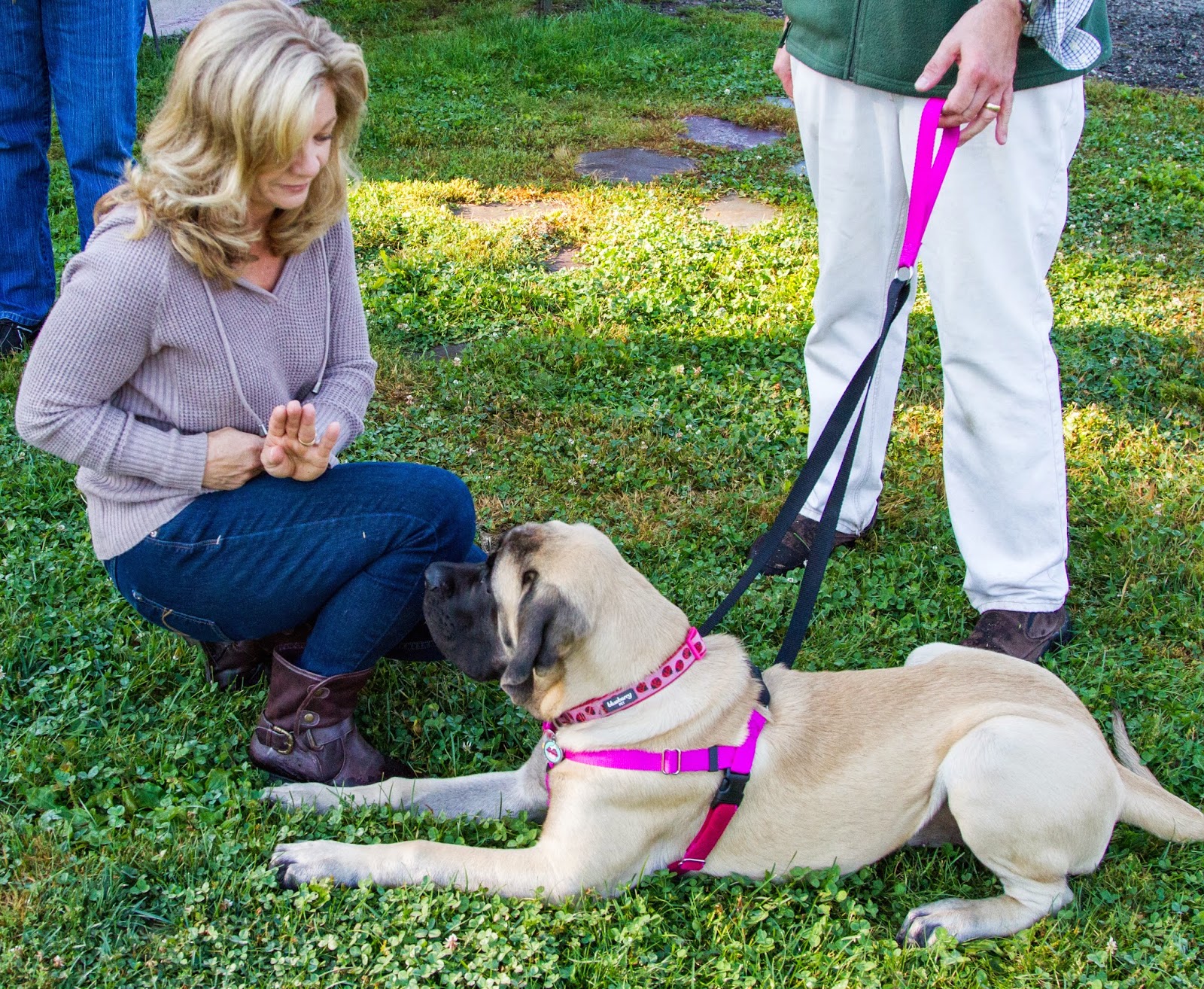 |
| 5 month Mastiff with excellent Emotional Control! |
Sadly, harsh training methods that are "too harsh for the dogs temperament" can create a dog that is afraid of strangers. Fear and stress associated with humans is a great recipe for Stranger Aggression as the pup matures. Ever wonder why adolescent dogs all of a sudden begin to growl or bite?
Keep in mind that dogs are emotional beings who will form a strong bond with the person who feeds and trains them. Shouldn't that person be you! Here are some helpful tips to set you and your pup up for success!
Keep in mind that dogs are emotional beings who will form a strong bond with the person who feeds and trains them. Shouldn't that person be you! Here are some helpful tips to set you and your pup up for success!
Always:
- Give your dog feedback to shape good habits. Example: when hand feeding a treat, if you feel teeth pull the treat away, do not reward a harsh mouth. Repeat by offering the treat until your pup only touches the treat or licks, then release and repeat many many times.
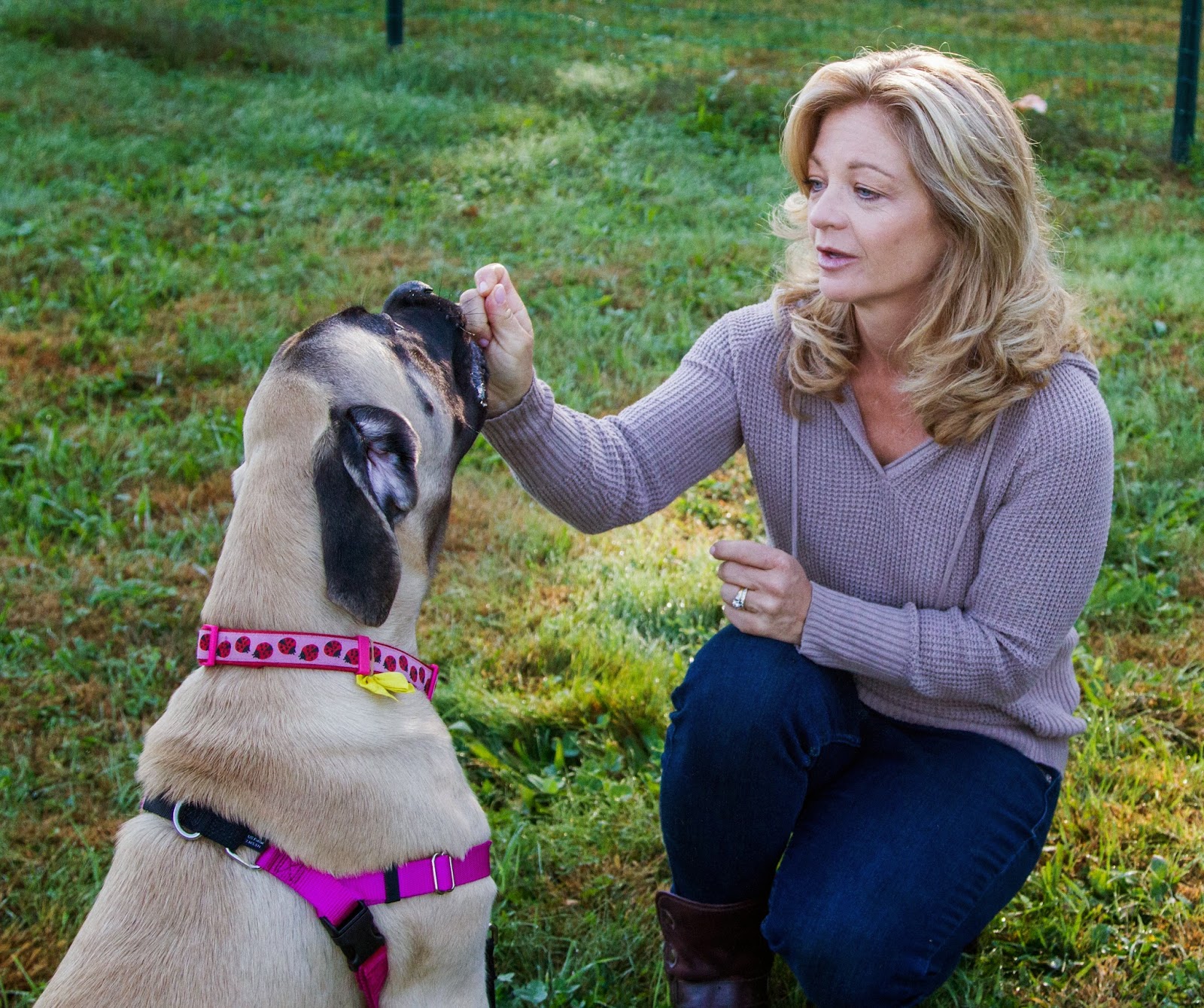 |
| Does your dog have a soft mouth? |
- Reward good behavior with something the dog finds rewarding.
- Use your dogs meal to practice behaviors you want. This also teaches a soft mouth.
- Always reward an alternative behavior to the unwanted behavior.
- Have your dog do a calm behavior before you reward with affection, food or play.
- Do change your pitch when training your dog.
- Do use a marker if you want to bridge the communication between dog and human, such as a clicker or verbal "yes".
- Do play tug, which teaches a soft mouth. Start with a calm dog, then tug, drop it, sit, repeat. All our dogs learn this pattern in Star Puppy Class!
- Learn new theories and behavioral techniques from the best in the business, including Dr. Ian Dunbar, Karen Pryor, Patricia McConnell, Sue Sternberg, Suzanne Clothier, Terry Ryan, Bob Bailey, Pia Sylvani, Victoria Stillwell, Turid Rugaas, or from an APDT Certified Trainer.
Avoid:
- Using your hand in a negative manner, such as holding mouth closed, sticking fingers down her throat, and certainly you should never strike your dog! Unless, of course, you want your dog to associate "hands" as something to fear!
- Avoid holding your dog down, or making him submit, as this can have very negative consequences. If your dog cannot trust you, then he will not trust your friends and you will see a hyper, over-the-top appeasement greeting, growly behavior, or submissive peeing develop.
- Creating pain or fear in the process of giving feedback.
- Rewarding your dog if he jumps then sits, unless you always want him to jump before he sits.
- Looking, touching or even yelling at a dog for barking out the window, as this attention is rewarding to most dogs, hence they will do it more!
- Taking advice from friends and uncertified Dog Trainers who want to use a pinch or shock collar.
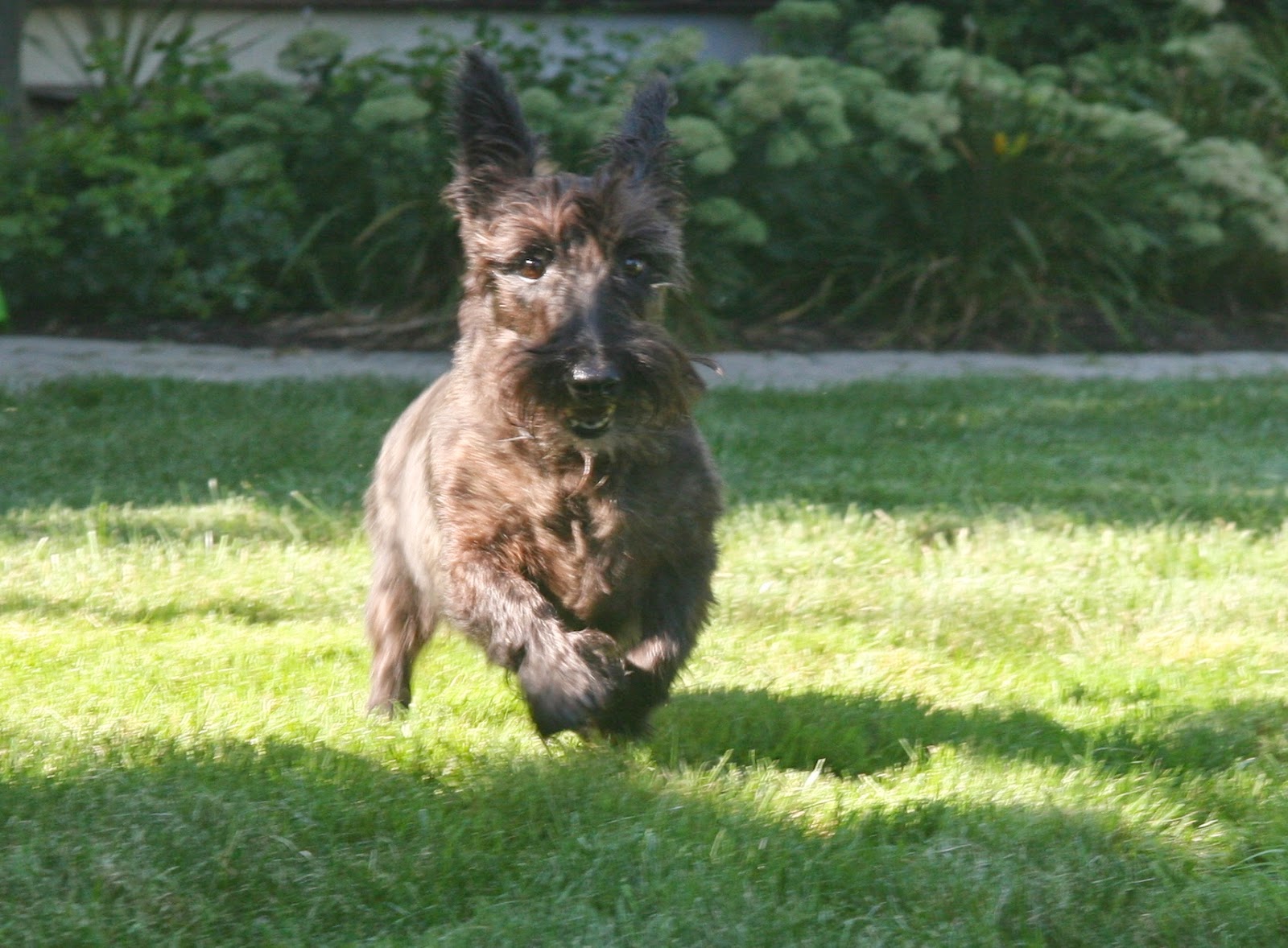 |
| Sophie comes when called because it always predicts good things! |
Wednesday, November 26, 2014
5 Body Postures, A Dog is Asking For Space

Level 1 distance Cues:
1. Dogs body is leaning away from the approaching hand.
2. Dogs paw is raised in a submissive manner.
3. Head is moving away asking for increased distance.
4. Eyes are avoiding the stranger
5. Mouth is closed, rather than open and relaxed.
Dogs often ask for distance in the only way they know how, but if the scary hand keeps coming, your dog may resort to a level 2 distance cue like a Growl, lip curl or show of teeth with a rigid body. I HOPE your dog growls rather than bites. Hence, do not punish the growl as it is an effective distance cue. When the dog is punished for growling, but is still afraid of that hand coming as it predicts pain, he may bite to protect himself.
Have you heard of someone who was bitten by a dog in the face while they were attempting to pet him or rub his belly? It is probable the dog used some distance cues before he resorted to a bite. Unfortunately, it is likely the human did not understand the signals and continued forward until the dog felt so threatened he did not have time to use a more moderate level one or level two response.
Dogs that are fearful or have been threatened by a previous human will be on guard and defensive. Canine behaviors asking for distance are far better than an attack with a bite, so please do not punish them. Rather, simply remove the approaching stimuli. Can you teach a dog a level 1 distance cue like a look away? Absolutely, but it takes time and patience -- and it is well worth the effort!
Sunday, November 16, 2014
Fight or Flight?
On a recent trip, I found myself in a nice hotel lobby visiting friends. I decided it was time for
"goodbyes" so I headed for the elevator. When the door opened, there were three rather imposing-looking men standing along the back wall. I froze for a second! Do I get in and turn my back to them? Do I step in and continue to face them? Do I walk away as if I forgot something?
Depending on our past life experiences we may all feel differently about being in this situation. Many of you might say "Wow, you are overly sensitive" or "I would flee, for sure!"
At only 5'1" I often feel vulnerable when alone, but knowing I was in a nice hotel, I chose to step into the elevator, turn slightly sideways and push the appropriate button. As the doors closed I felt an intense hot flash rush over my entire body. Feeling trapped with no flight path, I was over come with fear. I decided I would fight if needed and looked into the nearest mans face and said "Hi." He smiled and nodded his head. I looked at the young man in the middle and he nodded before I could speak and looked quickly away at the ground. I looked straight at the third man and his head was resting on the back wall with his eyes closed. With this information, I did not feel as threatened and was able to relax just a bit, although I was still on guard as the elevator took FOREVER to get to the 10th floor. I waited until the door began to open and then quickly stepped out of the door in a sideways movement and looked behind me to see if anyone would follow. Thankfully the doors closed and I was free to hustle to my room. The feeling of being safe was oh so good!
Fight or Flight, also called the acute stress response are terms ethologist's and behavioral
psychologist use to describe the behavior of numerous species -- including humans. If a stimulus is perceived as a threat, a more intense and prolonged discharge of locus ceruleus activates the sympathetic division of the nervous system. For a thorough understanding on how the body reacts, visit: (Thase & Howland, 1995)
We think of prey animals such as the horse, deer and other animals with wide set eyes to use flight as their way of staying safe. Predators such as wolves, cats & dogs will often choose flight if given the opportunity.
However, if a valued resource is worth fighting for, or if a predator is trapped and prevented from flight, then it will likely use a fight response to keep himself safe.
Fight-or-flight responses are as normal in our canine friends as in our human friends. When you see a dog use a fight response such as a growl with a specific stimulus, consider if the dog has a good reason to do so. Is the dog trapped? Is this dog given a chance to use flight? Could this dog have good reason to not trust a particular stimuli?
I suggest if you have a dog that is using a fight behavior, consider first the dogs history. Assess the situations, observe the dogs entire body, seek to understand before you consider how to proceed. Do not immediately correct or punish, as this dog may have good reason to growl or snap. The dog may simply be afraid. Help me prevent dogs from being punished for choosing fight when they are left with no other option. Dogs that have been punished for simply being afraid, are much harder to counter-condition later.
 |
| It is easier to understand human intentions. |
Depending on our past life experiences we may all feel differently about being in this situation. Many of you might say "Wow, you are overly sensitive" or "I would flee, for sure!"
Fight or Flight, also called the acute stress response are terms ethologist's and behavioral
psychologist use to describe the behavior of numerous species -- including humans. If a stimulus is perceived as a threat, a more intense and prolonged discharge of locus ceruleus activates the sympathetic division of the nervous system. For a thorough understanding on how the body reacts, visit: (Thase & Howland, 1995)
 |
| Am I clear? says the golden. Good, I don't want to bite you. |
We think of prey animals such as the horse, deer and other animals with wide set eyes to use flight as their way of staying safe. Predators such as wolves, cats & dogs will often choose flight if given the opportunity.
However, if a valued resource is worth fighting for, or if a predator is trapped and prevented from flight, then it will likely use a fight response to keep himself safe.
 |
| Back off, I am in fight mode as there is no flight accessible |
Fight-or-flight responses are as normal in our canine friends as in our human friends. When you see a dog use a fight response such as a growl with a specific stimulus, consider if the dog has a good reason to do so. Is the dog trapped? Is this dog given a chance to use flight? Could this dog have good reason to not trust a particular stimuli?
I suggest if you have a dog that is using a fight behavior, consider first the dogs history. Assess the situations, observe the dogs entire body, seek to understand before you consider how to proceed. Do not immediately correct or punish, as this dog may have good reason to growl or snap. The dog may simply be afraid. Help me prevent dogs from being punished for choosing fight when they are left with no other option. Dogs that have been punished for simply being afraid, are much harder to counter-condition later.
Sunday, October 12, 2014
Why Does My Dog Do That?
Do you ever wonder why your dog performs certain behaviors or motor patterns? I sure have! For example: Why does my dog roll on smelly things? Why does my dog shake his toy? Should I be worried if my dog stalks his playmate? Why does my dog guard his bones?
Specific behaviors that are unique to our dogs are called Phylogenetic behaviors. These behaviors, or behavior patterns, have developed over many many generations and truly have evolutionary significance to maximize reproduction and survival. Stalking and bouncing are examples of phylogenetic behavior, as is an innate fear of loud noises.
When we think of our dogs behaviors we can summarize that all their behaviors come from three simple motivations:
1. Hunting/obtaining food
2. Safety/avoidance seeking
3. Sexual/reproductive behaviors
Behaviors observed in just the hunting motivations: orient to sound or moving object, stare, freeze, creep, stalk, run, jump, grab, hold, shake, hold down, kill, eat, guard.
Can we change phylogenetic behaviors? All behaviors can be modified to some degree with patience and a strong counter conditioning process.
Inherently genetic behaviors may be strong in your dog and low in my dog, as each dog has a different genetic make up. Such as rolling in feces, a yucky behavior to us humans, but many of our dogs do it! Why? The science behind this behavior is that our dogs roll in animal feces or on a dead animal so they can mask their scent to better help them sneak up on their prey. Does your dog need to stalk his prey for survival? Unlikely, but this behavior can be a strong genetic trait.
We know some dogs learn to play fetch just by watching another dog play fetch. This is called Social Learning. Other dogs perform behaviors for the reward, for example my female Scottie will frequent my neighbors back yard and scan for a squirrel to come down the bird feeder. She has been successful on two occasions and enjoyed eating them as well. Does she need to hunt for survival? No, but this behavior is both rewarding to her, and a strong genetic trait, therefore she will repeat it.
Many dogs use hunting behavior patterns in play, others will use sexual motor patterns like mounting and neck biting to initiate play. The point is our dogs do many behavior patterns as a result of their genetic make up. If this behavior is followed by a reward, then this behavior will most likely continue to be practiced.
Specific behaviors that are unique to our dogs are called Phylogenetic behaviors. These behaviors, or behavior patterns, have developed over many many generations and truly have evolutionary significance to maximize reproduction and survival. Stalking and bouncing are examples of phylogenetic behavior, as is an innate fear of loud noises.
 |
| Hunting, for fun or survival? |
When we think of our dogs behaviors we can summarize that all their behaviors come from three simple motivations:
1. Hunting/obtaining food
2. Safety/avoidance seeking
3. Sexual/reproductive behaviors
Behaviors observed in just the hunting motivations: orient to sound or moving object, stare, freeze, creep, stalk, run, jump, grab, hold, shake, hold down, kill, eat, guard.
Can we change phylogenetic behaviors? All behaviors can be modified to some degree with patience and a strong counter conditioning process.
Inherently genetic behaviors may be strong in your dog and low in my dog, as each dog has a different genetic make up. Such as rolling in feces, a yucky behavior to us humans, but many of our dogs do it! Why? The science behind this behavior is that our dogs roll in animal feces or on a dead animal so they can mask their scent to better help them sneak up on their prey. Does your dog need to stalk his prey for survival? Unlikely, but this behavior can be a strong genetic trait.
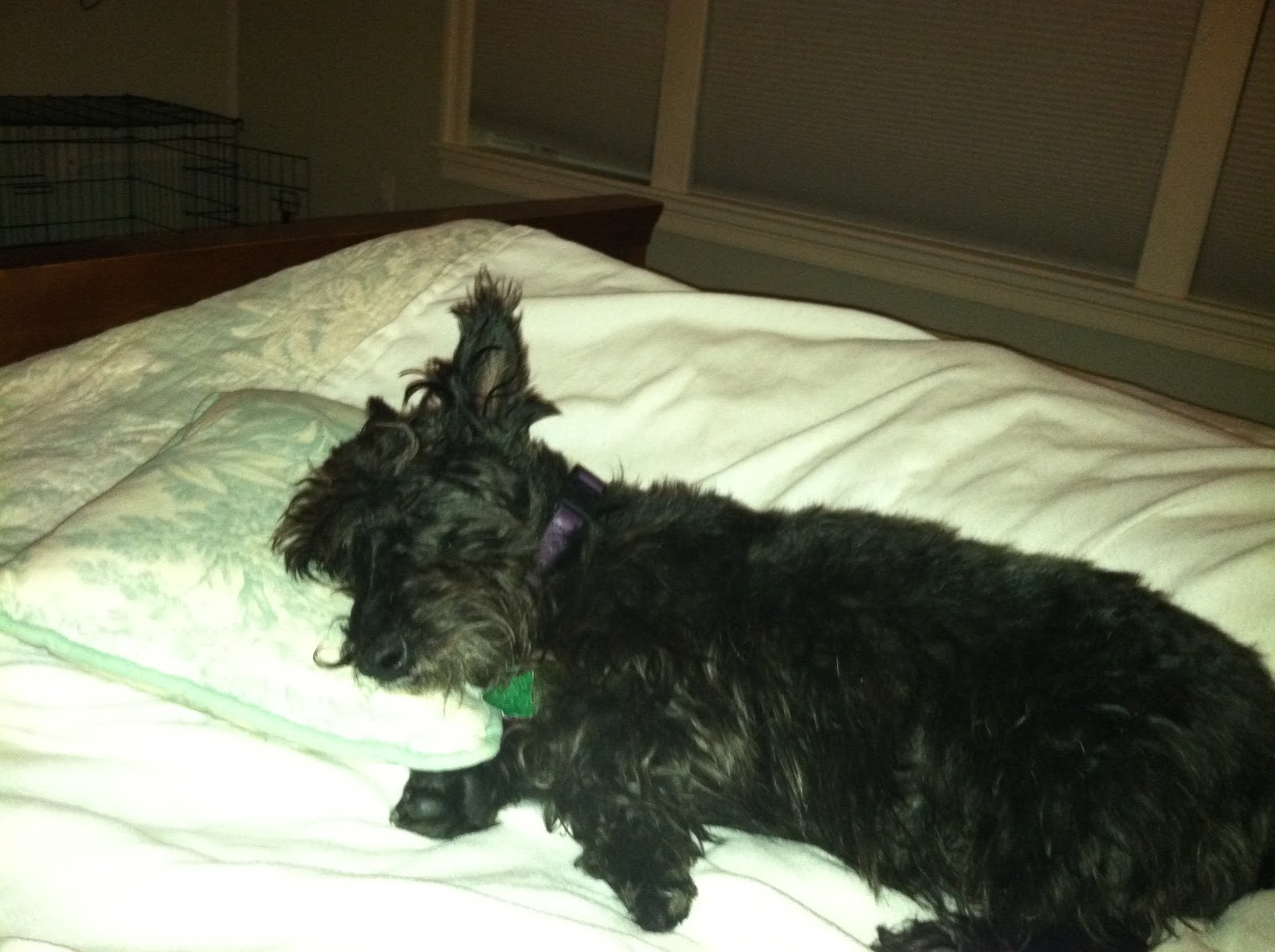 |
| Resting for the next hunt. |
Many dogs use hunting behavior patterns in play, others will use sexual motor patterns like mounting and neck biting to initiate play. The point is our dogs do many behavior patterns as a result of their genetic make up. If this behavior is followed by a reward, then this behavior will most likely continue to be practiced.
Wednesday, October 1, 2014
One Behavior You Must Teach Your Puppy?
To Sit? That is a nice default behavior, but not the most important one to teach.
To Come? Great behavior to have consistently for sure!
To Leave it? Awesome behavior to have, great on walks both on and off leash!
How about not to bite human flesh? Sounds pretty important to me! Bite inhibition is the technical term for a dogs ability to control the pressure they use when biting. If you could only teach your puppy or new rescue dog one behavior, please remember to teach him a soft mouth -- aka bite inhibition.
How? By giving your dog appropriate feedback. Over several days with the following positive techniques, your puppy will learn this life saving skill.
1. Hand feeding daily meals, release the food when your puppy is gentle or licks. If you feel teeth, wait until he softens, then reward.
Example: Say your pups name and when he look at you, offer a piece of food. Say your pups name and "come" offer a piece of food as a reward. Reward your puppy for coming and sitting 10 times per meal and you will have a solid sit and a softer mouth!
2. Play tug, using the rules of tug you can quickly help your puppy learn that when you feel teeth on your skin, playing stops. Remember, do not drop the toy or you could teach your puppy that biting is how they do get the toy. Instead, ask for a sit to begin the game, then say "take it" and play "tug" keeping the toy low to the ground. Next, put a treat to the pups nose and say "leave it" and
exchange with the food while putting the toy behind your back. Repeat, sit, take it, tug, leave it.
3. Body handling your puppy with a soft, flat gentle hand. If your puppy bites your hand, then let your hand go limp, dead like, and wait until the puppy removes his mouth from your hand. Repeat slowly and gently as your pup learns that hands predict good gentle scratches and massaging. Some puppies respond if you scream, but some thing you are simply playing, so this feedback may help and it may not as all puppies are different.
4. Allowing your puppy playtime with another friendly dog or in a puppy group. Playing with other pups will surely help your puppy learn
not to bite too hard, many pups learn to use a soft mouth when playing with their mother, however some pups miss out on this lesson and will therefore learn it while playing with other puppies and of course playing with you.
Teaching your puppy a soft mouth or good bite inhibition is the ONE most important behavior you need to teach. Remember, your pup will not stop using his mouth on you and your clothes in 1 day as he has been using it with his siblings for 8 weeks, be patient and give your puppy the feedback he so needs to be able to live with humans.
What should you not do? Scare your puppy or teach him that human hands are to be feared, as this tactic will most likely make him want to bite hands more. Why? Science has taught us that dogs who are handled in a physical or rough manner are more often to bite later in life. Science has also taught us that aggression breeds more aggression.
If you do not want your puppy to use his mouth to resolve conflict, then please do not use your hands to resolve conflict. Science has taught us that rough hands on a pup, will create unwanted behavior changes as the pup matures. Example: Submissive peeing, over the top wiggly greetings, worse mouthy behavior, biting later as an adolescent dog, growly and avoidance behaviors.
For a reference on teaching a soft mouth, refer to Sophia Yin's Low Stress Handling techniques
Dr. Sophia Yin, Low Stress Handling. Although Sophia passed away just yesterday, she will always be a source to reference because she educated those of us in the Pet Industry that the emotional well being of the animal is essential to avoiding unwanted behavior changes.
To Come? Great behavior to have consistently for sure!
To Leave it? Awesome behavior to have, great on walks both on and off leash!
 |
| hand feeding for good behavior |
How about not to bite human flesh? Sounds pretty important to me! Bite inhibition is the technical term for a dogs ability to control the pressure they use when biting. If you could only teach your puppy or new rescue dog one behavior, please remember to teach him a soft mouth -- aka bite inhibition.
How? By giving your dog appropriate feedback. Over several days with the following positive techniques, your puppy will learn this life saving skill.
1. Hand feeding daily meals, release the food when your puppy is gentle or licks. If you feel teeth, wait until he softens, then reward.
Example: Say your pups name and when he look at you, offer a piece of food. Say your pups name and "come" offer a piece of food as a reward. Reward your puppy for coming and sitting 10 times per meal and you will have a solid sit and a softer mouth!
 |
| Playing Tug can teach a soft mouth |
exchange with the food while putting the toy behind your back. Repeat, sit, take it, tug, leave it.
 |
| flat pan cake hands are non threatening |
4. Allowing your puppy playtime with another friendly dog or in a puppy group. Playing with other pups will surely help your puppy learn
 |
| Puppy play group |
Teaching your puppy a soft mouth or good bite inhibition is the ONE most important behavior you need to teach. Remember, your pup will not stop using his mouth on you and your clothes in 1 day as he has been using it with his siblings for 8 weeks, be patient and give your puppy the feedback he so needs to be able to live with humans.
What should you not do? Scare your puppy or teach him that human hands are to be feared, as this tactic will most likely make him want to bite hands more. Why? Science has taught us that dogs who are handled in a physical or rough manner are more often to bite later in life. Science has also taught us that aggression breeds more aggression.
If you do not want your puppy to use his mouth to resolve conflict, then please do not use your hands to resolve conflict. Science has taught us that rough hands on a pup, will create unwanted behavior changes as the pup matures. Example: Submissive peeing, over the top wiggly greetings, worse mouthy behavior, biting later as an adolescent dog, growly and avoidance behaviors.
For a reference on teaching a soft mouth, refer to Sophia Yin's Low Stress Handling techniques
Dr. Sophia Yin, Low Stress Handling. Although Sophia passed away just yesterday, she will always be a source to reference because she educated those of us in the Pet Industry that the emotional well being of the animal is essential to avoiding unwanted behavior changes.
Wednesday, September 17, 2014
Why is my Dog Lunging on the Leash?
Do you own a dog that does not act "normal" when he sees another dog on leash?
 |
| Learning good emotional control takes practice |
With effective behavior modification programs, these anxious reactive dogs can thrive in our homes and communities. Having a plan to keep them safe, predictable exercise routines, desensitization tools, healthy nutrition, doggie Zen and possibly medication, these dogs will love us unconditionally. Just look in there eyes and help them feel safe, always..
If you have taken on the task to raise a dog with fearful reactive behaviors, know you are not alone. I personally have three dogs who each have different levels of fears and often use distance cues with humans and dogs. I understand your stress of owning an unbalanced dog.... Even my family members have called them names, not truly understanding my dogs level of stress. I feel an enormous amount of empathy for these animals as I see in their body language how much more worried they are then other dogs. I have spent hours counter condition their fears to various stimuli and I work very hard to have a plan each time I take them in public so I can set them up
for success. I manage for safety, continually counter condition their fear emotions to positive ones so they know what to do in different situations and cherish each calm moment we have together. My two females came to me with bite histories and have each received their Canine Good Citizen Certification from two different trainers. One has gone on to be Therapy Dog International Certified, so do not lose hope and celebrate each small daily success!
Using the right balance of tools, your dog will one day be able to think through his arousal so you can reward him and not be frustrated with him.
 |
| Thinking through arousal... |
Using the right balance of tools, your dog will one day be able to think through his arousal so you can reward him and not be frustrated with him.
Sunday, August 24, 2014
Five Things You Should Never do to a Puppy!
 |
| Reward based training, with clear rules is scientifically the most effective and humane way to train. |
Each month I consult with stressed clients whose now 1 year old pup is biting family members, some even attacking. Every case has one common history fact: "I was told to do this when he growls at me."
FIVE THINGS YOU SHOULD NEVER DO TO A PUPPY: (harsh handling a pup can create aggression in your pup later in life)
1. Never hold his mouth closed when he bites you.
2. Never stick your fingers down his throat.
 |
| Flat gentle hands always, never scruff or biting may get worse as your puppy will need to defend himself. |
4. Never stare him in the eye until he submits.
5. NEVER use your hands to cause physical pain in any way.
WHAT SHOULD YOU DO?
1. Give your puppy appropriate feedback when he uses his mouth on you. Give a loud "OUCH" and move away from the puppy for a few seconds. If he however, is simply mouthing with no pressure, you can ignore him as he is using a soft mouth and many breeds are bred to use their mouths to assist owners in many ways.
 |
| Puppies and children learn together! |
3. Hand feed your puppy as many meals as you can. Place the food in the palm of your hand under your thumb, if you feel teeth, wait until he licks, then remove your thumb and reward (a task for mom and dad, not children). Try feeding your pup some peanut butter on a metal spoon (this may be necessary for pups with a particular hard mouth. They will learn to lick as it is more rewarding.
 |
| Teaching tug is essential and fun! |
 |
| hand feeding is a good thing to do! |
Tuesday, July 22, 2014
Don't Shoot the Dog - Jackpots Revised
Many of you have read Karen Pryer's book, Don't Shoot the Dog It is an educational book for parents as well as dog owners. After 20 years, Karen explains how the use of jackpots can work when used effectively. The below insert is straight from Karen's Blog and is worth reading:
Remember, though, that no one is always right. We all keep learning things all the time, revising and adding to what we knew before. That's one of the joys of science and a valuable phenomenon in the clicker training world.
Looking back at the jackpot section in Don't Shoot the Dog, now, twenty years after it was written and six years after the revision supervised by Murray Newman, I think that I failed to differentiate between jackpots as I see them, and another tool altogether: the non-contingent reward.
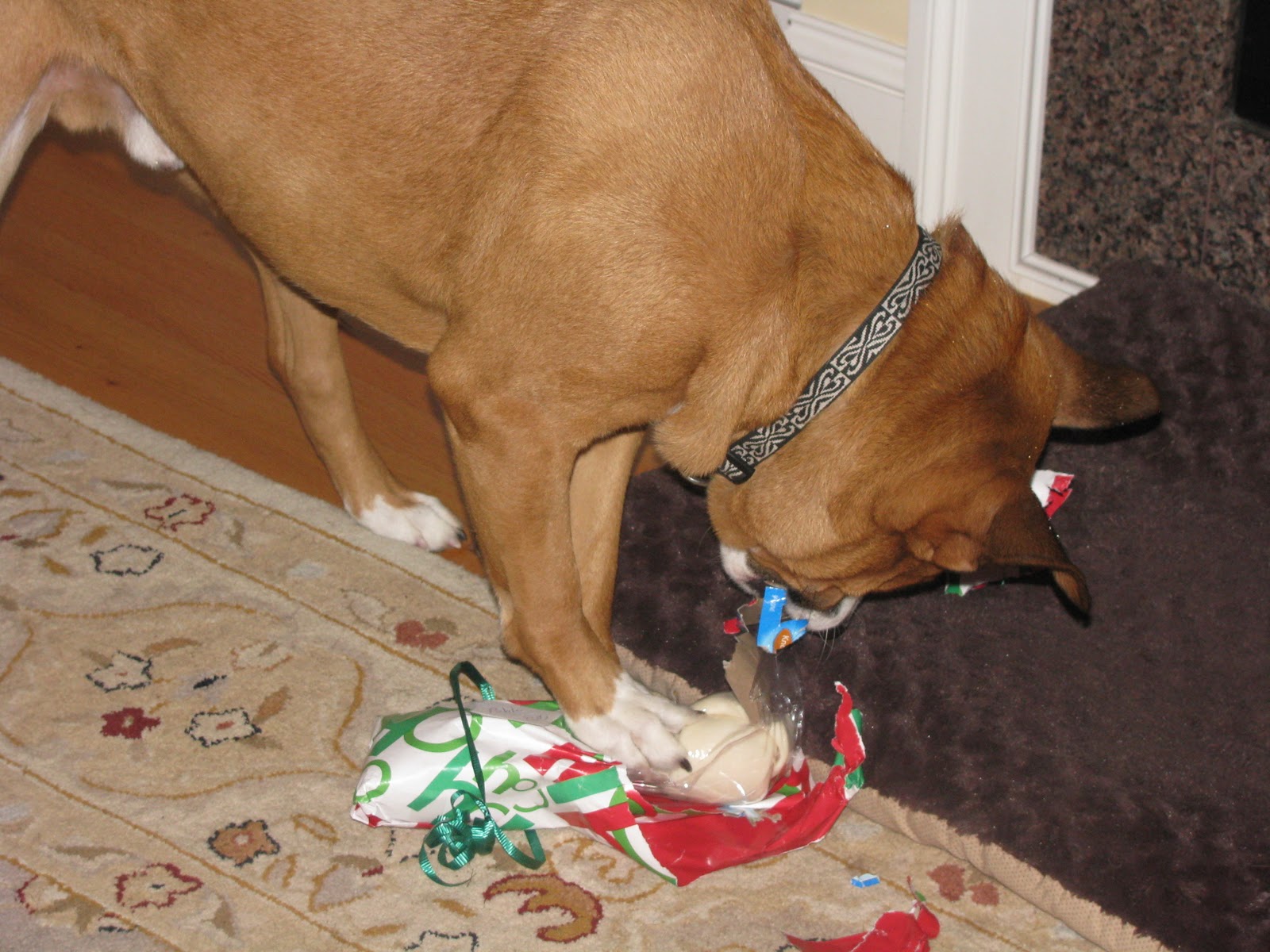 |
| A non-contingent reward "just because" |
A non-contingent reward is also something you get by surprise, but it is not associated with any particular behavior. One example in the book was the two free fish we gave to a discouraged dolphin, which perked her up and set her to trying to earn reinforcement again. Another example in the book was the ticket for ten free riding lessons that my parents bought me when, at sixteen, I was behaving poorly for weeks on end. It instantly corrected my bad mood. I included these as jackpots, but they were not; they were both examples of a non-contingent reward. The most powerful use of a non-contingent reward is to counteract the effects of an extinction curve; I know the dolphin in question was undergoing extinction of a bunch of operant behaviors; probably this sulky teenager was, too. Getting the news that good things are still available revived the efforts to seek reinforcement again.
Like the jackpot, a non-contingent reward is a tool to use rarely. And, like a jackpot, if it is going to work, you only need to do it once.
Saturday, July 5, 2014
Dog Aggression and Communication Signals
Why is my dog so aggressive to other dogs? This can usually be diagnosed with a detailed history: no play ever, hereditary, mother was sick or a guarder, or over socialized with aggressive or rough playing dogs.
Cycle of On-Leash Aggression (created problem from humans), as described in the Culture Clash, by Jean Donaldson, "The Bully dog" is often kept away from other dogs for long periods of time, he is usually rude with crude behavior brought on by a super motivated greeting as a result of deprivation when meeting other dogs, and has poor social skills. The owner is alarmed by intensity and tightens the leash and get’s too excited or nervous when interactions occur. High arousal, lack of social skills, scuffles with defensive dogs can occur. Barrier frustration such as windows, fences and leashes can increase the dogs frustration which makes you want to "correct" the behavior, which = punishment which = more Aggression = total isolation.
I believe dogs need time to express their intentions before they greet unknown dogs. Personalities among dogs differ as much as a classroom full of kindergarteners, therefore, expecting your dog to like every dog they meet is not that simple. Some dogs are very soft and have appropriate greetings, these are the dogs who are able to visit the beach and off leash parks without incident.
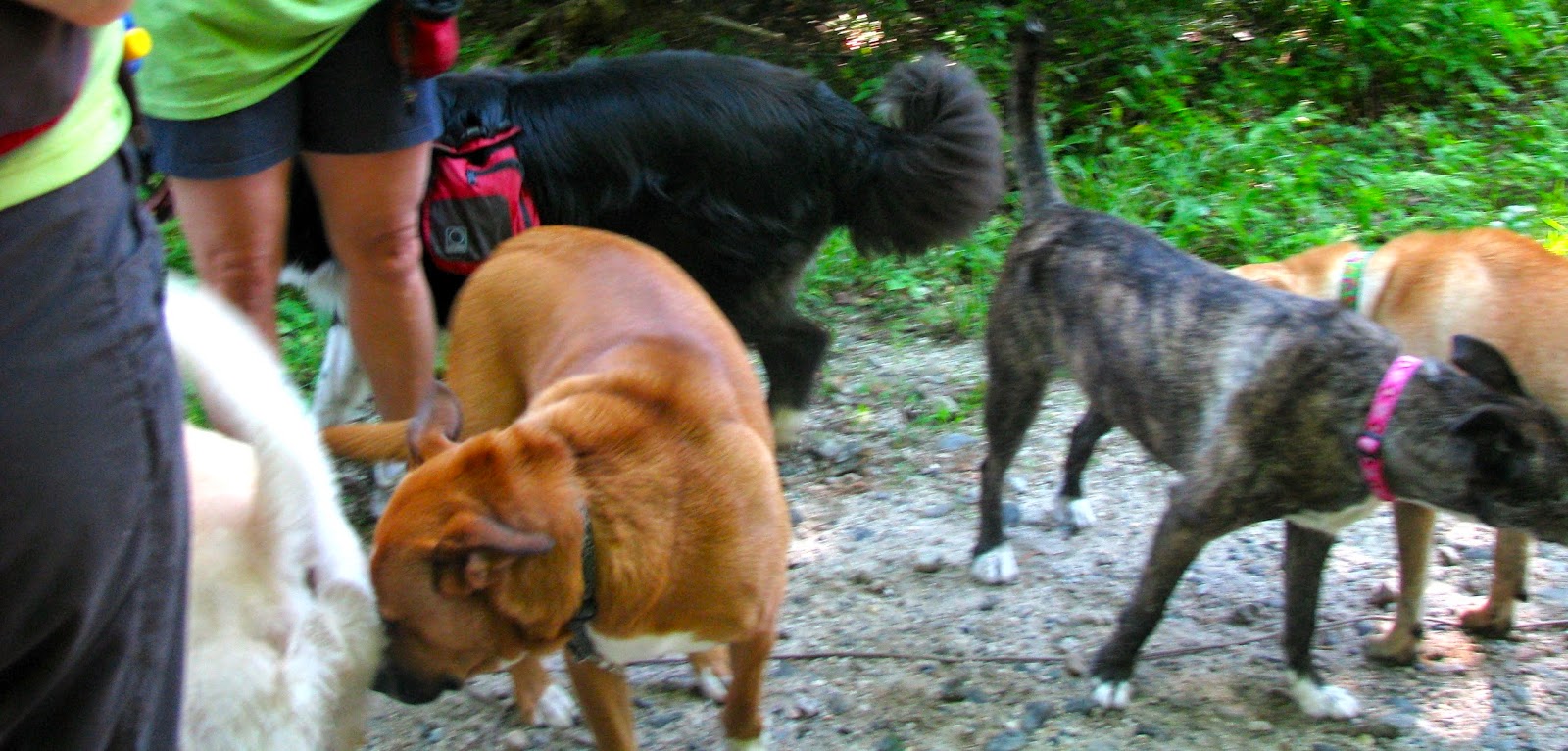 Helping your dog greet new dogs much slower will give your dog important and necessary information about the other dogs intentions. To the left, you see the brown dog in the middle of this pack at a local park. He is standing quite still with head lowered, visible tension in his jaw, mouth closed, low tail, ears back and a his hair beginning to stand up on his back. He is very uncomfortable about being so close to a strange dog and was called away quickly to avoid any conflict. This particular dog's behavior tells us humans that he needs a much slower greeting with new dogs.
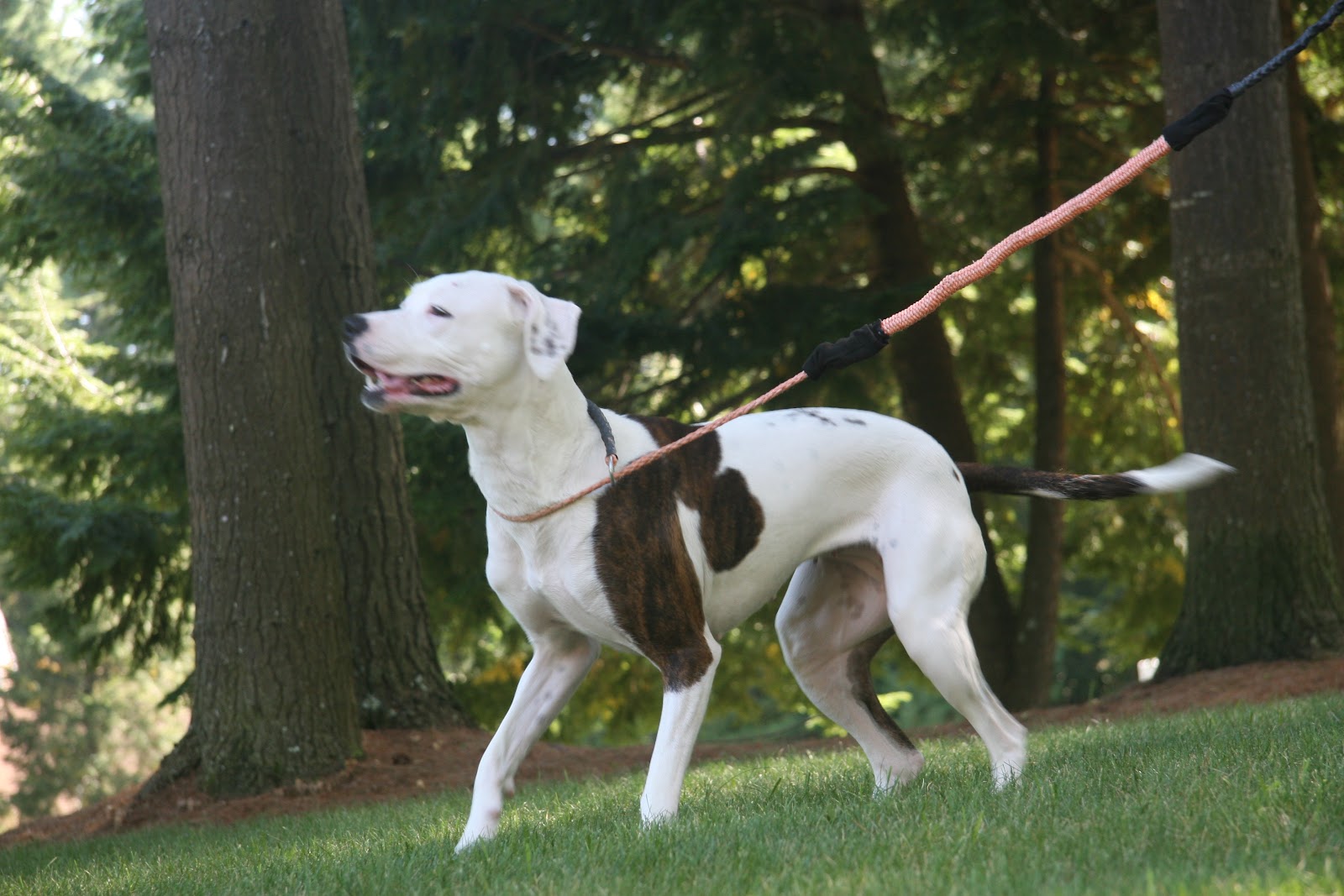 In this photo to the left , this beautiful girl has just seen a new dog and is reading the other dogs intentions and clearly expressing hers as well. Note the open mouth and soft eyes, lowered tail which is in motion and she is beginning to offer a play bow. While she is expressing intentions that she does want to greet the new dog, she is very excited and the other dog is a bit alarmed by her intense need to visit. After about 30 minutes of walking near each other, this girl and the other dog became play mates as you will see in the video below.
If you have a new puppy, please keep him/her safe and find nice friendly dogs to socialize with. Your dogs friends will influence his/her behavior! Just like you were influenced by those you visited with as an adolescent. So, know who your dogs friends are and watch for signs of fair play between the two and you let's try to prevent aggression from spreading.

Sunday, June 22, 2014
Sorry for the absent of Blog updates this Spring......
*I have been busy teaching 18 classes a week at Poetic Gold Farm in Falmouth, Maine
*Taken on the role as head trainer for the Pets For Vets Program for the state of Maine 2014
*Managing 10-12 in home private sessions per week
*Maintain training of my own 4 dogs
*Manage a relationship with my 3 teenagers, 2 home from college
*Focused on my 17 year old daughter's emotional high school softball season
*Most importantly celebrated 25 year wedding anniversary to my wonderful husband
As I write this I am in Newport, RI for the SPRCS initiative conference which stands for the Society for the Promotion of Applied Research in Canine Science. My brain is swirling with new concepts I want to share with my clients in the areas of temperament testing, breed differences, learning theory, canine body language, agonistic signals, motivational tools, small dog syndrome and much much more!
For those of you interested in June 28th, classes held in Falmouth, I do have just a few spots in the following:
9 am Family Dog I
10 am Family Dog advanced
11 am Controlled Unleashed
Best,
Judy
*I have been busy teaching 18 classes a week at Poetic Gold Farm in Falmouth, Maine
*Taken on the role as head trainer for the Pets For Vets Program for the state of Maine 2014
*Managing 10-12 in home private sessions per week
*Maintain training of my own 4 dogs
*Manage a relationship with my 3 teenagers, 2 home from college
*Focused on my 17 year old daughter's emotional high school softball season
*Most importantly celebrated 25 year wedding anniversary to my wonderful husband
As I write this I am in Newport, RI for the SPRCS initiative conference which stands for the Society for the Promotion of Applied Research in Canine Science. My brain is swirling with new concepts I want to share with my clients in the areas of temperament testing, breed differences, learning theory, canine body language, agonistic signals, motivational tools, small dog syndrome and much much more!
For those of you interested in June 28th, classes held in Falmouth, I do have just a few spots in the following:
9 am Family Dog I
10 am Family Dog advanced
11 am Controlled Unleashed
Best,
Judy
Tuesday, May 6, 2014
New Class Schedule for June......
Class Schedule
Here's my upcoming class schedule!
Spring Seminars:
May TBD Surviving Canine Adolescence at Poetic Gold Farm, Falmouth ME
July 27th Canine Communication, Dog to Dog at It's A Dogs World, York ME
All classes listed below are taught by Judy Moore,
Associate Certified Dog Behavior Consultant
No Classes will be held on the following dates:
Wednesday, May 14, 2014
AKC Star Puppy Class (6-Weeks) $140
Family Dog (basic obedience) (6-Weeks) $140
Poetic Gold Farm 7 Trillium Road, Falmouth, ME 04105
No Classes will be held on the following dates:
Wednesday, May 14th 2014
Spring Seminars:
May TBD Surviving Canine Adolescence at Poetic Gold Farm, Falmouth ME
July 27th Canine Communication, Dog to Dog at It's A Dogs World, York ME
All classes listed below are taught by Judy Moore,
Associate Certified Dog Behavior Consultant
No Classes will be held on the following dates:
Wednesday, May 14, 2014
AKC Star Puppy Class (6-Weeks) $140
- 8 AM Saturday's beginning April 19th, at Poetic Gold Farm
- 8 AM Saturday's beginning June 28th, at Poetic Gold Farm
- 6 PM Wednesday's beginning April 30, at Poetic Gold Farm
- 9 AM Monday's beginning April 28th, at Poetic Gold Farm FULL
- 5 PM Monday's beginning April 28th, at Poetic Gold Farm FULL
- 9 AM Saturday's beginning May 3rd, at Poetic Gold Farm
- 9 AM Monday's beginning June 9th, at Poetic Gold Farm
- 5 PM Monday's beginning June 9th, at Poetic Gold Farm
- 6 PM Wednesday's beginning June 11th, at Poetic Gold Farm
- 9 AM Saturday's beginning June 28, at Poetic Gold Farm
- 10 AM Monday's beginning April 28th, at Poetic Gold Farm
- 5 PM Wednesday's beginning April 30th, at Poetic Gold Farm
- 10 AM Saturday's beginning April 19th, at Poetic Gold Farm FULL
- 10 AM Monday's beginning June 9th, at Poetic Gold Farm
- 5 PM Wednesday's beginning April 30th, at Poetic Gold Farm
- 10 AM Saturday's beginning June 28th, at Poetic Gold Farm
Canine Good Citizen (CGC) Certification (6- Weeks) $140
- 11:30 PM Wednesday's beginning April 16th, at Poetic Gold Farm
- 11:30 PM Wednesday's beginning June 11th, at Poetic Gold Farm
Outdoor Adventure (6-Weeks) - getting reliable behaviors away from home $150
- 12:30 Monday's beginning April 14th, at Poetic Gold Farm (full)
- 1:30 PM Saturday's beginning April 19th, at Poetic Gold Farm (full)
- 12:30 Monday's beginning June 9th, at Poetic Gold Farm
- 1:30 PM Saturday's beginning June 28th, at Poetic Gold Farm
Control Unleashed (6-Weeks) - increase dogs focus and confidence $150
- 11 AM Monday's beginning April 14th, at Poetic Gold Farm (full)
- 6 PM Monday's beginning April 14th, at Poetic Gold Farm (full)
- 12:30 PM Wednesday's beginning April 16th, at Poetic Gold Farm (full)
- 11 AM Saturday's beginning April 19th, at Poetic Gold Farm (full)
- 11 AM Monday's beginning June 9th, at Poetic Gold Farm
- 6 PM Monday's beginning June 9th, at Poetic Gold Farm
- 12:30 PM Wednesday's beginning June 11th, at Poetic Gold Farm
- 11 AM Saturday's beginning June 28th, at Poetic Gold Farm
- 7:00 PM Mondays beginning April 14th, at Poetic Gold Farm (very full)
- 7:00 PM Mondays beginning June 9th, at Poetic Gold Farm
- 7 PM Wednesday's beginning April 30th, at Poetic Gold Farm (1 spot left)
- 7 PM Wednesday's beginning June 11th, at Poetic Gold Farm
Poetic Gold Farm 7 Trillium Road, Falmouth, ME 04105
- Please drive slowly entering Lady Slipper as well as on Trillium (continue on gravel road)
- Registration fees paid directly to Canine Behavior Counseling, LLC
No Classes will be held on the following dates:
Wednesday, May 14th 2014
Sunday, April 20, 2014
Easter Break
Happy Easter!!
No classes April 21st through April 25th at Poetic Gold Farm or Tender Touch as many of my clients are out of town on Spring Break and visiting family.
See everyone back this Saturday April 26th.
Best,
Judy
No classes April 21st through April 25th at Poetic Gold Farm or Tender Touch as many of my clients are out of town on Spring Break and visiting family.
See everyone back this Saturday April 26th.
Best,
Judy
Wednesday, April 16, 2014
Positive Reinforcement Training is Best
| Interesting study reported in Psychology Today. I am not surprised by the findings — just further confirmation of my Training approach. Judy Moore |
The Effect of Training Method on Stress Levels in Dogs | Psychology Today |
The Effect of Training Method on Stress Levels in Dogs
Discipline-based training increases stress levels in dogs.
At a dog training seminar that I attended recently I found myself engaged in a familiar conversation, namely the effect of various types of dog training methods on the behavior of pet dogs. Nowadays the line seems to be drawn between two camps, one advocating "positive dog training" (which uses rewards such as food and play) versus "discipline-based training" (which incorporates slip collars and leash tugs and other physical interventions to enforce compliance).
Prior to the mid-1940s, most dog training was done using discipline-based training, since most of the early training models came from military dog trainers who had the idea that a dog should be trained using the same kind of discipline-based procedures that were used for human recruits. The change toward more positive training came about because of a series of books written by Blanche Saunders. Although by today's positive training standards she was still a bit harsh, she clearly recognized the value of rewards and was much softer on her canine students than most trainers before her. Over time, positive dog training has come to dominate the canine training scene, following much along the model of the techniques used by Ian Dunbar and others. However over the past few years, due to the influence of certain high profile dog trainers who have popular television series like Cesar Millan, discipline-based training has begun to gain in popularity.
One of the people in the group that I was speaking with insisted that discipline-based training procedures should not have been abandoned, and that no real proof exists showing negative effects on dogs. She complained that there was a bias among canine researchers, who she referred to as "foodies" since they usually reward the dogs with a stream of food treats. "Just because we live in a kinder and gentler world doesn't mean that we can't teach a dog that when he does something we don't like it has negative consequences," she said. "Properly applied, by people who know what they're doing, there's nothing wrong with negative reinforcement or a little bit of punishment. The problem is that most researchers and the people they get to train the dogs they test probably don't really believe in discipline-based training, and so they either overdo it, or don't work as hard at using it properly."
As luck would have it I had just finished going over an article that was recently accepted for publication in the Journal of Veterinary Behavior* that directly dealt with this issue. It was done by two French researchers, Stéphanie Deldalle and Florence Gaunet who wanted to test the effect of the two training styles. They wanted to use the most naturalistic setting that they could find, and to collect data based on observation rather than upon changes in blood chemistry or heart rate or other invasive procedures. What they did first was to attend a number of dog training classes in their vicinity and observe the training procedures that were used. In the end they selected one class which used positive dog training methods almost exclusively and contrasted it to another dog training class which used discipline-based methods (mostly negative reinforcement). They reasoned that the instructors in both of these classes were teaching their students using the method that they favored because, as trainers, they believed it was the most efficient system and would produce the best results.
Once the classes were selected, dog and owner pairs were brought in and tested on familiar exercises such as heeling and sitting on command. There were 26 dogs trained using discipline-based procedures and 24 using positive training. The researchers were not looking at actual learning performance, but rather were measuring the amount of stress that dogs appeared to show when performing their learned exercises. They used easily observable behaviors associated with stress, such as mouth licking, yawning, scratching, sniffing, shivering, whining, low posture, attempts to run away, and whether or not the dog avoided making eye contact with their handler.
The results were rather straightforward. If we simply look at whether a dog showed any of the stress related behaviors we find that 65% of the discipline-based trained dogs showed at least one such sign, as compared to only 8% of the positively train dogs. For some selected behaviors the differences were quite striking, such as in mouth licking (38% discipline; 8% positive), yawning (23% discipline; 0% positive), and low posture (46% discipline; 8% positive). One of the results which I found most interesting had to do with whether or not the dog looked at the owner's face. Both humans and dogs have a tendency to avoid looking at things that raise their stress levels or make them uncomfortable, so the fact that only 38% of the discipline trained dogs looked at their owners faces as compared to 88% of the positively trained dogs seems telling.
This is a small study, but because it is done using actual class trained pet dogs and instructors who believe in their particular training method, it is quite interesting. It seems to be just one more study that suggests that using punishment and negative reinforcement can produce potentially harmful and unwanted emotional changes in dogs. For additional findings on similar topics click here or click here.
Stanley Coren is the author of many books including: The Wisdom of Dogs; Do Dogs Dream? Born to Bark; The Modern Dog; Why Do Dogs Have Wet Noses? The Pawprints of History; How Dogs Think; How To Speak Dog; Why We Love the Dogs We Do; What Do Dogs Know? The Intelligence of Dogs; Why Does My Dog Act That Way? Understanding Dogs for Dummies; Sleep Thieves; The Left-hander Syndrome
Copyright SC Psychological Enterprises Ltd. May not be reprinted or reposted without permission
* Data from: Stéphanie Deldalle & Florence Gaunet (2014). Effects of 2 training methods on stress-related behaviors of the dog (Canis Familiaris) and on the dog-owner relationship. Journal of Veterinary Behavior, 9, 58 – 65.
Monday, March 3, 2014
How to Raise a Dog Friendly Puppy
This is an example of an email I receive from distressed puppy owners several times per month....
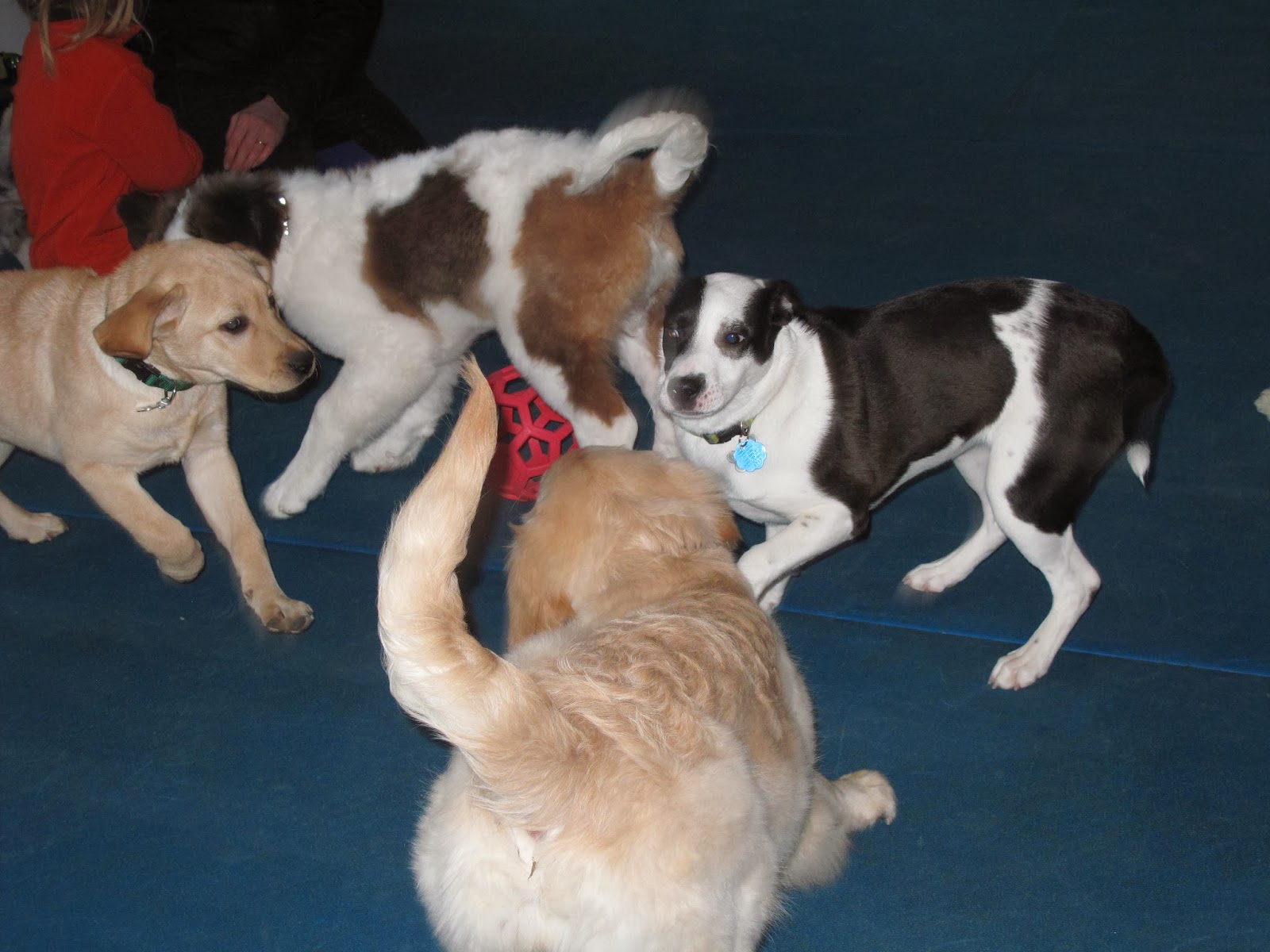 "My dog was taken to the dog park at least 6 times a month during the first 7 months of his/her life, in addition to daily interactions with dogs we let him play with all the dogs on the beach! Once he/she turned 10 months old he/she started becoming aggressive with large pushy dogs or any dog who challenged him/her. He/she can get along with some smaller dogs depending on that dog. My dog has two adult dogs that he/she has known since he/she was 8-10 weeks old that he/she gets along GREAT with."
Will your puppy be exposed to being pushed around by rough adolescent
dogs? Is it true aggression breeds more aggression? Do you know who your dog is playing with now and what that friend is teaching your dog? Is it true a puppy can be over socialized?
As a Certified Dog Behavior Consultant I am swamped with dog aggressive dogs who owners all report they were fine when they were puppies.
All of these dogs who were once dog friendly have one thing in common....they have experienced bully behavior through social learning.
Ask anyone who has raised a puppy and allowed that pup to play with other young puppies
in a supervised class or the neighbors friendly dog or their family members friendly dog and they will tell you that their dog has remained friendly. They have never encouraged their pup to play in large packs of rough adolescent canine play. As a bonus, these puppies leash manners are wonderful as they are not use to being able to pull their owners to every dog they see.
If I get a puppy next year which is a strong possibly, I will make sure I know who my pup is playing with and I will observe this play so my puppy does not become too confident and begin being a bully to other dogs. I will absolutely allow my dog the joy's of playing, however with only very friendly dogs that I know and if he/she begins to be too pushy, I will step in immediately to lower the arousal, even if I have to step in many times during the same play session so it does not become over the top or rough. Practiced behaviors become strong habits, let's make sure our dogs are practicing good habits each day so they remain dog friendly.
Seek out a friend with a very social dog and slowly introduce them by taking a 30 minute walk near each other. After this long walk, you should have a good idea if both dogs are interested in interacting or not. My Outdoor Adventure Class give owners a safe place to allow their dogs to play while being supervised. Often members of class exchange numbers and meet outside of class knowing that arranging play dates will keep their dogs play skills appropriate.
Will your puppy be exposed to being pushed around by rough adolescent
As a Certified Dog Behavior Consultant I am swamped with dog aggressive dogs who owners all report they were fine when they were puppies.
All of these dogs who were once dog friendly have one thing in common....they have experienced bully behavior through social learning.
Ask anyone who has raised a puppy and allowed that pup to play with other young puppies
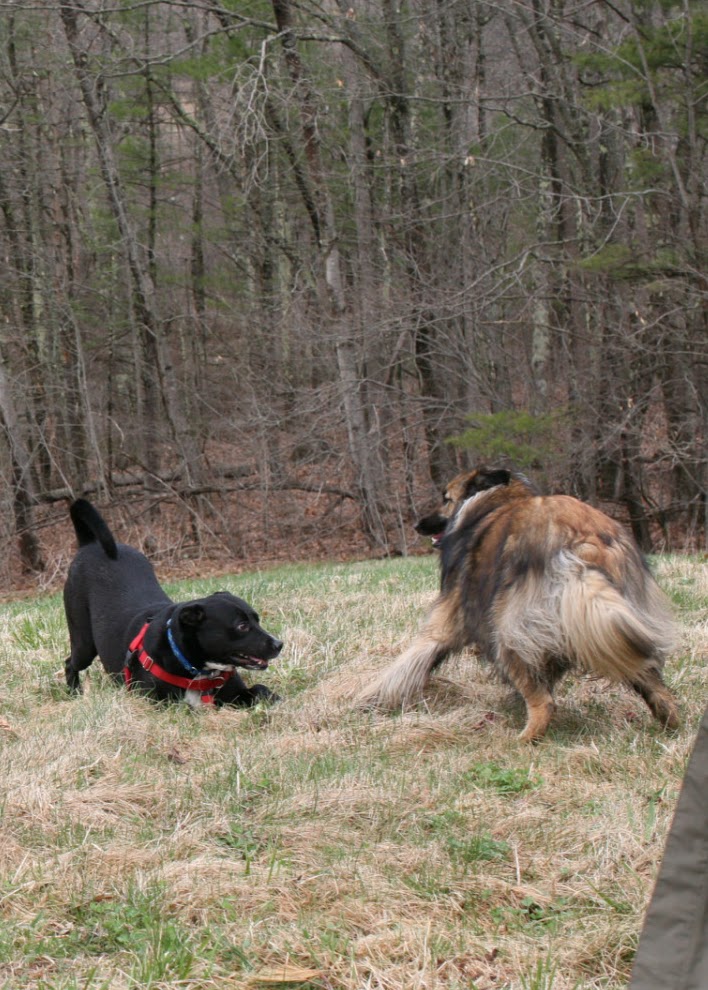 |
| Henry and Nell clearly express their intentions to engage in mutual play. |
If I get a puppy next year which is a strong possibly, I will make sure I know who my pup is playing with and I will observe this play so my puppy does not become too confident and begin being a bully to other dogs. I will absolutely allow my dog the joy's of playing, however with only very friendly dogs that I know and if he/she begins to be too pushy, I will step in immediately to lower the arousal, even if I have to step in many times during the same play session so it does not become over the top or rough. Practiced behaviors become strong habits, let's make sure our dogs are practicing good habits each day so they remain dog friendly.
Seek out a friend with a very social dog and slowly introduce them by taking a 30 minute walk near each other. After this long walk, you should have a good idea if both dogs are interested in interacting or not. My Outdoor Adventure Class give owners a safe place to allow their dogs to play while being supervised. Often members of class exchange numbers and meet outside of class knowing that arranging play dates will keep their dogs play skills appropriate.
Thursday, January 30, 2014
Preventing Dog to Dog Aggression
Protect your dog from becoming aggressive by knowing where he is and who his playmates are. The topic of leash aggression arises so often, I feel the need to address it often in my blogs. For dog trainers it is very clear why we do not let our dogs greet unknown dogs while on leash. I want my dogs attention on ME when I have him on a leash. I prefer he not pull my shoulder off my body when on leash, so I never let him greet other dogs when on leash and guess what? He does not ask anymore because he knows the rule structure. In my opinion, the BEST reason to avoid letting your dog greet unknown dogs while on leash is to keep him or her safe. Once your dog gets into a scuffle while on leash, just the site of a dog while on leash can become very scary for your pup.
 |
| tight leash is nearly un avoidable. |
 |
| Social dogs can relax in the presence of other dogs even while being on a leash. |
I do understand your dog needs daily exercise to get him through his adolescence. If your dog plays well with the neighbors dog, then your dog is already social! Walking on-leash together is a great way to learn leash manners around other dogs. Or, hire a dog-walker who only brings one dog to your session and watch how your dog interacts with that dog. Your dog-walker will help him learn leash manners and prevent any unwanted behaviors from being reinforced. Many dogs are surrendered because they can no longer cope with being on a leash in society. Who's to blame? These dogs were not born dog-aggressive. Rather, it is learned by putting them in environments that are out of control and scary. So please know who your dog is playing with, and if the play is appropriate. We can all agree that aggression breeds more aggression, so please know
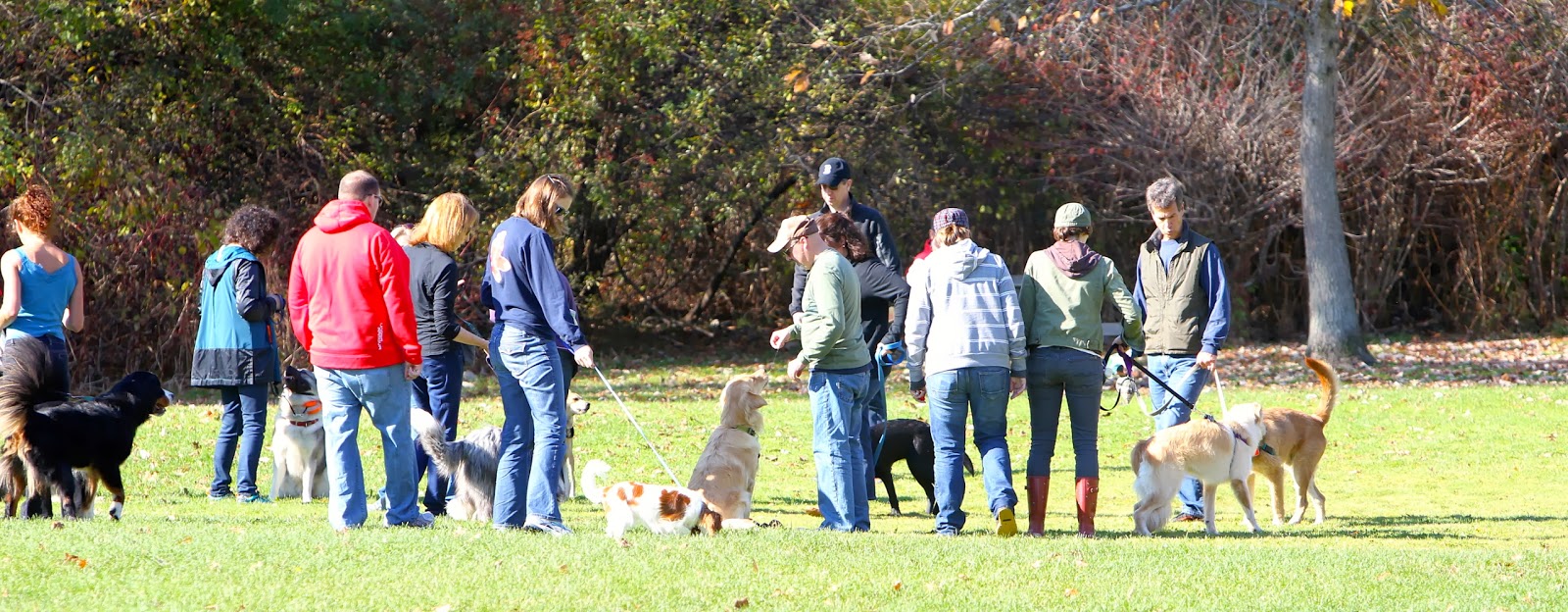
In the photo to the right, my Outdoor Adventure Class is open to dog friendly dogs. Dogs that have good emotional control, dogs that can sit and watch a dog go by without demanding to get to it, and dogs that are not overly pushy. If your dog is demanding to say "hello" to every dog that goes by, think about why that behavior is developing and where it is being reinforced. I hope to see you and your dog in a training class, while on-leash and enjoying each other's calm company!
Sunday, January 26, 2014
A growl is better than a bite!
I am often called to a home where a dog has nipped or bitten a child. I realize many think that a dog should NEVER use his teeth to resolve conflict with a human, and I agree in a perfect world, humans should NEVER hit a dog with their hand to resolve conflict either.
When there is a language barrier between two species, communication is often misunderstood and
conflict can easily follow. A three year old running at a dog with an object in his hand can be scary. How many times does your dog have to get up and move away to keep himself out of trouble before someone slows down the noisy moving child?
If by noon, the dog has looked away three times, offered a few tongue flicks, turned his head away five times and gotten up from his resting place four times to avoid conflict with the little tornado, then on the twelth time he may give a growl. I can not tell you how tolerant a dog should be, but I can tell you that they all have a threshold or a breaking point just like we humans do. I hope you recognize the growl as a low level warning that your dog is asking for space, and please do NOT punish the warning growl. In the future, I guarantee you would prefer your dog growl as a distance cue rather than use his teeth!
What other pet animal is so tolerant of children? Bunnies will squeek a warning and nip, cats will hiss and claw out, hamsters have also learned that nipping gets them safely back in their cage.
I am happy to report that many moms have asked me to speak to their children as a way to educate the child on how the dog is "feeling" when they are near. While some dogs enjoy having kids around, clearly others do not. Our responsibility is to step in and help our dogs feel safe so they do not have to resolve the conflict alone.
If you live or work with children, it is especially helpful for you to know your dogs signals that he or she may be feeling worried. That way you can intervene so that your dog never has to growl or nip, or reach his or her threshold point.
I am certain that the dogs in the above photo, who are being fed by the young girl in the stroller, are feeling pretty good being fed by a child that is not running around. However, if she were to get out of the stroller and run at these dogs, they would not feel the same way and one of them would need to be removed to keep him from hitting his threshold. With lots of positive associations and yummy treats, both these dogs can learn to enjoy children running around them.
So please, if you observe a dog feeling worried about a child moving nearby, remove either the child or the dog so that the dog is feeling safe and the dog does not get into trouble. An ounce of knowledge can go along way to helping both dogs and children grow up together in a positive way.
When there is a language barrier between two species, communication is often misunderstood and
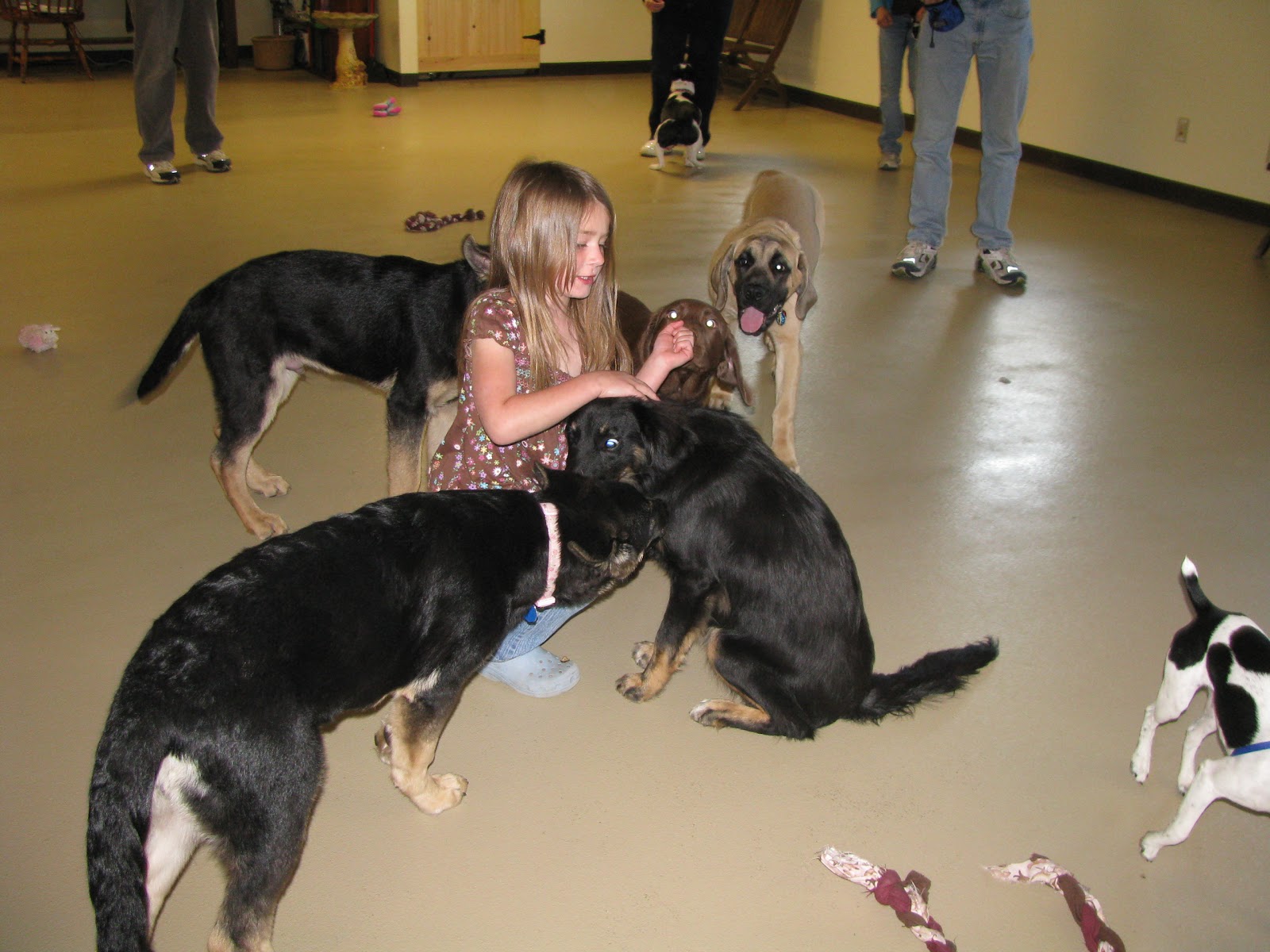 |
| Socializing pups with calm children is essential. |
If by noon, the dog has looked away three times, offered a few tongue flicks, turned his head away five times and gotten up from his resting place four times to avoid conflict with the little tornado, then on the twelth time he may give a growl. I can not tell you how tolerant a dog should be, but I can tell you that they all have a threshold or a breaking point just like we humans do. I hope you recognize the growl as a low level warning that your dog is asking for space, and please do NOT punish the warning growl. In the future, I guarantee you would prefer your dog growl as a distance cue rather than use his teeth!
What other pet animal is so tolerant of children? Bunnies will squeek a warning and nip, cats will hiss and claw out, hamsters have also learned that nipping gets them safely back in their cage.
 |
| I like this child, she is not moving and she feeds me! |
If you live or work with children, it is especially helpful for you to know your dogs signals that he or she may be feeling worried. That way you can intervene so that your dog never has to growl or nip, or reach his or her threshold point.
I am certain that the dogs in the above photo, who are being fed by the young girl in the stroller, are feeling pretty good being fed by a child that is not running around. However, if she were to get out of the stroller and run at these dogs, they would not feel the same way and one of them would need to be removed to keep him from hitting his threshold. With lots of positive associations and yummy treats, both these dogs can learn to enjoy children running around them.
So please, if you observe a dog feeling worried about a child moving nearby, remove either the child or the dog so that the dog is feeling safe and the dog does not get into trouble. An ounce of knowledge can go along way to helping both dogs and children grow up together in a positive way.
Saturday, January 11, 2014
New Year! New Puppy?
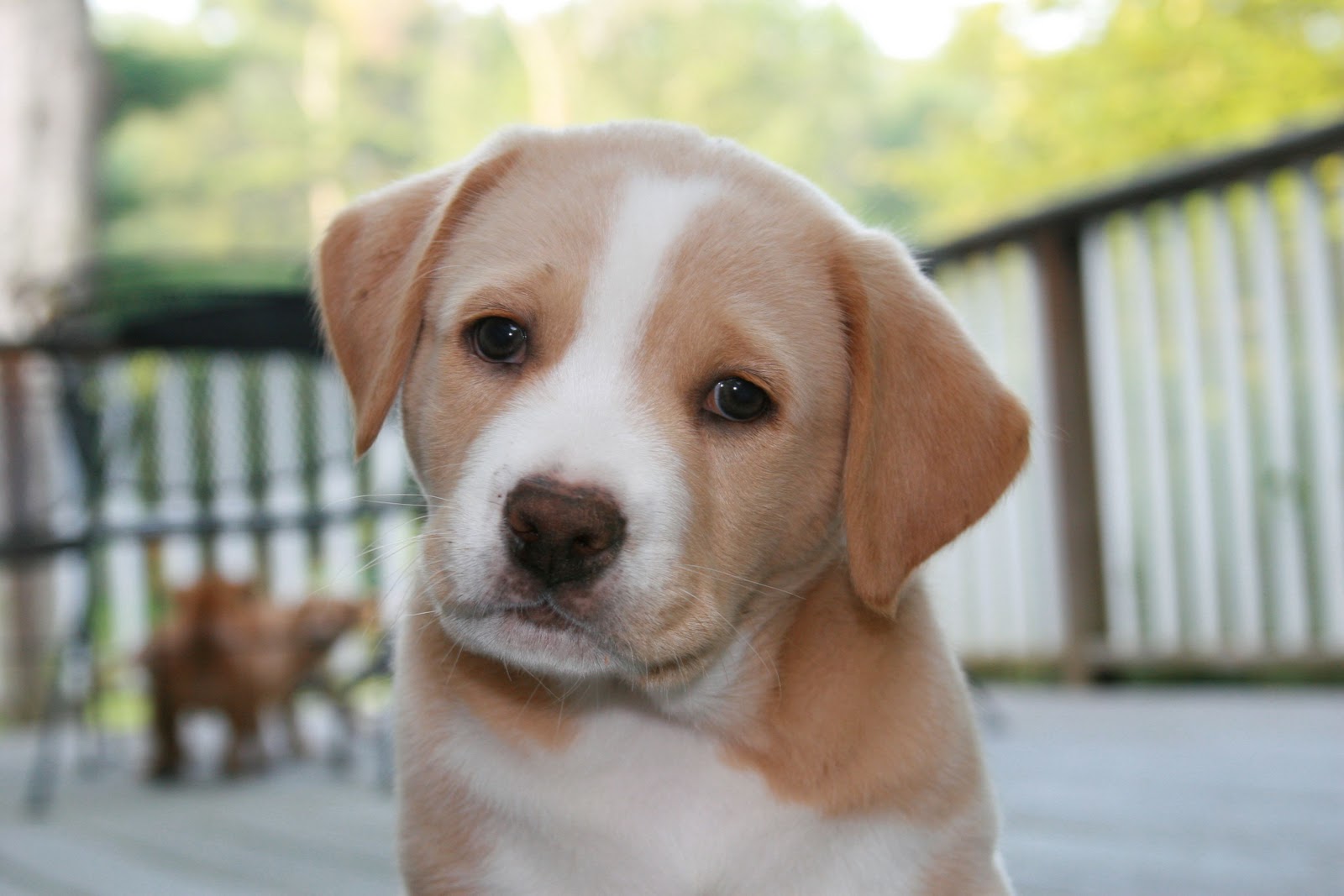
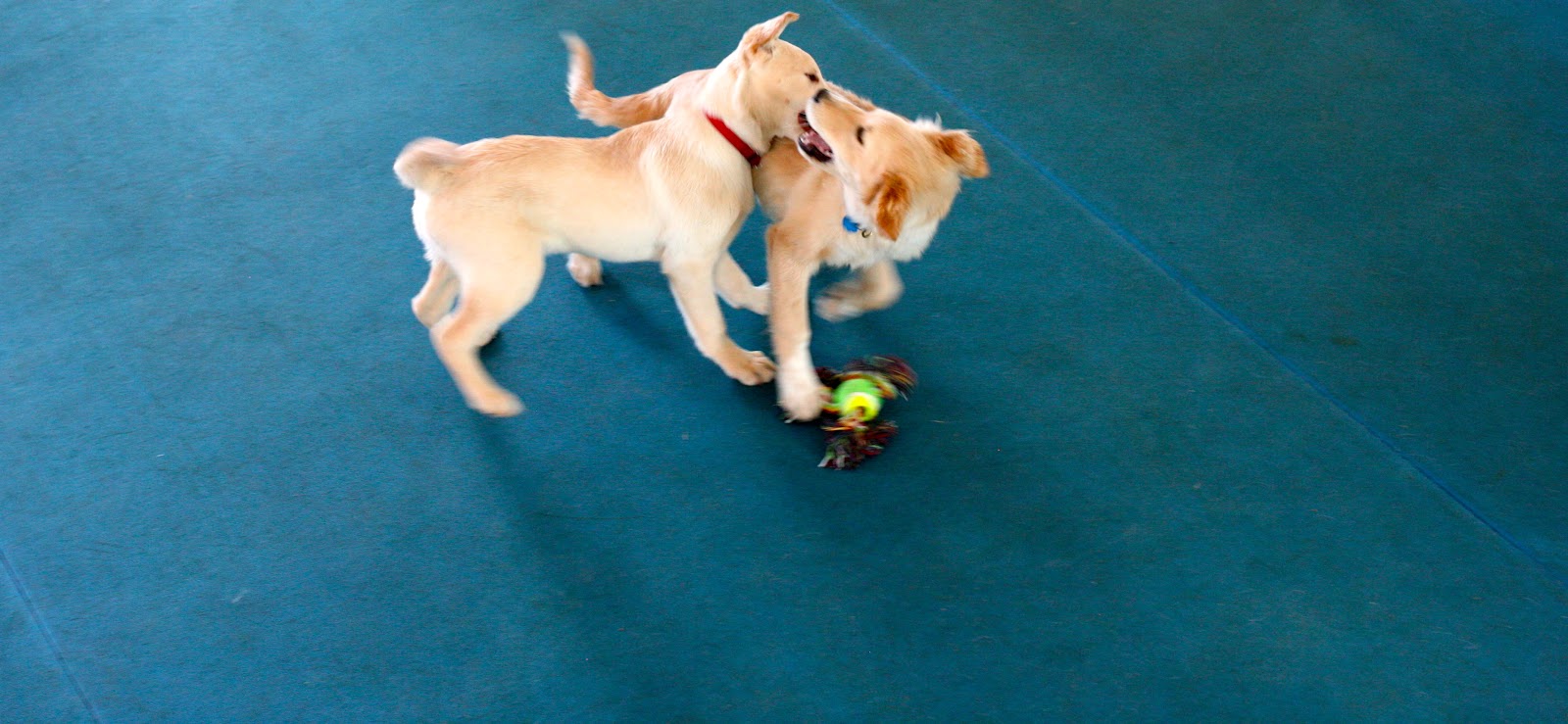
There are numerous Certified Pet Dog Trainers who can help you teach your pup appropriate behavior to succeed in a human home. Using Positive Reinforcement Communication and lots of patience, you will eventually have a wonderful family dog. To find a Certified Pet Dog Trainer in your area, investigate this link: CCPDT Certification for Pet Dog Trainers
I have 3 basic rules that I use often with new puppy owners:
 |
| Socialized dogs, enjoy life enrichment activities |
2. Reward your dog all day long for appropriate behaviors. Example, if you are going to let your pup out of his crate, then put your hand on the latch, if your puppy is calm open the crate and reward with freedom. If however he climbs on the door and barks at you. Take your hand off the latch and wait. When your puppy is calm or sitting, then you can open the door, if he tries to bolt out, close the door quickly, and wait until he sits or is calm, then reward with freedom!
3. Show your puppy what it is you prefer he do and reinforce it with something. For example, if your puppy bites on your hand, remove your hand and quickly replace it with a toy. Move the toy around on the floor and praise your puppy when he chases, and mouths the toy. If he bites your hand or arm let him know it hurts and replace it with a toy.
Keep in mind your puppy has been using his mouth to play with his siblings for weeks, so he is conditioned to do so. It is your job to help him learn good bite inhibition and socialize him well with new places, people and allow him to play with other puppies to help him learn good social skills.
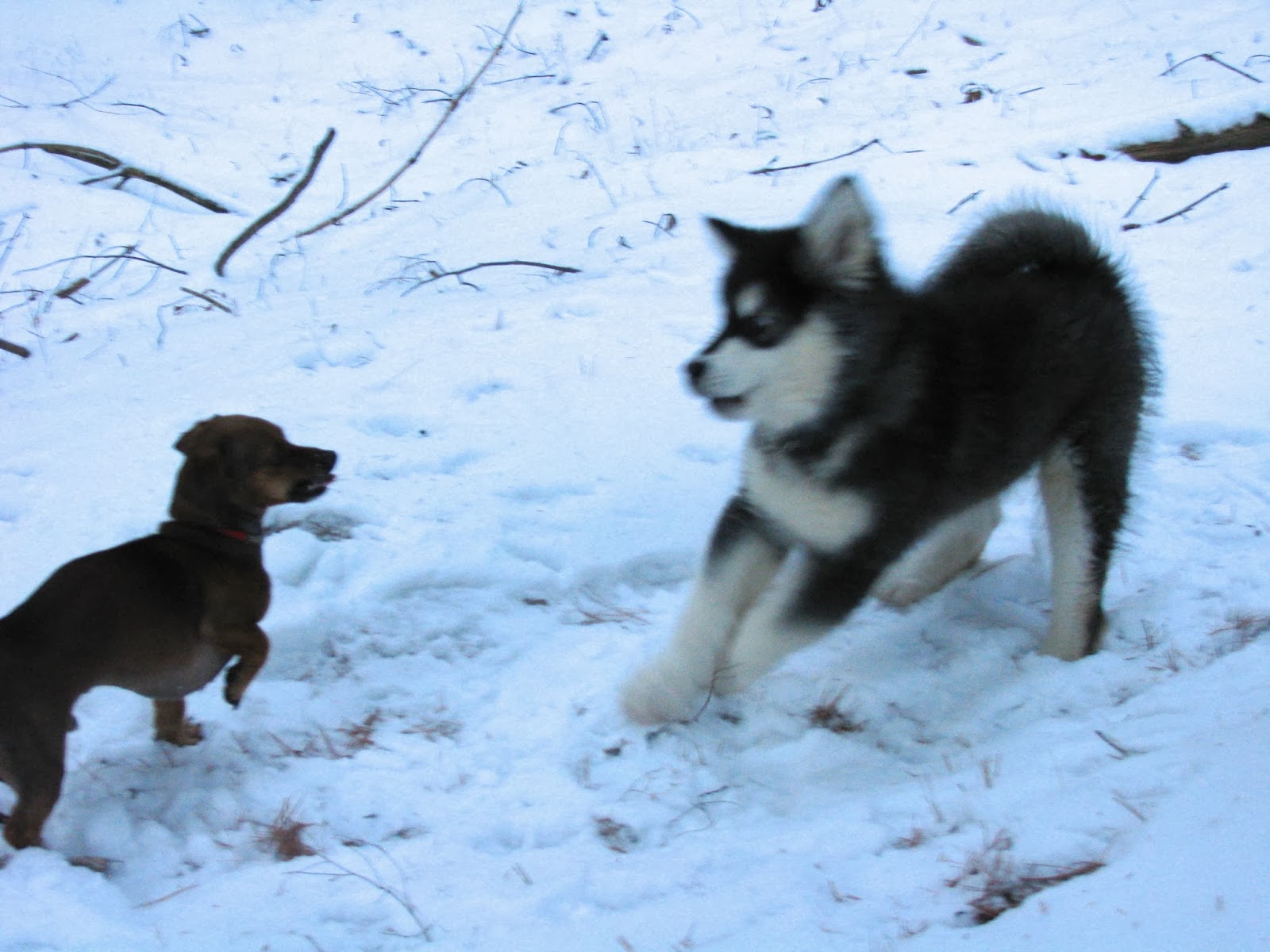 In this photo to the right, the 13 week old Malamute started to bark at the 4 year old Dachshund. This Dachshund is not happy about having to potty in 10 degree weather and so is not interested in playing. He signals this to the pup by closing his mouth, freezing his body, making direct eye contact and then begins to give a low growl directed at the puppy. The young pup quickly began to back away and go look for another playmate. Helping this Malamute have good social skills is important as we do not want him to grow in to a large bully.
To ensure your puppies behavior is shaped to be a calm family pet, consider a puppy socialization class taught by a professional! CBC Puppy Class Schedule
Subscribe to:
Posts (Atom)