Please click here to see my NEW website:
Canine Behavior Counseling, LLC with Judy Moore
Showing posts with label Training. Show all posts
Showing posts with label Training. Show all posts
Monday, May 18, 2015


Sunday, January 18, 2015

Wednesday, November 26, 2014
5 Body Postures, A Dog is Asking For Space

Level 1 distance Cues:
1. Dogs body is leaning away from the approaching hand.
2. Dogs paw is raised in a submissive manner.
3. Head is moving away asking for increased distance.
4. Eyes are avoiding the stranger
5. Mouth is closed, rather than open and relaxed.
Dogs often ask for distance in the only way they know how, but if the scary hand keeps coming, your dog may resort to a level 2 distance cue like a Growl, lip curl or show of teeth with a rigid body. I HOPE your dog growls rather than bites. Hence, do not punish the growl as it is an effective distance cue. When the dog is punished for growling, but is still afraid of that hand coming as it predicts pain, he may bite to protect himself.
Have you heard of someone who was bitten by a dog in the face while they were attempting to pet him or rub his belly? It is probable the dog used some distance cues before he resorted to a bite. Unfortunately, it is likely the human did not understand the signals and continued forward until the dog felt so threatened he did not have time to use a more moderate level one or level two response.
Dogs that are fearful or have been threatened by a previous human will be on guard and defensive. Canine behaviors asking for distance are far better than an attack with a bite, so please do not punish them. Rather, simply remove the approaching stimuli. Can you teach a dog a level 1 distance cue like a look away? Absolutely, but it takes time and patience -- and it is well worth the effort!
Wednesday, October 1, 2014
One Behavior You Must Teach Your Puppy?
To Sit? That is a nice default behavior, but not the most important one to teach.
To Come? Great behavior to have consistently for sure!
To Leave it? Awesome behavior to have, great on walks both on and off leash!
How about not to bite human flesh? Sounds pretty important to me! Bite inhibition is the technical term for a dogs ability to control the pressure they use when biting. If you could only teach your puppy or new rescue dog one behavior, please remember to teach him a soft mouth -- aka bite inhibition.
How? By giving your dog appropriate feedback. Over several days with the following positive techniques, your puppy will learn this life saving skill.
1. Hand feeding daily meals, release the food when your puppy is gentle or licks. If you feel teeth, wait until he softens, then reward.
Example: Say your pups name and when he look at you, offer a piece of food. Say your pups name and "come" offer a piece of food as a reward. Reward your puppy for coming and sitting 10 times per meal and you will have a solid sit and a softer mouth!
2. Play tug, using the rules of tug you can quickly help your puppy learn that when you feel teeth on your skin, playing stops. Remember, do not drop the toy or you could teach your puppy that biting is how they do get the toy. Instead, ask for a sit to begin the game, then say "take it" and play "tug" keeping the toy low to the ground. Next, put a treat to the pups nose and say "leave it" and
exchange with the food while putting the toy behind your back. Repeat, sit, take it, tug, leave it.
3. Body handling your puppy with a soft, flat gentle hand. If your puppy bites your hand, then let your hand go limp, dead like, and wait until the puppy removes his mouth from your hand. Repeat slowly and gently as your pup learns that hands predict good gentle scratches and massaging. Some puppies respond if you scream, but some thing you are simply playing, so this feedback may help and it may not as all puppies are different.
4. Allowing your puppy playtime with another friendly dog or in a puppy group. Playing with other pups will surely help your puppy learn
not to bite too hard, many pups learn to use a soft mouth when playing with their mother, however some pups miss out on this lesson and will therefore learn it while playing with other puppies and of course playing with you.
Teaching your puppy a soft mouth or good bite inhibition is the ONE most important behavior you need to teach. Remember, your pup will not stop using his mouth on you and your clothes in 1 day as he has been using it with his siblings for 8 weeks, be patient and give your puppy the feedback he so needs to be able to live with humans.
What should you not do? Scare your puppy or teach him that human hands are to be feared, as this tactic will most likely make him want to bite hands more. Why? Science has taught us that dogs who are handled in a physical or rough manner are more often to bite later in life. Science has also taught us that aggression breeds more aggression.
If you do not want your puppy to use his mouth to resolve conflict, then please do not use your hands to resolve conflict. Science has taught us that rough hands on a pup, will create unwanted behavior changes as the pup matures. Example: Submissive peeing, over the top wiggly greetings, worse mouthy behavior, biting later as an adolescent dog, growly and avoidance behaviors.
For a reference on teaching a soft mouth, refer to Sophia Yin's Low Stress Handling techniques
Dr. Sophia Yin, Low Stress Handling. Although Sophia passed away just yesterday, she will always be a source to reference because she educated those of us in the Pet Industry that the emotional well being of the animal is essential to avoiding unwanted behavior changes.
To Come? Great behavior to have consistently for sure!
To Leave it? Awesome behavior to have, great on walks both on and off leash!
 |
| hand feeding for good behavior |
How about not to bite human flesh? Sounds pretty important to me! Bite inhibition is the technical term for a dogs ability to control the pressure they use when biting. If you could only teach your puppy or new rescue dog one behavior, please remember to teach him a soft mouth -- aka bite inhibition.
How? By giving your dog appropriate feedback. Over several days with the following positive techniques, your puppy will learn this life saving skill.
1. Hand feeding daily meals, release the food when your puppy is gentle or licks. If you feel teeth, wait until he softens, then reward.
Example: Say your pups name and when he look at you, offer a piece of food. Say your pups name and "come" offer a piece of food as a reward. Reward your puppy for coming and sitting 10 times per meal and you will have a solid sit and a softer mouth!
 |
| Playing Tug can teach a soft mouth |
exchange with the food while putting the toy behind your back. Repeat, sit, take it, tug, leave it.
 |
| flat pan cake hands are non threatening |
4. Allowing your puppy playtime with another friendly dog or in a puppy group. Playing with other pups will surely help your puppy learn
 |
| Puppy play group |
Teaching your puppy a soft mouth or good bite inhibition is the ONE most important behavior you need to teach. Remember, your pup will not stop using his mouth on you and your clothes in 1 day as he has been using it with his siblings for 8 weeks, be patient and give your puppy the feedback he so needs to be able to live with humans.
What should you not do? Scare your puppy or teach him that human hands are to be feared, as this tactic will most likely make him want to bite hands more. Why? Science has taught us that dogs who are handled in a physical or rough manner are more often to bite later in life. Science has also taught us that aggression breeds more aggression.
If you do not want your puppy to use his mouth to resolve conflict, then please do not use your hands to resolve conflict. Science has taught us that rough hands on a pup, will create unwanted behavior changes as the pup matures. Example: Submissive peeing, over the top wiggly greetings, worse mouthy behavior, biting later as an adolescent dog, growly and avoidance behaviors.
For a reference on teaching a soft mouth, refer to Sophia Yin's Low Stress Handling techniques
Dr. Sophia Yin, Low Stress Handling. Although Sophia passed away just yesterday, she will always be a source to reference because she educated those of us in the Pet Industry that the emotional well being of the animal is essential to avoiding unwanted behavior changes.
Tuesday, July 22, 2014
Don't Shoot the Dog - Jackpots Revised
Many of you have read Karen Pryer's book, Don't Shoot the Dog It is an educational book for parents as well as dog owners. After 20 years, Karen explains how the use of jackpots can work when used effectively. The below insert is straight from Karen's Blog and is worth reading:
Remember, though, that no one is always right. We all keep learning things all the time, revising and adding to what we knew before. That's one of the joys of science and a valuable phenomenon in the clicker training world.
Looking back at the jackpot section in Don't Shoot the Dog, now, twenty years after it was written and six years after the revision supervised by Murray Newman, I think that I failed to differentiate between jackpots as I see them, and another tool altogether: the non-contingent reward.
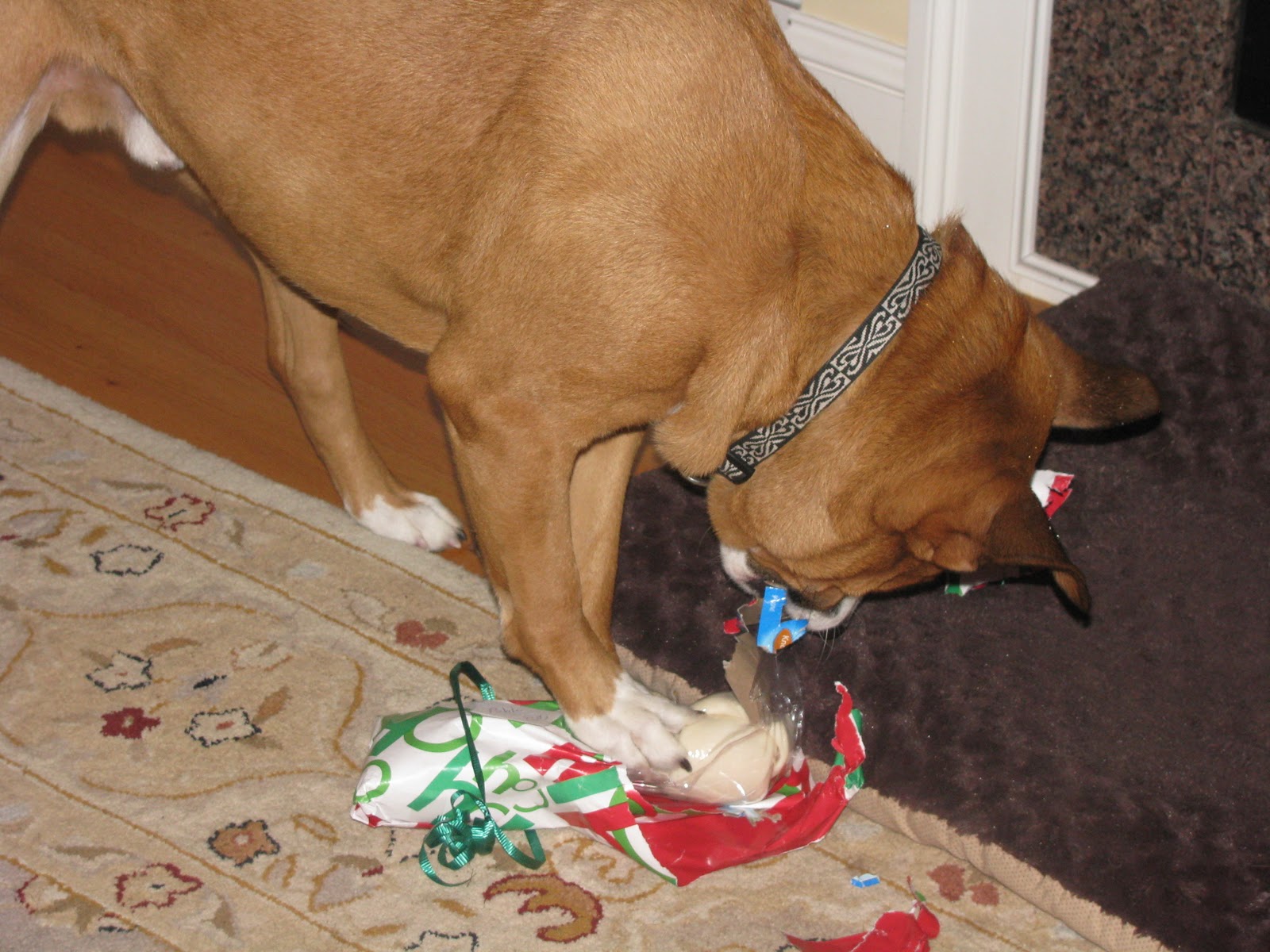 |
| A non-contingent reward "just because" |
A non-contingent reward is also something you get by surprise, but it is not associated with any particular behavior. One example in the book was the two free fish we gave to a discouraged dolphin, which perked her up and set her to trying to earn reinforcement again. Another example in the book was the ticket for ten free riding lessons that my parents bought me when, at sixteen, I was behaving poorly for weeks on end. It instantly corrected my bad mood. I included these as jackpots, but they were not; they were both examples of a non-contingent reward. The most powerful use of a non-contingent reward is to counteract the effects of an extinction curve; I know the dolphin in question was undergoing extinction of a bunch of operant behaviors; probably this sulky teenager was, too. Getting the news that good things are still available revived the efforts to seek reinforcement again.
Like the jackpot, a non-contingent reward is a tool to use rarely. And, like a jackpot, if it is going to work, you only need to do it once.
Saturday, July 5, 2014
Dog Aggression and Communication Signals
Why is my dog so aggressive to other dogs? This can usually be diagnosed with a detailed history: no play ever, hereditary, mother was sick or a guarder, or over socialized with aggressive or rough playing dogs.
Cycle of On-Leash Aggression (created problem from humans), as described in the Culture Clash, by Jean Donaldson, "The Bully dog" is often kept away from other dogs for long periods of time, he is usually rude with crude behavior brought on by a super motivated greeting as a result of deprivation when meeting other dogs, and has poor social skills. The owner is alarmed by intensity and tightens the leash and get’s too excited or nervous when interactions occur. High arousal, lack of social skills, scuffles with defensive dogs can occur. Barrier frustration such as windows, fences and leashes can increase the dogs frustration which makes you want to "correct" the behavior, which = punishment which = more Aggression = total isolation.
I believe dogs need time to express their intentions before they greet unknown dogs. Personalities among dogs differ as much as a classroom full of kindergarteners, therefore, expecting your dog to like every dog they meet is not that simple. Some dogs are very soft and have appropriate greetings, these are the dogs who are able to visit the beach and off leash parks without incident.
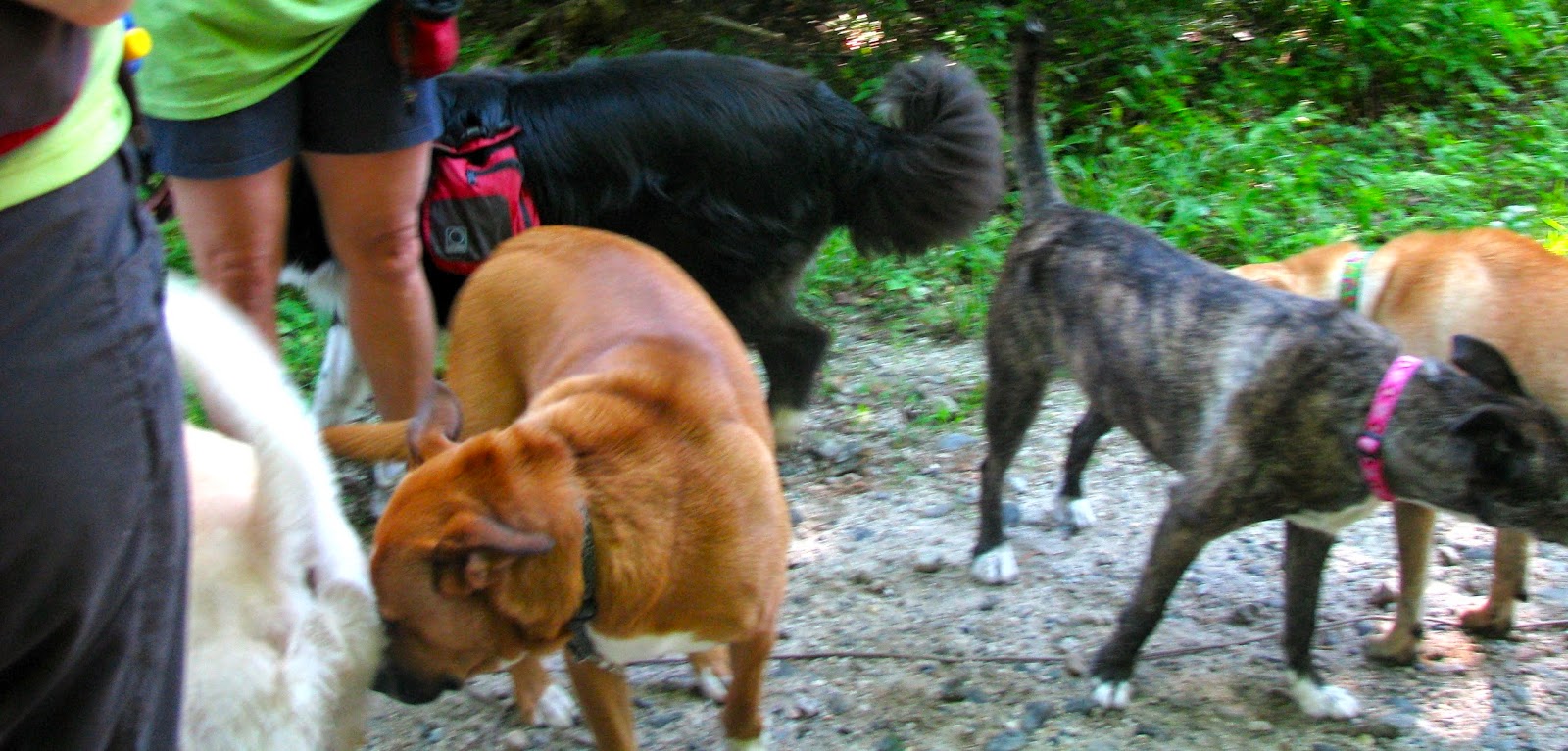 Helping your dog greet new dogs much slower will give your dog important and necessary information about the other dogs intentions. To the left, you see the brown dog in the middle of this pack at a local park. He is standing quite still with head lowered, visible tension in his jaw, mouth closed, low tail, ears back and a his hair beginning to stand up on his back. He is very uncomfortable about being so close to a strange dog and was called away quickly to avoid any conflict. This particular dog's behavior tells us humans that he needs a much slower greeting with new dogs.
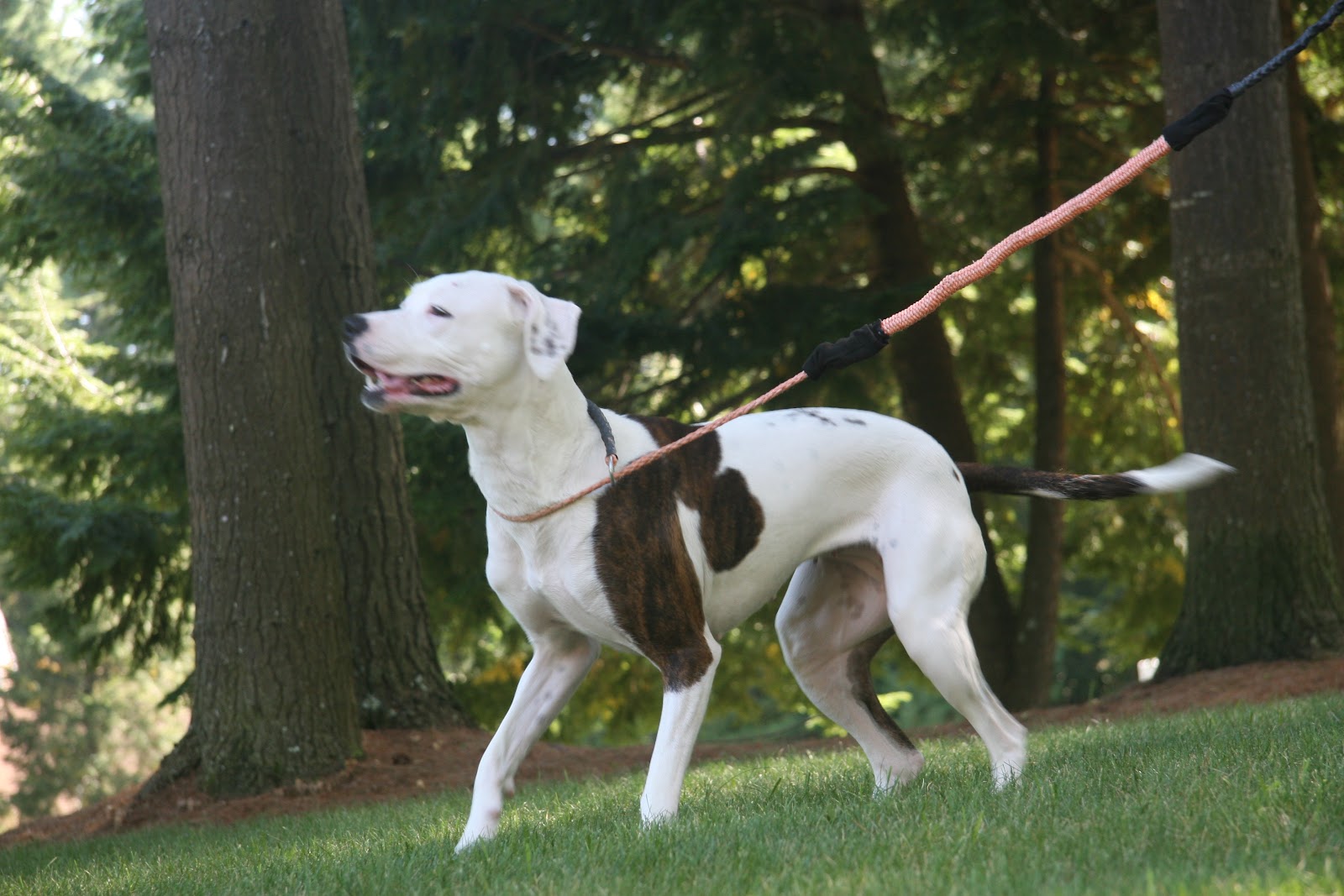 In this photo to the left , this beautiful girl has just seen a new dog and is reading the other dogs intentions and clearly expressing hers as well. Note the open mouth and soft eyes, lowered tail which is in motion and she is beginning to offer a play bow. While she is expressing intentions that she does want to greet the new dog, she is very excited and the other dog is a bit alarmed by her intense need to visit. After about 30 minutes of walking near each other, this girl and the other dog became play mates as you will see in the video below.
If you have a new puppy, please keep him/her safe and find nice friendly dogs to socialize with. Your dogs friends will influence his/her behavior! Just like you were influenced by those you visited with as an adolescent. So, know who your dogs friends are and watch for signs of fair play between the two and you let's try to prevent aggression from spreading.
Tuesday, December 17, 2013
Canine Body Language Seminar
Presented by
Judy Moore ACDBC
Associate Certified Dog Behavior Consultant
When: Saturday, January 4, 2014
Where: Poetic Gold Farm
7 Trillium Lane, Falmouth, ME
Time: 10am- noon
Fees: Dogs attending for evaluation $75
Attendees for audit $25
 |
| who is the most worried here? |
I'll will review how canines communicate with each other and how they try to communicate with us. You will learn to identify signs of canine stress and fear which can assist you in preventing unwanted behaviors such as a snap or bite. Many dogs offer distance cues, however we as humans miss them; therefore many dogs resort to a level 3 bite because no one respected the level 1 or 2 distance cue.
If you work with, own, or live with a dog who exhibits shy or skittish behavior, you will benefit from a basic understanding of how they "speak" to us with body language.
Live Demo dogs and Q&A discussion included!
For more information or to attend contact Judy at Judyamoore@mac.com
Wednesday, December 4, 2013
Associate Certified Dog Behavior Consultant now available in Portland Maine
BIG NEWS!!
I am very proud to announce my hard work and continued education has earned me the title of
Associate Certified Dog Behavior Consultant- ACDBC. I am the only ACDBC south of Bangor, and the only one in Portland, Maine. My desire to better understand dog behavior and behavior problems is on going and I will continue to study and learn to better help my clients.
For clients in the Bangor area, please reach out to Don Hanson, of Green Acres Kennels as he is a CDBC and a person I myself reach out to. Welcome to Green Acres Kennel Shop - Green Acres Kennel Shop
Already have a dog trainer? Please be sure you are using someone certified by a recognizable organization such as:
APDT the Association of Pet Dog Trainers
IAABC International Association of Animal Behavior Consultants
CCPDT Certification Council for Pet Dog Trainers
For help in setting you and your dog up for success, I certainly recommend a Certified positive reinforcement trainer.
I am very proud to announce my hard work and continued education has earned me the title of
 |
| Happy clients and well behaved dogs |
For clients in the Bangor area, please reach out to Don Hanson, of Green Acres Kennels as he is a CDBC and a person I myself reach out to. Welcome to Green Acres Kennel Shop - Green Acres Kennel Shop
Already have a dog trainer? Please be sure you are using someone certified by a recognizable organization such as:
APDT the Association of Pet Dog Trainers
IAABC International Association of Animal Behavior Consultants
CCPDT Certification Council for Pet Dog Trainers
For help in setting you and your dog up for success, I certainly recommend a Certified positive reinforcement trainer.
Monday, November 25, 2013
Pets for Vets Program Launched here in Portland, Maine
I am happy to announce that Portland, Maine has an official Chapter for the Pets for Vets Program and I am the official trainer of the canines for this wonderful program. I will be assessing, training and matching dogs with Veterans in need of a companion dog.
Tom Targett, Chapter Director is to be recognized and thanked for his dedication in getting this Portland Chapter off and running. Tom is an ideal Director as a returning Veteran himself and his understanding and love of dogs.
Our mission at the Pets for Vets program is to help support veterans while providing a second chance for shelter pets by rescuing, training and pairing them with veterans right here in our community who could benefit from a companion animal.
I am pleased to inform you that we will be introducing our first match early in December! I am not sure who is more excited about this upcoming match? Tom, my self or our Veteran, we are all simply joyful to be a part of this first match!
For further information about our new Portland, Maine Chapter, contact:
Thomas Targett - tomt521@aol.com
http://pets-for-vets.com/category/northeast/portlandme/pme-news/
Tom Targett, Chapter Director is to be recognized and thanked for his dedication in getting this Portland Chapter off and running. Tom is an ideal Director as a returning Veteran himself and his understanding and love of dogs.
Our mission at the Pets for Vets program is to help support veterans while providing a second chance for shelter pets by rescuing, training and pairing them with veterans right here in our community who could benefit from a companion animal.
I am pleased to inform you that we will be introducing our first match early in December! I am not sure who is more excited about this upcoming match? Tom, my self or our Veteran, we are all simply joyful to be a part of this first match!
 |
| Each Monday from November 18 to December 10, from 6 – 8 p.m. Pets for Vets, Maine Chapter will be near the Santa photo area at the Maine Mall in Portland. |
For further information about our new Portland, Maine Chapter, contact:
Thomas Targett - tomt521@aol.com
http://pets-for-vets.com/category/northeast/portlandme/pme-news/
Saturday, November 2, 2013
Good Things Happen...
When I introduce a new rule structure to my dogs or to my clients dog, I make sure good things happen when the dog performs the wanted or desired behavior. We can all agree that consequence
drives behavior in all of us, but I really want you to think of the consequence as a positive and rewarding one. It is not just that I believe it works, it is scientifically proven that if a dog does a behavior and what follows is rewarding, the behavior will be repeated. This repeated behavior performed several times per day and continued over a few weeks becomes a desired habit. Is that not what we all are trying to do? Shape our dogs behavior into good habits?
Here are a few examples you might want to try:
1. Good things happen when you are on your mat!
Simply have your dog near you with a handful of treats and your dog's mat. Lay the mat on the floor and when your dog sniffs it, looks at it or step on it, say "yes" and drop a treat or two between his paws. Ask your dog to get off the mat, pick it up and walk a few steps with it in your hand. Repeat the process of laying the mat down and rewarding your dog for moving onto the mat. You can initially walk around the mat and stop while facing your dog with the mat between you two. When he steps onto it, say "yes" and reward generously. Initially, put the mat away between sessions and play this game a few times per day. When you see your dog get excited that you are about to lay the mat down, add a cue like "go to your mat" just before you lay the mat down. Once your dog is walking on the mat quickly, wait on the "yes" and see if your dog offers you a sit, then say "yes" and reward. Eventually your dog will offer you a down and then you can jackpot this behavior.
To maintain this behavior of "go to your mat" you will want to randomly reward your dog when you see him go to his mat without being asked. This can be a good massage, kong time, bone time, yummy treat or a good scratch, whatever your dog finds rewarding. I use this each morning as we enter the kitchen, each of my dogs will move towards their mat and I will eventually feed them while they are on their mat waiting patiently. I no longer ask them to go to their mat, they know going to their mat predicts they will get fed, which is rewarding to them and nice for me not to have 12 paws under my feet!
2. Good things happen when you look at me!
Training your dog to perform a simple behavior is nearly impossible without first having your dog's attention. If your dog is not quick to look at you, teach your dog that looking at you is ALWAYS followed by a reward.
Again, begin with a handful of your dogs yummy treats and your dog near you, maybe on a leash if necessary. Say your dog's name, and when he looks at you say "yes" and toss him a treat. Wait a few seconds and repeat, saying his name, and marking the moment his head turns towards you and rewarding.
Another game that works well to get your dogs attention is to simply sit in a chair with some treats in hand. Toss a treat on the floor and when your dog eats the treat he will most likely look at you to see if more food is flying. When he looks your way, say "yes" and toss another over his head. When he eats the treat he will come near you again and you can smile and say "yes" when he looks at you and repeat the process. Your dog will learn that looking at you predicts Good things happen, and will repeat the behavior.
If you are reading this Blog, then I assume you have a dog or are thinking about getting a dog. My hope is that you are a positive influence in training your dog and not one who feels they need to dominate a dog. Consider how effective science-based training is, and how your dog "feels" when you are training. I hope your dog feels good when you are near, when he looks at you and when you reach to touch him. If not, read more of my blog to learn how to train your dog while also having a happy, healthy and trusting relationship.
Here are a few examples you might want to try:
1. Good things happen when you are on your mat!
 |
| Good things happen when you go to a mat, these two are chewing on stuffed kongs. |
To maintain this behavior of "go to your mat" you will want to randomly reward your dog when you see him go to his mat without being asked. This can be a good massage, kong time, bone time, yummy treat or a good scratch, whatever your dog finds rewarding. I use this each morning as we enter the kitchen, each of my dogs will move towards their mat and I will eventually feed them while they are on their mat waiting patiently. I no longer ask them to go to their mat, they know going to their mat predicts they will get fed, which is rewarding to them and nice for me not to have 12 paws under my feet!
 |
| How does your dog feel when he looks at you? |
Training your dog to perform a simple behavior is nearly impossible without first having your dog's attention. If your dog is not quick to look at you, teach your dog that looking at you is ALWAYS followed by a reward.
Again, begin with a handful of your dogs yummy treats and your dog near you, maybe on a leash if necessary. Say your dog's name, and when he looks at you say "yes" and toss him a treat. Wait a few seconds and repeat, saying his name, and marking the moment his head turns towards you and rewarding.
Another game that works well to get your dogs attention is to simply sit in a chair with some treats in hand. Toss a treat on the floor and when your dog eats the treat he will most likely look at you to see if more food is flying. When he looks your way, say "yes" and toss another over his head. When he eats the treat he will come near you again and you can smile and say "yes" when he looks at you and repeat the process. Your dog will learn that looking at you predicts Good things happen, and will repeat the behavior.
If you are reading this Blog, then I assume you have a dog or are thinking about getting a dog. My hope is that you are a positive influence in training your dog and not one who feels they need to dominate a dog. Consider how effective science-based training is, and how your dog "feels" when you are training. I hope your dog feels good when you are near, when he looks at you and when you reach to touch him. If not, read more of my blog to learn how to train your dog while also having a happy, healthy and trusting relationship.
Saturday, September 28, 2013
Puppies First Impressions
When you bring your puppy home, you want to raise him or her to be the best Family Dog possible. We all have good intentions when raising a puppy, however there are some mis-guided and uneducated people who will tell you that you need to dominate your dog so they respect you. This is not only poor advice, once it is done, you may not be able to take it back.
 |
| I am bonding these small pups to human contact. |
Imprinting is life long and can not be overcome; Dr. Konrad Lorenz first studied imprinting in birds, primarily geese in 1935, so this concept is not new. What he found was that different species of animals have an early/critical period in their learning development which cannot be reversed.
 |
| Helping puppies associate hands as being gentle is crucial for a soft mouth |
Imprinting establishes an individual animals preference for a certain species. Hence, if a puppy in its later stages of his critical period is subjected to a traumatic event such as rough handling by its breeder, vet, or trainer, it may result in a defensive attack or behavior pattern when the animal is touched in a certain way -- even a year or more later in the dogs life.
Common to trainers is the puppy that is fine with Dad, but bites hard at mom or the children in the home. This scenario is all too common when Dad has used his hands to reprimand the pup in a forceful way for biting (which is a normal way for a pup to interact). While the pup does obviously require feedback on what to sink his teeth into, too often Dad holds the pups mouth shut, pushes his lip onto a tooth, scruffs the pup or holds him down. All of these actions will make this puppy bite others in the family more often and with greater force. Another negative side effect is the 10 month old puppy who cannot sit still for petting. He is too nervous and worried to just sit, so he wiggles and wiggles his body in an "over the top" appeasement behavior pattern, all the while turing his butt towards the person and lowers his head to ward off the scary behavior which he had to endure as a young pup.
Now that you know how important First Impressions are to your puppy, always be a Positive influence in your puppies life. Not only for the well being of your puppy, but for those who may be learning from your example also.
Friday, August 30, 2013
7 Day Challenge
Many clients ask; "How do I train my dog?" First and foremost, to train a dog, you must have the dog's attention! Can you get your dog to sit for one minute without a leash on? If so, then you have already
learned how to get your dogs attention -- wonderful! If not, then I ask you to take my 7 day challenge!
I ask that you hand feed your dog every meal for 1 week, every meal, and see how your relationship changes in just 7 days. You might keep a journal and really see your dogs attention on you grow with enthusiasm and duration in many different behaviors.
If your dog can already sit and stay in your home, then I suggest you take your training on the road and
see if your dog can perform the same behaviors in your front yard, down the street, and at the local park. Training in environments with lots of stimulation takes practice, tasty motivation and often lots of patience. If your dog cannot sit and stay in your yard, then you simply are not ready to ask for this emotional control at the park. Set your dog up for success and begin developing good habits in just one week!
Ideas for training: come, come/sit, shake, down, leave it, touch, roll over, high five, speak, sit/stay, down/stay, wait, watch me, you get it!
What if my dog will not look at me? Simply use his meal mixed with some yummy treats and sit down in a chair. Toss a treat on the floor near your dog, while he is eating the treat, say his name in a happy tone. When he looks at you say "yes" and toss another treat. Continue playing this game for the entire meal. The next day you can try playing this game outside or add different criteria like "Fido come" when he is eating the treat and reward by tossing another treat away from you.
Have fun, motivate using your happy pitch and smile at your dog every time he looks at you. If you are frustrated and using a firm tone, he may comply but I'd bet he avoids looking at you. I want your dog to offer behaviors such as coming to you because it makes him feel good, not come to you to avoid a correction. There is no relationship building in correction training, as the dog is simply performing a behavior to avoid the punishment -- Life is Not Good for these dogs! So, try rewarding with every meal for 7 days and I am sure you will see a new relationship building and love it!
 |
| Puff in a down stay, I rewarded him with food about 6 times in 1 minute to help him build duration in this behavior. |
I ask that you hand feed your dog every meal for 1 week, every meal, and see how your relationship changes in just 7 days. You might keep a journal and really see your dogs attention on you grow with enthusiasm and duration in many different behaviors.
If your dog can already sit and stay in your home, then I suggest you take your training on the road and
 |
| Focus here at 4 months. |
Ideas for training: come, come/sit, shake, down, leave it, touch, roll over, high five, speak, sit/stay, down/stay, wait, watch me, you get it!
 |
| Outdoor Adventure dogs have good focus. |
What if my dog will not look at me? Simply use his meal mixed with some yummy treats and sit down in a chair. Toss a treat on the floor near your dog, while he is eating the treat, say his name in a happy tone. When he looks at you say "yes" and toss another treat. Continue playing this game for the entire meal. The next day you can try playing this game outside or add different criteria like "Fido come" when he is eating the treat and reward by tossing another treat away from you.
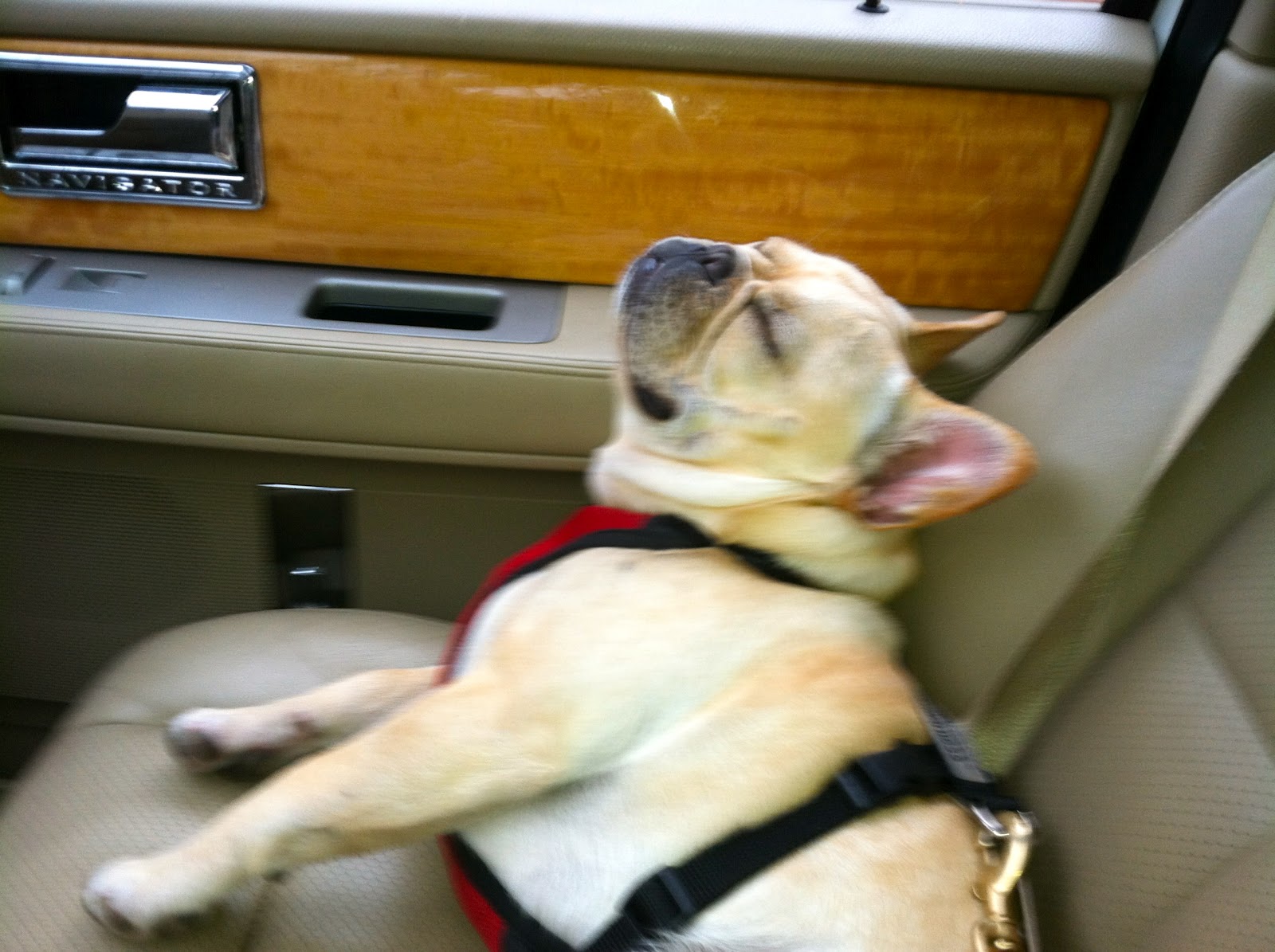 |
| After training! |
Friday, June 28, 2013
What Does Stress Look Like?
When I think of unwanted behavior, I think of stress as the two are often related.
My goal here is to help you identify your dogs stress signals so you can get them help before this stress causes unwanted behavior. Science clearly states that stress leads to health problems, negatively affect relationships with others and can also make us grumpy, irritable, less tolerant and even aggressive.
Is it true if we humans are stressed our dogs can sense it? Yes, when we feel worried, anxious or angry, our dogs will certainly be effected in some way. Different dogs will react differently to mental and physical pressures in their environment.
How many of us often turn to physical exercise to relieve stress or tension felt from our environment. Is your dog able to go for a daily jog to relieve the stress he carries around or is he confined to run the fence line and bark in frustration becoming more and more aroused. Does he destructively chew your furniture, pace wildly and mouth your arms and hands when you enter? You may perceive this mouthy greeting as excitement, but it is stress.
Signs of Stress come in many different forms:
Environmental triggers are everywhere, who is
present, how many stimuli, if they are approaching slowly or quickly, how your dog feels at that moment, what smells are near, what he sees and hears are all triggers that can cause your dog stress and they are constantly effecting your dogs behavior.
Knowing the signs of stress in your dog is essential to keep him safe, happy and healthy.
For more information consider reading Stress in Dogs by Marina Scholz and Clarissa Von Reinhardt, well worth the time to read.
 |
| This dog is worried |
 |
| Go Away! |
Is it true if we humans are stressed our dogs can sense it? Yes, when we feel worried, anxious or angry, our dogs will certainly be effected in some way. Different dogs will react differently to mental and physical pressures in their environment.
How many of us often turn to physical exercise to relieve stress or tension felt from our environment. Is your dog able to go for a daily jog to relieve the stress he carries around or is he confined to run the fence line and bark in frustration becoming more and more aroused. Does he destructively chew your furniture, pace wildly and mouth your arms and hands when you enter? You may perceive this mouthy greeting as excitement, but it is stress.
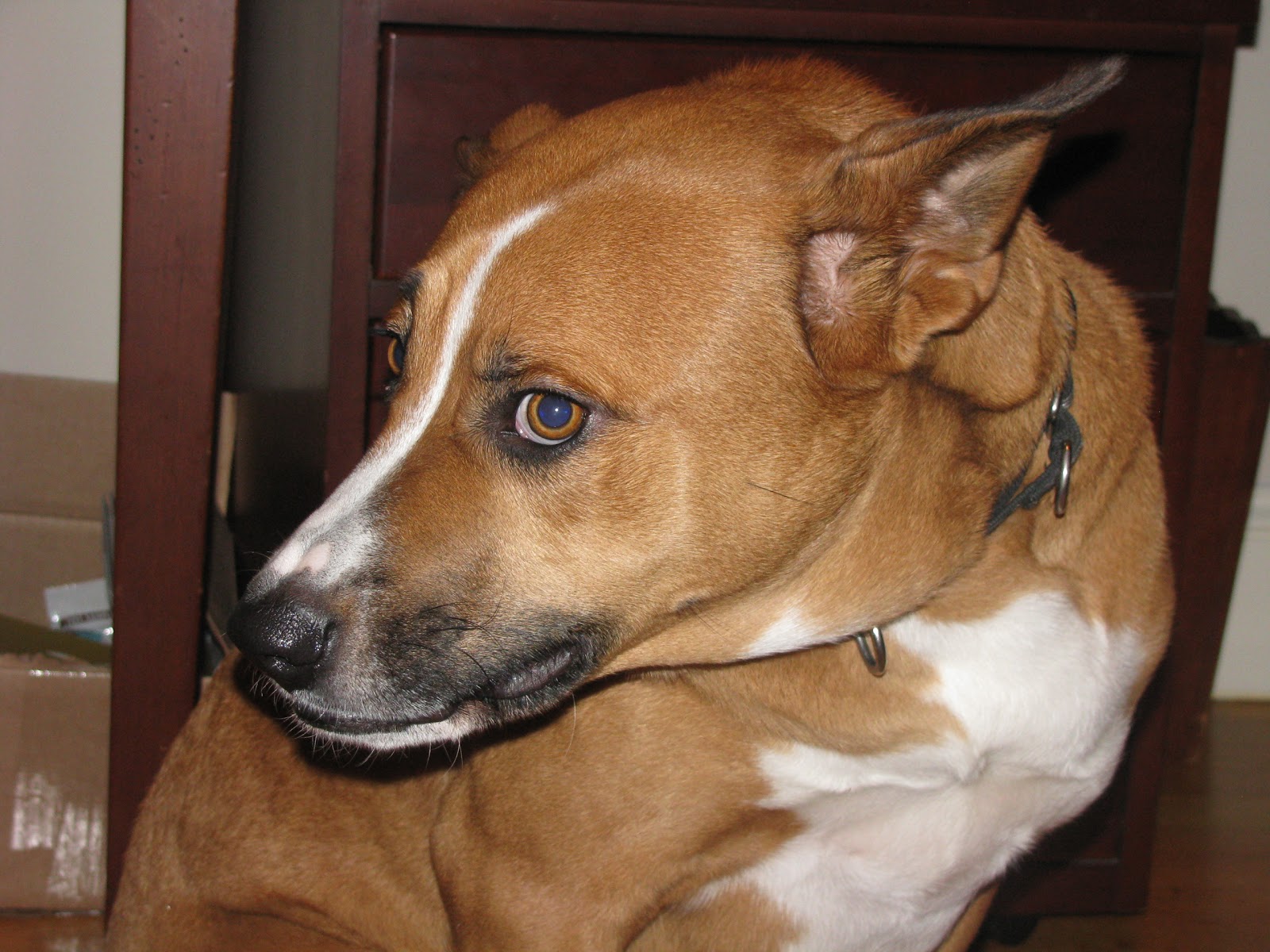 |
| An unfamiliar dog has approached to the right, this mix is looking away to avoid conflict. |
- Does your dog ever bark rapidly, scan the environment for a threat, pace back and forth, tremble, chew in a ripping or destructive manner, pant when not tired, flatten his ears back, lower his head when approached (guilty appearance), cower or urinate when you or anyone else approaches, hide between your feet, growl, lick his lips when not eating, yawn when not tired, turn his nose away from his favorite treat when in an unfamiliar environment. Urinate or defecate when arriving at a new home, or training center.
- Young adolescent pups may playfully mount dogs or humans or do this as a sign of stress as is biting the leash and excessive mouthing of human hands. Exaggerated self grooming which can cause hair loss, sudden outbreak of dander can also be stress related.
- Does your dog often begin to sniff the ground when meeting new dogs, stop to scratch just as a greeting is about to occur, avoids the new dog completely? We know stress can effect health, stress that continues over a period of time can cause a dogs immune system to become fragile due to increased cortisol in the system. Have you ever considered that a dogs unpleasant body odor or bad breath can be the result of high stress.
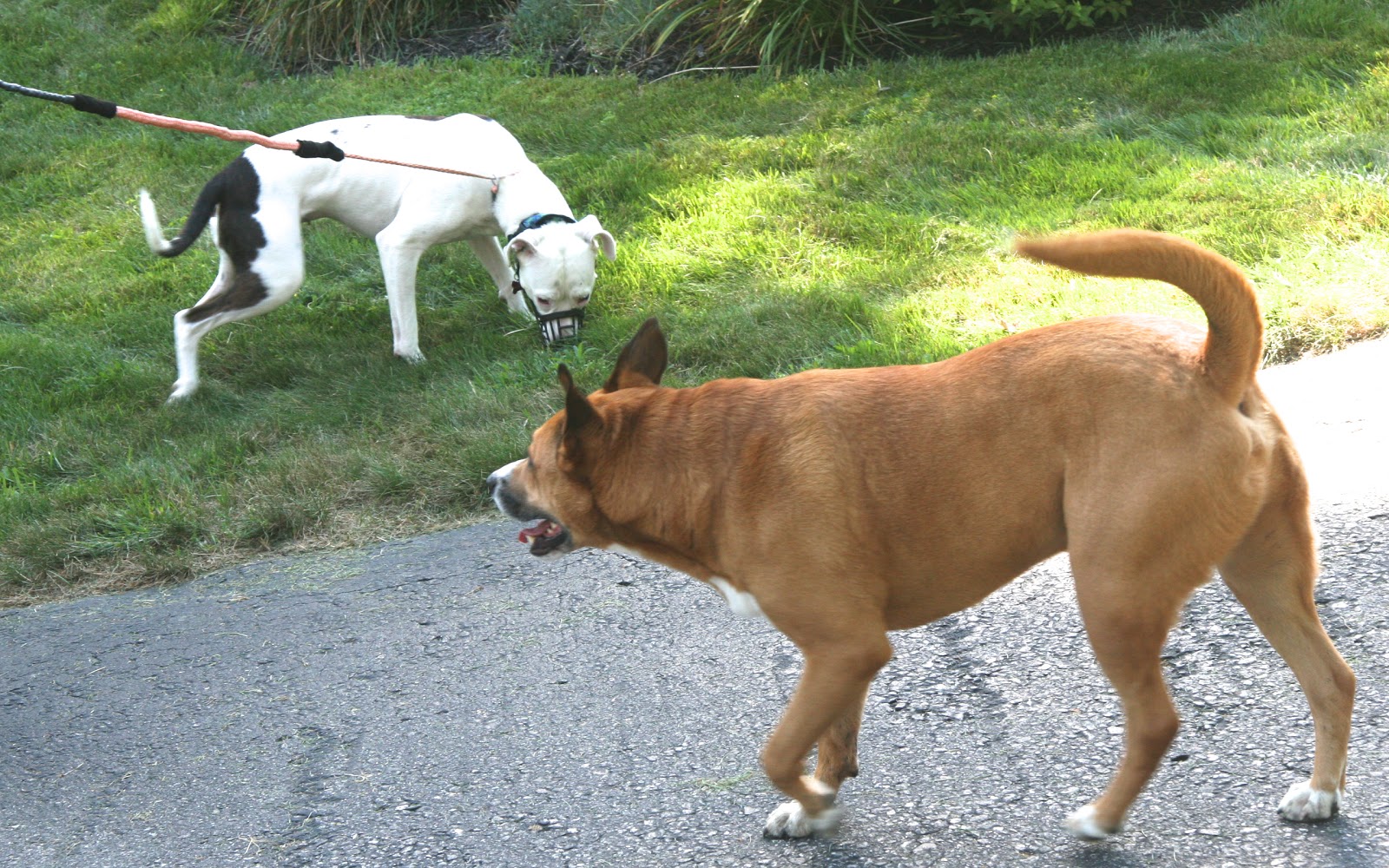 |
| White dog is fearful and sniffs to avoid greeting |
Environmental triggers are everywhere, who is
 |
| Where is this dogs weight shifted? |
Knowing the signs of stress in your dog is essential to keep him safe, happy and healthy.
For more information consider reading Stress in Dogs by Marina Scholz and Clarissa Von Reinhardt, well worth the time to read.
Saturday, April 27, 2013
Puppy Socialization Classes
Inadequate socialization with new stimuli does not only make the dogs life much less enjoyable, as confinement to the home or yard is boring and incredibly frustrating. Dogs who are poorly socialized also make life much more difficult for their owner.
Maizy, a foster scottie, was highly territorial and fearful of dogs. She learned to meet and greet appropriately and made several friends while she was with me. The approach used was called BAT, or Behavior Adjustment Training, which is a slow process of helping a dog obtain much needed information from a new dog in a way the dog can process it comfortably.
With BAT, older dogs can be socialized. But, keep in mind, it is a much slower process and becomes frustrating for many owners as you need to go at the dogs pace.
So, please set yourself and your new puppy up for success and join a Socialization Class by a Certified Pet Dog Trainer (CPDT). I recommend one where you stay in class with your puppy, and learn what play is appropriate and what is considered too much for your pup. The AKC S.T.A.R. puppy class is a great way to get your pup started on being a canine good citizen and avoid aggression and other unwanted behaviors. I think we can all agree, that a trained, social dog makes a wonderful family pet, and unsocialized dogs that exhibit fear and aggression are often given up or euthanized -- a result that really could be prevented with proper socialization as a puppy.
Sunday, April 7, 2013
Positively Rewarding

When pet owners learn to teach their dog new behaviors using positive reinforcement, their reaction is always, always, the same: "I had no idea how smart my dog was!" The only thing they did

Seeing how happy this owner was, and how quickly she became more connected to her pup, reminded me once again how effective positive reinforcement training is -- both for the dog and owner!
Friday, March 29, 2013
Staying Positive
I recently attended a Behavior Clinic where we taught our dogs new behaviors using a technique called shaping which is where we rewarded our dogs for making the slightest attempt at the behavior we wanted.
What I LOVED about this training seminar was that everyone was happy, smiling and really positive as they changed their dogs behavior. Yes, that is right, we were getting new behaviors and everyone was happy!
So why is it when you teach your dog a trick like paw, high five, or roll over you get super excited when they make the right choice, "YES", click, click "YES" as if one marker is not enough? Many of us repeat the marker due to our excitement! The dogs clearly get that they did something right because our feedback to them is exactly that: "positive and rewarding." Many of you can't stop there, you need to go show someone how smart your dog is, so you repeat the cue, your dog does the behavior and you again, shrill with "Yes" "Good Dog" and shower him with positive and rewarding feedback.
You must be smiling by now because you know this to be true! So, I want you to use the same positive feedback to reward your dog the next time you
are working with him. The way I see it, behavior is behavior, and, although you may feel the need to be serious when asking for a specific behavior, your dog just knows you are tense and not as much fun. So, I ask you to be more fun, smile and make a big deal when your dog does any small behavior you like. I do think you will see a softer, happier dog that will be able to focus on you longer because you are relaxed, fun and rewarding to be with!
Can you still change your pitch while training? Yes, but make the "positive" much more exciting and rewarding!
What I LOVED about this training seminar was that everyone was happy, smiling and really positive as they changed their dogs behavior. Yes, that is right, we were getting new behaviors and everyone was happy!
 |
| Maisey's mom is always smiling and rewarding her! |
You must be smiling by now because you know this to be true! So, I want you to use the same positive feedback to reward your dog the next time you
 |
| Maisey's dad has a soft tone, loose leash and is smart to tell her what she is doing right! |
Can you still change your pitch while training? Yes, but make the "positive" much more exciting and rewarding!
Sunday, March 24, 2013
My Dog is Fearful
Many dogs are afraid of other dogs, men, strangers, children, loud trucks, bikes, scooters, skate boards, odd scents, noises, and many more stimuli. I have spent the last 10 years helping my own dogs and many others live happier, less stressful lives. The first thing you need to realize is that you are not alone! Many many dog owners are feeling just as you are. While we are all at different stages of conditioning our dogs to feel better about certain stimuli, we all have similar fears and stressors. Staying positive is essential! Right now, think about all the behaviors your dog has learned recently. You know your attitude effects your dog, so stay positive! And remember: you are not alone!
Here are a few things to consider:
Here are a few things to consider:
- Seek out a Certified Trainer who has experience with insecure, anxious and fearful dogs, as they will have a better understanding of what you and your dog are feeling. Find someone who has current testimonials or good references so you know they are using Positive methods.
- Avoid expecting a specific goal, or anxiety will creep in when you fear you may not reach this goal.
- Instead, set simple goals that you and your dog can meet together every moment, every day, week by week and be happy with these small steps.
- Be honest with yourself right now that your dog will never be the "perfect" dog. It is okay, you will still love and protect him or her because he needs you to.
- Think of the advantages of owning a shy or fearful dog:
- He gives you unconditional love because he is worried about others.
- He only needs to be by your side to be content with life.
- His love is without strings attached.
- There are no pressures to earn titles, win ribbons or be the best.
- You will never lose him, as he is too worried about going too far away.
- You will learn more about dog behavior than your neighbor.
- He will not pull you to greet everyone.
These are just a few but there are many advantages to owning a shy or fearful dog. Sure, it can be scary at times! Just remember your dog is not acting this way to make your life miserable. Rather, he is coping the best way he knows how and is begging for some help!
As an example of a positive training attitude, the photo below shows a handsome dog to the far left that is fearful of people, yet he is able to give nice eye contact to his owner. When we began with this boy, we were happy when he could simply offer a quick glance at his owner when strangers were near by. After months of positive conditioning, he is much more comfortable as you can see in this photo.
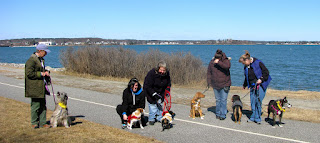 I can assure you that his owner was thrilled with each small progression he made at gaining confidence, and was happy to reward him for looking at her even for 1 second when 50 feet away! We slowly progressed, and while he will never be a therapy dog, does that really matter? What sets this owner apart? Her expectations are reasonable, and, when not met, she is still okay with the outcome! Why? Because she knows when her dog does fall back into an old, unwanted behavior it is because we pushed him too far too fast.
As an example of a positive training attitude, the photo below shows a handsome dog to the far left that is fearful of people, yet he is able to give nice eye contact to his owner. When we began with this boy, we were happy when he could simply offer a quick glance at his owner when strangers were near by. After months of positive conditioning, he is much more comfortable as you can see in this photo.
 I can assure you that his owner was thrilled with each small progression he made at gaining confidence, and was happy to reward him for looking at her even for 1 second when 50 feet away! We slowly progressed, and while he will never be a therapy dog, does that really matter? What sets this owner apart? Her expectations are reasonable, and, when not met, she is still okay with the outcome! Why? Because she knows when her dog does fall back into an old, unwanted behavior it is because we pushed him too far too fast.
So please, set your criteria such that you and your dog can succeed together! Otherwise you will be disappointed and your frustration will simply make your anxious dog even more stressed. Keep your training sessions relaxed, and positive. Don't push your dog beyond what he or she can handle comfortably, or else the negative experience will just set you both back. Stay patient, stay positive and celebrate all the small successes along the way. You and your dog will be much happier as a result!
Tuesday, March 19, 2013
Have a Plan When Changing Behavior
When a dog is repeatedly frightened by the same stimuli, and is not ever given a chance to think and feel differently about this stimuli, you will likely see the same reaction long term to this stimuli whenever it presents itself.
 |
| Pablo looks at me with dogs in the distance |
Have a plan! Spring is a time when people and children will be out and about not only a lot more, but at predictable times. Skate boards, bikes, scooters and motorcycles will all be zipping by very soon. If these are things your dogs gets aroused and barks or lunges at, then let's make a plan!
Think about rewarding your dog for staying calm when he hears the trigger, be sure your dog is definitely going to practice a new behavior. How? Be far enough away from the stimuli and have high enough motivation that your dog can not fail! Once you start getting a new behavior, you realize your dog can change his habits, he just needs you to set him up for success and be sure he can stay under threshold so his old habit does not appear.
When your dog is under threshold or far enough away from the scary stimuli that he is able to think about the stimuli and how he feels, you know you are making progress!
So, if given the chance, would your dog would run across the street and bark at the neighbor child on his scooter? If the answer is, "Yes", then start with your dog down the street each day at the optimal time, and reward your dog for looking or just alerting to the neighbor as he comes out. Each day use high value rewards and get just five feet or so closer to the neighbor. Over time, your dog will realize that the presence of the neighbor predicts him getting his treat; hence his emotion to the neighbor appearing will be very different in just a few training sessions.
Please do not try to get closer every day, but stay the same distance so your dog can feel safe. Going too fast is a common problem and will most likely force your dog to use an old unwanted habit.
Finally, I recommend you always end on a good moment when things are calm and going smoothly so when you begin the next time, you and your dog will have a good feeling about training in this location.
Finally, I recommend you always end on a good moment when things are calm and going smoothly so when you begin the next time, you and your dog will have a good feeling about training in this location.
Sunday, March 10, 2013
Behavior is Shaped by the Environment
I try not to sound like a broken record, but I do continually hit home the fact that the environment is training your dog. Specifically, the environment is shaping your dogs behavior in small successes each day, each minute.
Think about how other forms of life are shaped by the environment they live in, and often shape that environment in return. Do the habits of your roommate, co-worker or spouse effect your behavior? Do you ever avoid, engage, or seek out a particular human just because it meets your needs? Dogs do the same!

This Golden has learned that a hard eyed stare will make the smaller Dachshund mix turn and move away from her food.
If the hard eye stare works, then the Golden no longer needs to attack to get her message across. Dogs, again, do what works for them.

Why is this important? If your puppy barks frequently to get your older dog to interact with it, then this pup is learning to be rude and bark loudly in order to gain the attention it desires. What if your puppy is jumping on you to get attention then quickly sitting for the reward? You pup will learn that jumping gets a) your attention, and b) some form of a yummy treat.
What if your adolescent dog is repeatedly getting into scuffles at the local dog park or in day care? Your dog is learning the tools to be successful, lunging quicker, faster, higher can be very rewarding. Dogs, simply stated, do what works for them.
What if your adolescent dog is repeatedly getting into scuffles at the local dog park or in day care? Your dog is learning the tools to be successful, lunging quicker, faster, higher can be very rewarding. Dogs, simply stated, do what works for them.
Think about how other forms of life are shaped by the environment they live in, and often shape that environment in return. Do the habits of your roommate, co-worker or spouse effect your behavior? Do you ever avoid, engage, or seek out a particular human just because it meets your needs? Dogs do the same!
The photo below shows a small Dachshund mix thinking about stealing some breakfast! However, the Golden uses what works for her to prevent sharing.

This Golden has learned that a hard eyed stare will make the smaller Dachshund mix turn and move away from her food.
If the hard eye stare works, then the Golden no longer needs to attack to get her message across. Dogs, again, do what works for them.
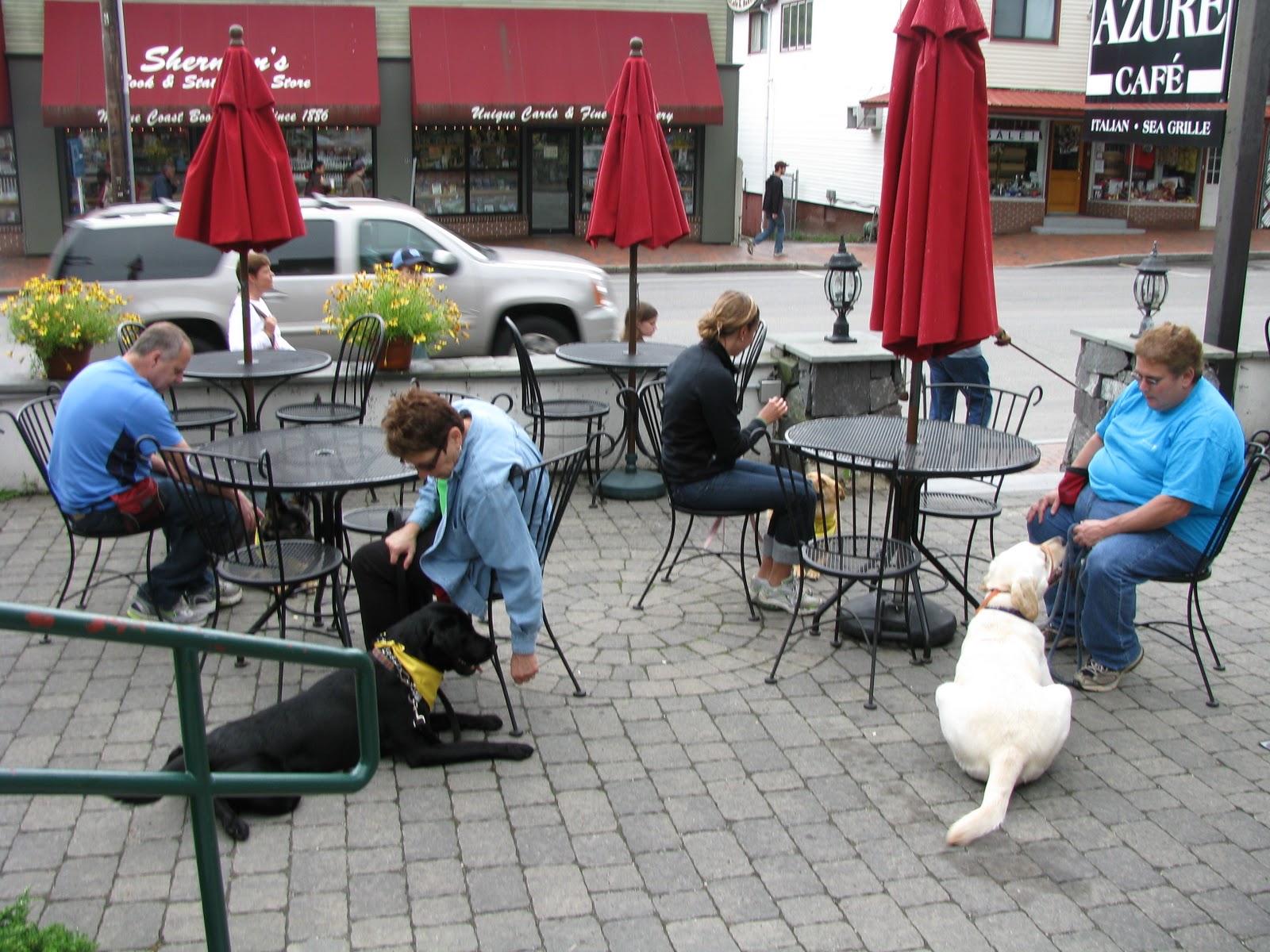
In this photo to the right the dogs are learning that they get rewarded when they offer calm behavior such as a down position. Very quickly the dogs learn that when they are lying down the cookies begin to drop from the sky! We then ask the dogs to move to a new spot and they again quickly offer a down knowing their behavior predicts good things!
Again, habits are formed by practicing them daily and by enjoying the rewards they offer. So if you see your dog forming good habits like sitting to go out or sitting for affection, then great! But if your pup is over mouthy and you find yourself rewarding with play, then think about how you or your environment is shaping your dogs behavior on a daily basis. Make the necessary changes to set your pup up for good habits that will be enjoyed and appreciated!
Again, habits are formed by practicing them daily and by enjoying the rewards they offer. So if you see your dog forming good habits like sitting to go out or sitting for affection, then great! But if your pup is over mouthy and you find yourself rewarding with play, then think about how you or your environment is shaping your dogs behavior on a daily basis. Make the necessary changes to set your pup up for good habits that will be enjoyed and appreciated!
Monday, March 4, 2013
Changing Your Dogs Emotional Response
Simply wanting your dog to respond differently to sights and sounds is not enough. In the last Blog, I talked about having a plan, going slow and being in a good emotional place yourself.
Please keep in mind, when your dog becomes afraid or anxious his emotional state is responding to one or more triggers in the environment, which will cause a physical response. The better you can read your dogs body language the more success you will have in desensitizing him to his triggers. What do I mean: desensitization is defined as the diminished emotional responsiveness to a negative or aversive stimulus after repeated exposure to it. It also occurs when an emotional response is repeatedly evoked in situations in which the action tendency that is associated with the emotion proves irrelevant or unnecessary. Desensitization is a process primarily used to assist individuals unlearn phobias and anxieties.
source: Wikipekia.org
For example, you may see your dog respond by barking and lunging at a trigger, however before this, look for signs of stiffness, body freeze, standing tall on toes, closed mouth with a hard stare, ear twitching, sniffing high in the air, whining, pacing or beginning to bark. These are also, your dogs physical responses to his unsettled emotional state. I believe with training you will get better at responding more quickly and thoughtfully to your dogs change in body language.
Now think simple, maybe even fun!
Two games you can use to desensitize your dog to a trigger:
1. Find it: In this video you will see a slightly reactive Miniature Pincher playing a fun hunting game in the grass we call "find it", while a boy moves slowly in the distance. To teach your dog to play find it, simply take a few pieces of your dogs kibble or treats, show him the food, say "find it" and toss the food near you on the floor. Repeat in the quiet of your home where there are no distractions. This Miniature Pincher knew how to play this game several weeks before we added the trigger of a child talking and moving about in the distance.
How do you measure success? Notice the dog alerts to the child and the handler quickly continues the game. The dog does not go over threshold with any barking or lunging.
2. Fetch: Many dogs love to play fetch with their owners and this game is often begun in the home or the dogs own back yard and is rewarded by lots of enthusiasm from the handler. Taking this fun game and playing it with your dog at a distance from a trigger can be a great way to desensitize.
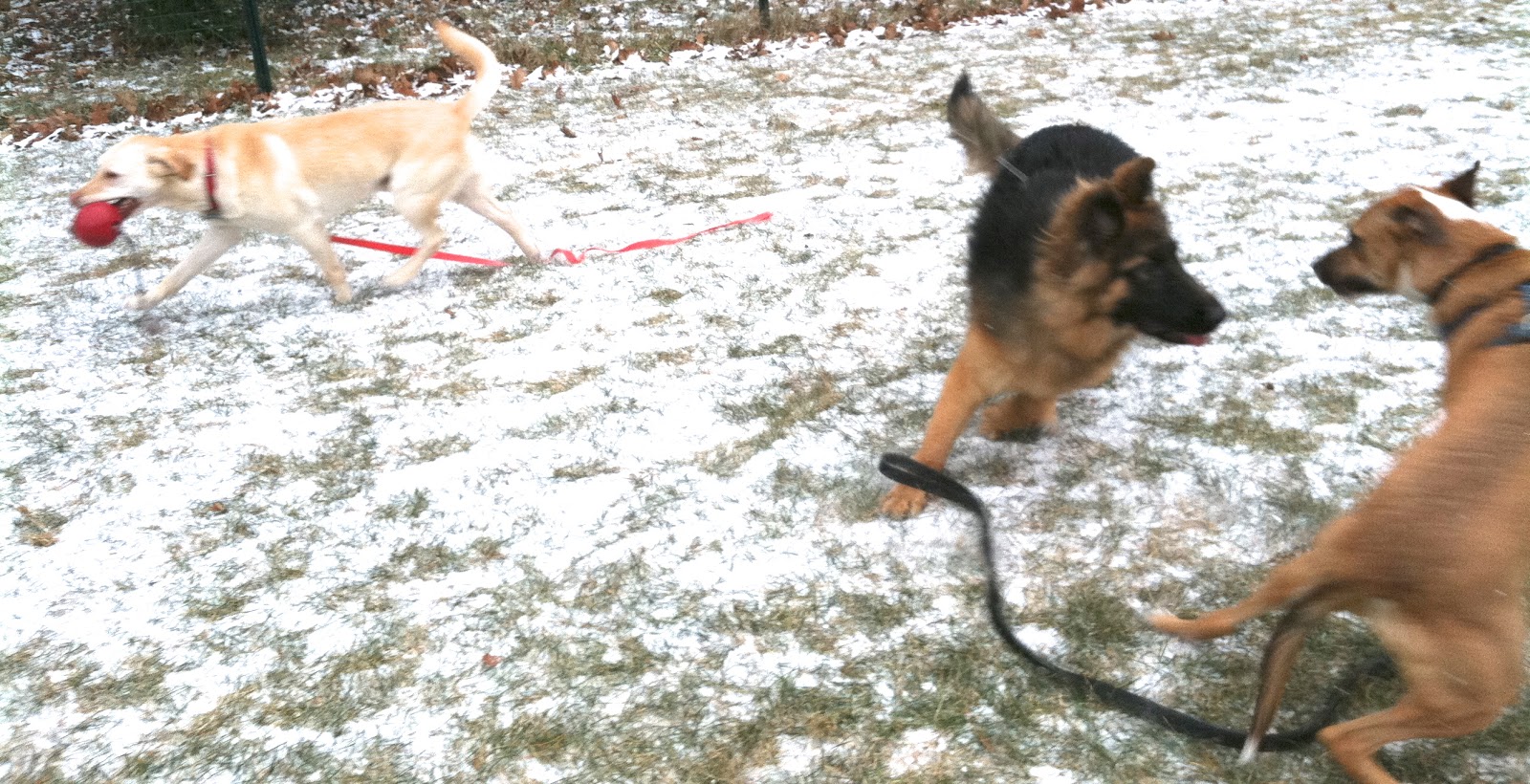
In this photo you see a yellow lab in the back ground playing a fun game of fetch with his owner while two other adolescent dogs are playing nearby. While the proximity is quite close, this yellow lab has had a great deal of training and focus work. Initially, you would begin at a distance from the trigger and be aware of your dogs body language so you can keep him engaged in the game as soon as he alerts to the trigger but before he actually reacts.
I hope this blog gives you some motivation to change your dogs behavior and not just shock it. I know there are many dog trainers who will happily take your money to stop unwanted behavior, however adding punishment to a stressed out dog is simply shattering his nervous system and breaking any relationship you thought you may have had with him.
Subscribe to:
Posts (Atom)