Showing posts with label separation anxiety. Show all posts

Friday, June 28, 2013

What Does Stress Look Like?

When I think of unwanted behavior, I think of stress as the two are often related.

This dog is worried
Go Away!
My goal here is to help you identify your dogs stress signals so you can get them help before this stress causes unwanted behavior. Science clearly states that stress leads to health problems, negatively affect relationships with others and can also make us grumpy, irritable, less tolerant and even aggressive.

Is it true if we humans are stressed our dogs can sense it?  Yes, when we feel worried, anxious or angry, our dogs will certainly be effected in some way.  Different dogs will react differently to mental and physical pressures in their environment.

How many of us often turn to physical exercise to relieve stress or tension felt from our environment.  Is your dog able to go for a daily jog to relieve the stress he carries around or is he confined to run the fence line and bark in frustration becoming more and more aroused.  Does he destructively chew your furniture, pace wildly and mouth your arms and hands when you enter?  You may perceive this mouthy greeting as excitement, but it is stress.
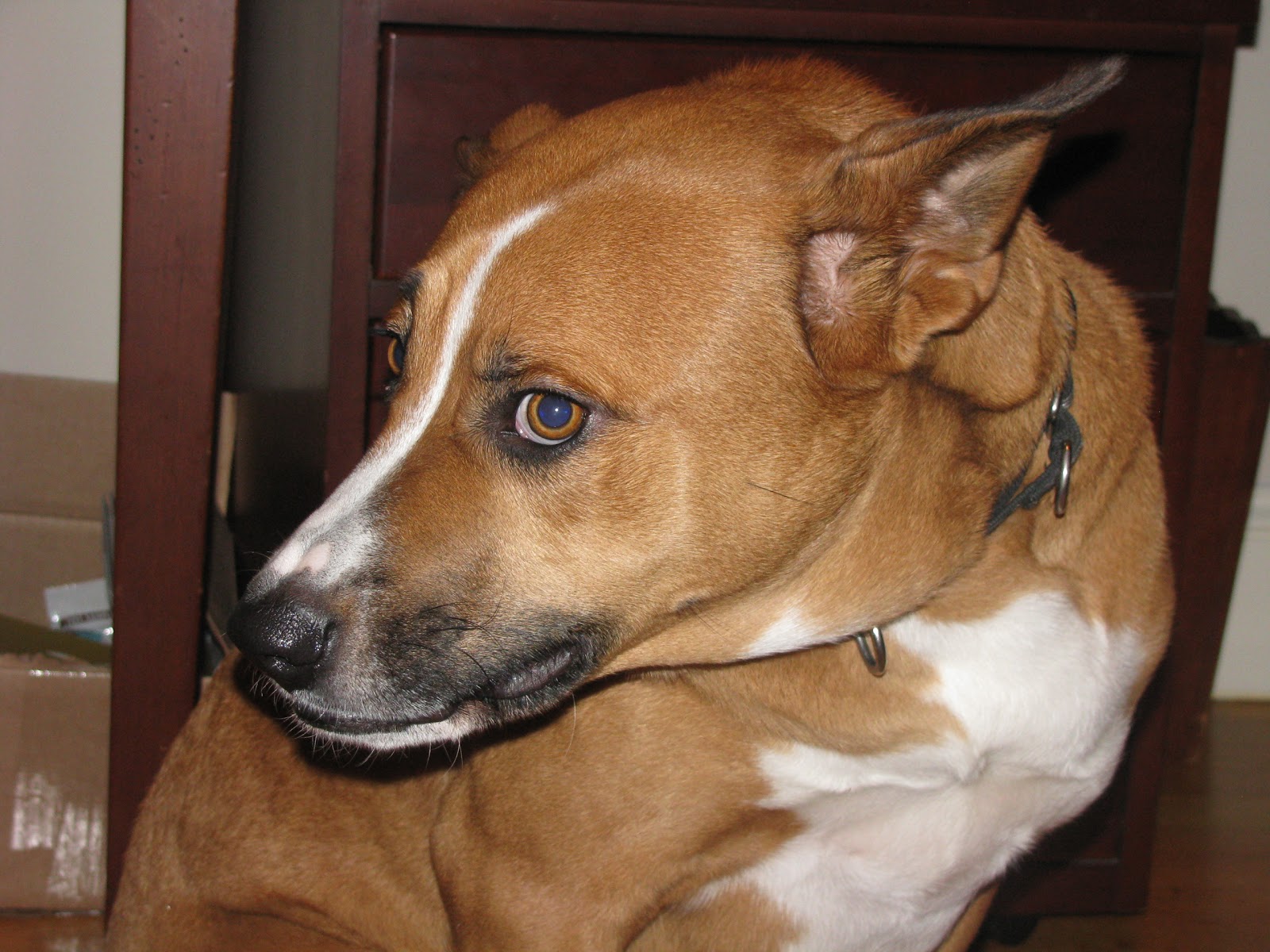
An unfamiliar dog has approached to the
right, this mix is looking away to avoid conflict. 
Signs of Stress come in many different forms:

  • Does your dog ever bark rapidly, scan the environment for a threat, pace back and forth, tremble, chew in a ripping or destructive manner, pant when not tired, flatten his ears back, lower his head when approached (guilty appearance), cower or urinate when you or anyone else approaches, hide between your feet, growl, lick his lips when not eating,  yawn when not tired, turn his nose away from his favorite treat when in an unfamiliar environment.  Urinate or defecate when arriving at a new home, or training center.  
  • Young adolescent pups may playfully mount dogs or humans or do this as a sign of stress as is biting the leash and excessive mouthing of human hands. Exaggerated self grooming which can cause hair loss, sudden outbreak of dander can also be stress related. 
  • White dog is fearful and sniffs
      to avoid greeting
  • Does your dog often begin to sniff the ground when meeting new dogs, stop to scratch just as a greeting is about to occur, avoids the new dog completely?  We know stress can effect health, stress that continues over a period of time can cause a dogs immune system to become fragile due to increased cortisol in the system.  Have you ever considered that a dogs unpleasant body odor or bad breath can be the result of high stress. 
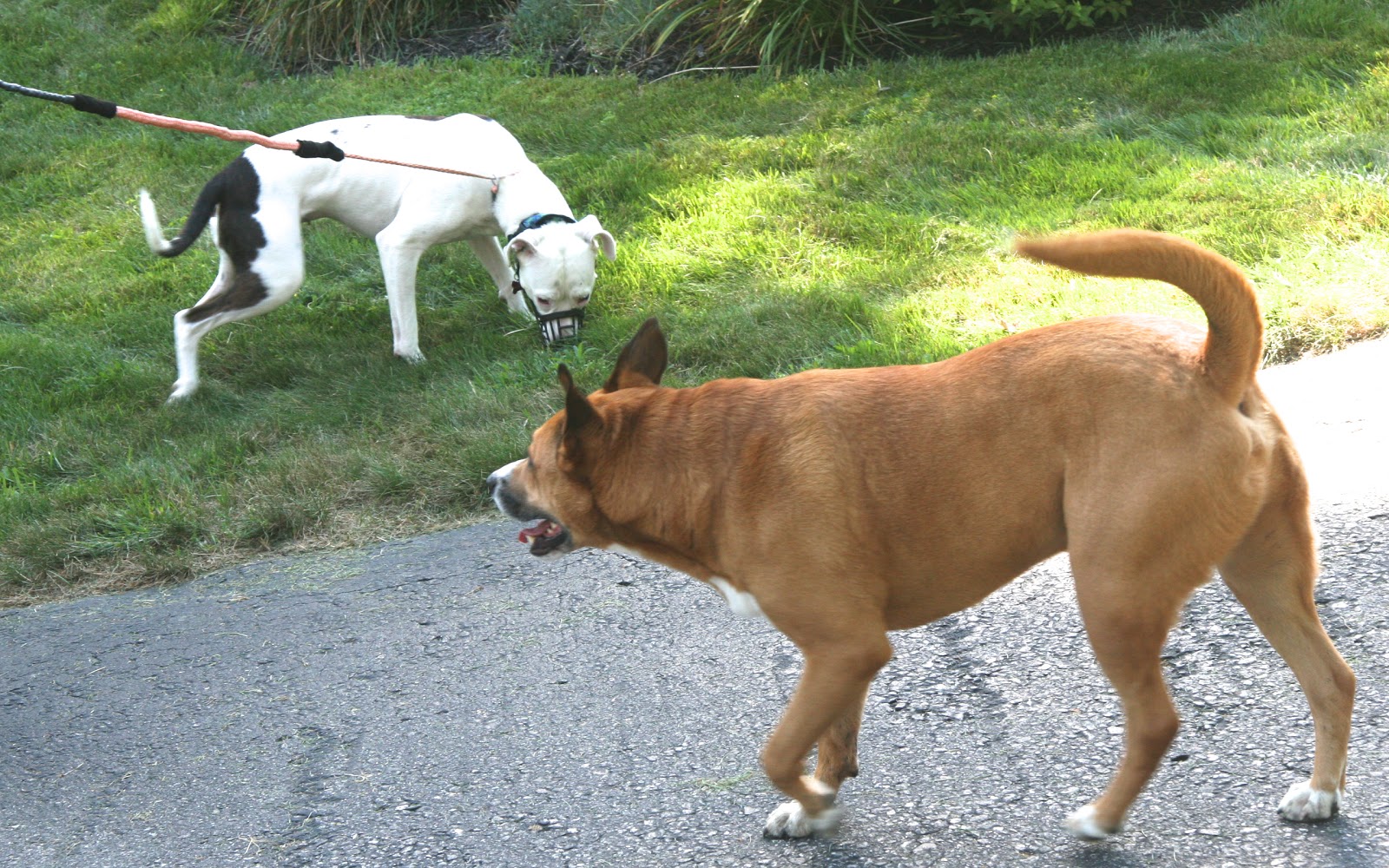
Environmental triggers are everywhere,  who is
Where is this dogs
weight shifted?
present, how many stimuli, if they are approaching slowly or quickly, how your dog feels at that moment, what smells are near, what he sees and hears are all triggers that can cause your dog stress and they are constantly effecting your dogs behavior.

Knowing the signs of stress in your dog is essential to keep him safe, happy and healthy.

For more information consider reading Stress in Dogs by Marina Scholz and Clarissa Von Reinhardt, well worth the time to read.


Thursday, September 6, 2012

Back to School!


September is here and the kids have gone back to school to begin a new year of learning!

Vacations have come and gone, colleges have been visited, common applications have been started, the pantry is restocked with healthy foods and the sports schedule is on the refrigerator.  For me, it is a time to return my full focus on the thing I enjoy the most, behavior modification!

Transitions take time, households are bustling, emotions may be heightened, and new routines are forming.  Just like children, our dogs are in transition too which may include some setbacks in behavior due to these changes.

Stress effects our dogs like it does us, potty accidents, whining, barking, chewing and over the top greetings are all common setbacks that may occur as kids head back to school.

What can you do?  Be calm, patient and understand that your pup is not doing anything to be spiteful.  The fact is that many dogs do not do well with change, dogs do best when their lives are predictable, the unknown may be scary to them.  Quickly establish your new routine, and help your dog know that you will return, hire a dog walker to let him out when you will be gone long hours, exercise him in the morning, feed him out of an interactive toys mixed with yummy treats that roll around and are fun.  If your dog is barking when you are gone, he is clearly stressed and not simply trying to wake up the neighbors.

When are they coming home!
Be sure your dog has a crate or room in your home where he feels really good, feed him and play with him there.  When you leave, toss him his interactive toy like a kong, everlasting fire hydrant or any toy stuffed with goodies and do not say a word that predicts you leaving finally, please do not look him in the eye as you close the door.

If your dog is having a set back during this time of year, he is most likely stressed, so think about how he might be feeling during this transition and what simple steps you can do to help him!
Happy Fall!     Judy

Friday, May 4, 2012

Desensitizing or Sensitizing

When we change a dogs association, we often discuss the "how to's" of desensitizing the dog to a stimuli (stranger, noise, moving cars, bikes, children ect.)  If your steps of desensitizing are not working you must consider the fact that you may actually be sensitizing your dog or increasing arousal and anxiety rather than decreasing them.
Sara playing "find it" at the park
Sara, a sweet beagle mix in my Outdoor Adventure Class is fearful of new environments and will often shake and not take treats.  Using a series of games and food she enjoys like "find it", we are helping desensitize her to new places.

Taking a dog that is fearful of cars and tying him to a street sign would most likely increase the dogs fear and arousal or sensitize him to the sight and sound of cars.  After this type of training, the dog would be more likely to bark at the simple sound of a car.

However, if you stay a distance from the street where the dog is not yet aroused and play his favorite game of tug, find it, or fetch, you may find that the dog seems unaware of the cars going by.  I have used play to desensitize many dogs to their fears. This type of desensitization helps the dog associate a happy, playful emotional state when near loud or fast moving cars.


Thursday, December 15, 2011

Barking

I frequently get asked about barking problems or why do dogs bark?  Our dogs bark for a variety of reasons: 
  • Dogs will bark if they feel threatened. 
  • They may bark when they play and get excited.
  • Some dogs will bark for attention from us or another dog. 
  • Some will bark if they are in pain and they’ll even bark when they’re lonely, bored or stressed. 
  • Certain breeds or breed types are also genetically inclined to bark more than others.
Desensitizing these shelties to moving stimuli
How you’ll prevent or resolve your issue with barking will partially depend on what is triggering your dog to bark. For example if your dog is barking or vocalizing because he’s in pain, treating the source of his pain would be the obvious solution. If your dog is barking through the front window as dogs pass by your house, blocking off access to that window is a simple way to help prevent his barking.


Keep in mind that the more your dog practices barking the better he’ll get at it. So identifying what is triggering your dog to bark and if possible, removing the trigger or changing the emotions that cause your dog to bark are best.  For Example, if your dog barks each day he hears the mail truck, take your dog out side and reward you dog with a yummy treat for looking at the truck, after a few days of this classical conditioning, take your dog out and reward him for looking at you or any other behavior they offer before they bark.  Eventually, your dog will learn to simply look at the mail truck and watch it go by with no worries at all.

In my opinion, antibark collars which use shock are inhumane and are inappropriate for all kinds of barking problems (and often make the problem worse). Many dogs that have been shocked for barking at a mail man or garbage truck have ended up trying to bite this stimuli which causes them pain each time it is near.  With the right kind of behavior modification and a strong desire to stop the problem, most pet parents can successfully resolve barking issues using classical conditioning methods.

The Alert Barker does so to alert you to someone or something outside, the answer is quite simple. Remove the source of what triggers his barking. For instance if your dog barks at people as they walk past your home, prevent his access to the window using furniture, closing blinds, blocking off the area with a baby gate.  Remember, if your dog barks and the person or dog moves away, this is very rewarding for the dog and will certainly be repeated.

The Lonely Barker is often more simple to modify, try changing your dog’s environment a bit.
Remember that your dog probably wants to be with people. Dogs who are left outside for long periods of time are often the worst offenders of barking. Your dog needs to play with you and feel like he is a part of the family. Dogs typically don’t do well when left alone for long periods of time. Make sure you set aside time for regular walks, playtime – even some training sessions. You’ll want to be sure that you give him the social contact that he needs to keep his body and mind occupied. Barking when left alone may also indicate separation anxiety. If you think that anxiety is the source of your dog’s barking, contact a certified dog trainer.

Attention Barking  may be a dog that barked and you tossed him a toy, you have just taught your dog, “When I bark you play!” Even if you look at him or verbally scold your dog when he barks, you will still be teaching him that his barking is a successful way to get your attention. What can you do?  You need to ignore his demands. His barking may initially
increase and so don’t give in or he will learn that persistence pays off. However, if he barks and you really ignore him or even better if you ignore him and walk away until he is quiet, he will eventually learn that barking doesn’t work and it will decrease.  


Our dogs are not trying to dominate us, they simply do a behavior and if something follows that they like then they will repeat the behavior.  Dogs are smarter than we think, so be carful and watch what you are rewarding!

Wednesday, October 26, 2011

Toys

Many of you have asked me about interactive toys to help keep your dog busy when left alone.

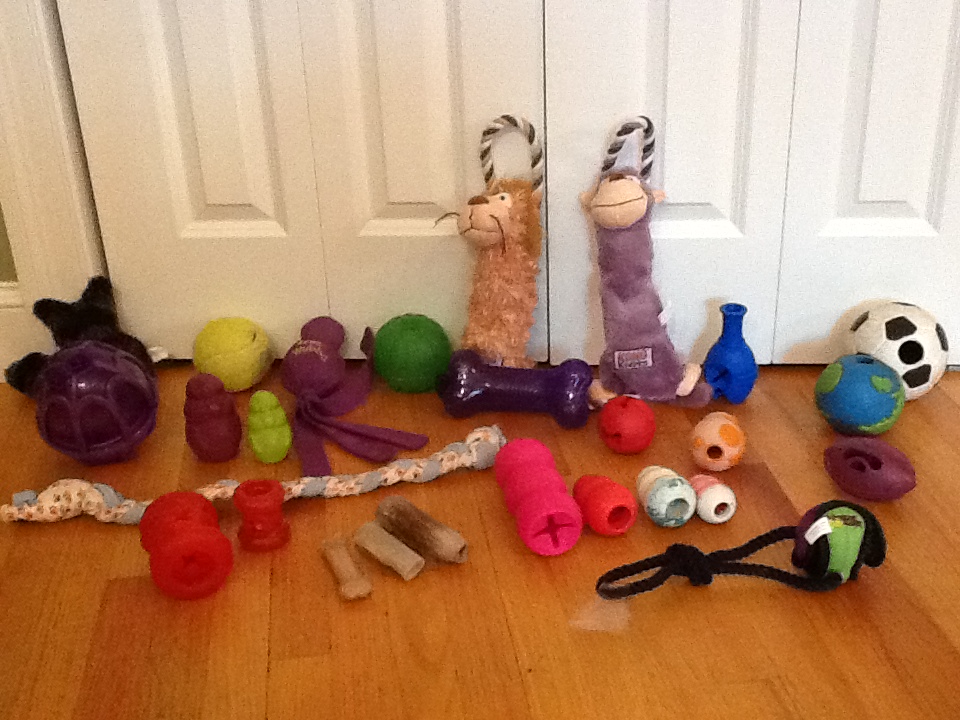
Below are some of the toys I use to create positive associations for many dogs in many different ways.  For example, when I leave I often say "Kong Time" and leave each dog with a stuffed toy. The sound of a delivery truck is often another "kong time" as I want my dogs to be excited not fearful when this sound occurs.

 If I am training a foster dog to use a crate, I only feed them using these toys, and, again, happily say "crate," and toss a yummy toy or two in the crate so the dog associates it with something good!

These are simply a few ideas to help enrich your dogs life.

Premier Tumble Ball, assorted Kongs, Everlasting Toys, Squirrel Dude, Planet Dog, Rip and Tug.
To get started be sure to make the toy easy for your dog to receive a reward, otherwise they will lose interest.  The balls are great for beginners using dry kibble mixed with a few treats.
For the experienced dog, pack the Kong with a variety of goodies!  For example, begin with a bit of peanut Butter, next add some raw meat or pieces of hotdog or cheese, followed by some kibble, dry treats, and repeat the process!  It is like a party every time as your dog works hard to get to his favorite goodie!  Be sure to use a cue like "kong time", your dog will begin to salivate rather than pant when you are leaving!

Thursday, October 13, 2011

Conference Day 2 - Reactivity in Dogs

Impulse control, hyperactivity, reactivity and arousal are all topics discussed in today's symposium on "Living on the edge." If you have attended any of my reactive dog classes you would have heard me use these terms and how they effect your dogs emotional state.

Today's topics included many practical methods of incorporating daily routines and opportunities to help your dog practice desirable behaviors. We know that good training is always started at home! Daily practice at home with feeding, training, and play can improve a dogs impulse control and arousal habits. New behaviors and techniques for keeping your dogs arousal under threshold will be incorporated into our up coming classes.

Today's conference ended with an informational panel discussion including dog behavior specialists: Suzanne Clothier, Ian Dunbar, Trish King, Dr. Petra Mertens, Dr. Pamela Reid, and Pia Silvani. What a great source of caine knowledge here to discuss arousal and how it effects reactivity.

looking forward to tomorrow's sessions on K9

Wednesday, July 20, 2011

Separation Anxiety or Distress....which is it?

Because not all dogs that are left alone experience  
anxiety, animal behaviorists are beginning to use other terms  
including separation behaviors.

Separation Distress
Distress is simply an animal's inability to adapt to stress (or the  conditions that are causing stress). In humans or animals, the result  of distress is often demonstrated by poor coping skills that include inappropriate  
urinating or defecating (toilet-trained children who are experiencing  distress might wet the bed or wet their pants), making noise (dogs bark and whine while distressed children might cry), and destruction  or aggression.

In many situations, separation distress is a more accurate term than  
separation anxiety.  Some owners have even called their pups behavior Separation Fun. They can learn that when their owner is gone, they can counter surf, sleep on their owners bed, lounge on the couch, dig in the trash, relieve their bladder without anyone yelling at them.

Separation Behaviors
Some owners return home to discover toilet paper has been dragged from  
the bathroom all through the house and underwear is now strewn about  
the living room. A tornado went through the house? No, the dog was at  
it again. 
The idea that some dogs get bored and start a party when their owners  
are gone is controversial. What we do know is that something happens, as  
toilet paper is all around the house, shoes are chewed, and perhaps the  
dog urinated on the bed. These occurrences can all be accurately  
referred to as separation behaviors.


So before you implement a major training program, perhaps you should
determine if your dog is truly anxious or simply bored.  What we do know is that
punishment often creates more bad behaviors.


Helping dogs cope while being left alone is a process, but one that will save your
furniture and earn you freedom for the life of your dog!