Showing posts with label reactive. Show all posts

Wednesday, September 17, 2014

Why is my Dog Lunging on the Leash?

Do you own a dog that does not act "normal" when he sees another dog on leash? 
Learning good emotional control takes practice
Many dogs do not have good coping skills to greet another dog when confined by a leash.    
You may describe this type of dog as fearful, hyper vigilant, aggressive, reactive, out of control, barks all the time, rude, pushy, anxious or even clingy.  Dogs who exhibit these behaviors are cruelly labeled and often given up on, but the truth is that these behaviors are your dog's way of begging for some help.  If your dog is displaying these emotions he is clearly not a calm dog, and therefore not a balanced or content dog.  Unbalanced dogs are riddled with emotions they cannot control, which make them difficult to live with and own, but these are the dogs that need us the most.....


With effective behavior modification programs, these anxious reactive dogs can thrive in our homes and communities.  Having a plan to keep them safe, predictable exercise routines, desensitization tools, healthy nutrition, doggie Zen and possibly medication, these dogs will love us unconditionally.  Just look in there eyes and help them feel safe, always..

If you have taken on the task to raise a dog with fearful reactive behaviors, know you are not alone.  I personally have three dogs who each have different levels of fears and often use distance cues with humans and dogs.  I understand your stress of owning an unbalanced dog....  Even my family members have called them names, not truly understanding my dogs level of stress. I feel an enormous amount of empathy for these animals as I see in their body language how much more worried they are then other dogs.  I have spent hours counter condition their fears to various stimuli and I work very hard to have a plan each time I take them in public so I can set them up
Thinking through arousal...
for success.  I manage for safety, continually counter condition their fear emotions to positive ones so they know what to do in different situations and cherish each calm moment we have together.  My two females came to me with bite histories and have each received their Canine Good Citizen Certification from two different trainers.  One has gone on to be Therapy Dog International Certified, so do not lose hope and celebrate each small daily success!  


Using the right balance of tools, your dog will one day be able to think through his arousal so you can reward him and not be frustrated with him.

Saturday, July 5, 2014

Dog Aggression and Communication Signals

Why is my dog so aggressive to other dogs?  This can usually be diagnosed with a detailed history: no play ever, hereditary, mother was sick or a guarder, or over socialized with aggressive or rough playing dogs.

Cycle of On-Leash Aggression (created problem from humans), as described in the Culture Clash, by Jean Donaldson, "The Bully dog" is often kept away from other dogs for long periods of time, he is usually rude with crude behavior brought on by a super motivated greeting as a result of deprivation when meeting other dogs, and has poor social skills.  The owner is alarmed by intensity and tightens the leash and get’s too excited or nervous when interactions occur.  High arousal, lack of social skills, scuffles with defensive dogs can occur.  Barrier frustration such as windows, fences and leashes can increase the dogs frustration which makes you want to "correct" the behavior,  which = punishment  which = more Aggression = total isolation.
I believe dogs need time to express their intentions before they greet unknown dogs.  Personalities among dogs differ as much as a classroom full of kindergarteners, therefore, expecting your dog to like every dog they meet is not that simple. Some dogs are very soft and have appropriate greetings, these are the dogs who are able to visit the beach and off leash parks without incident. 
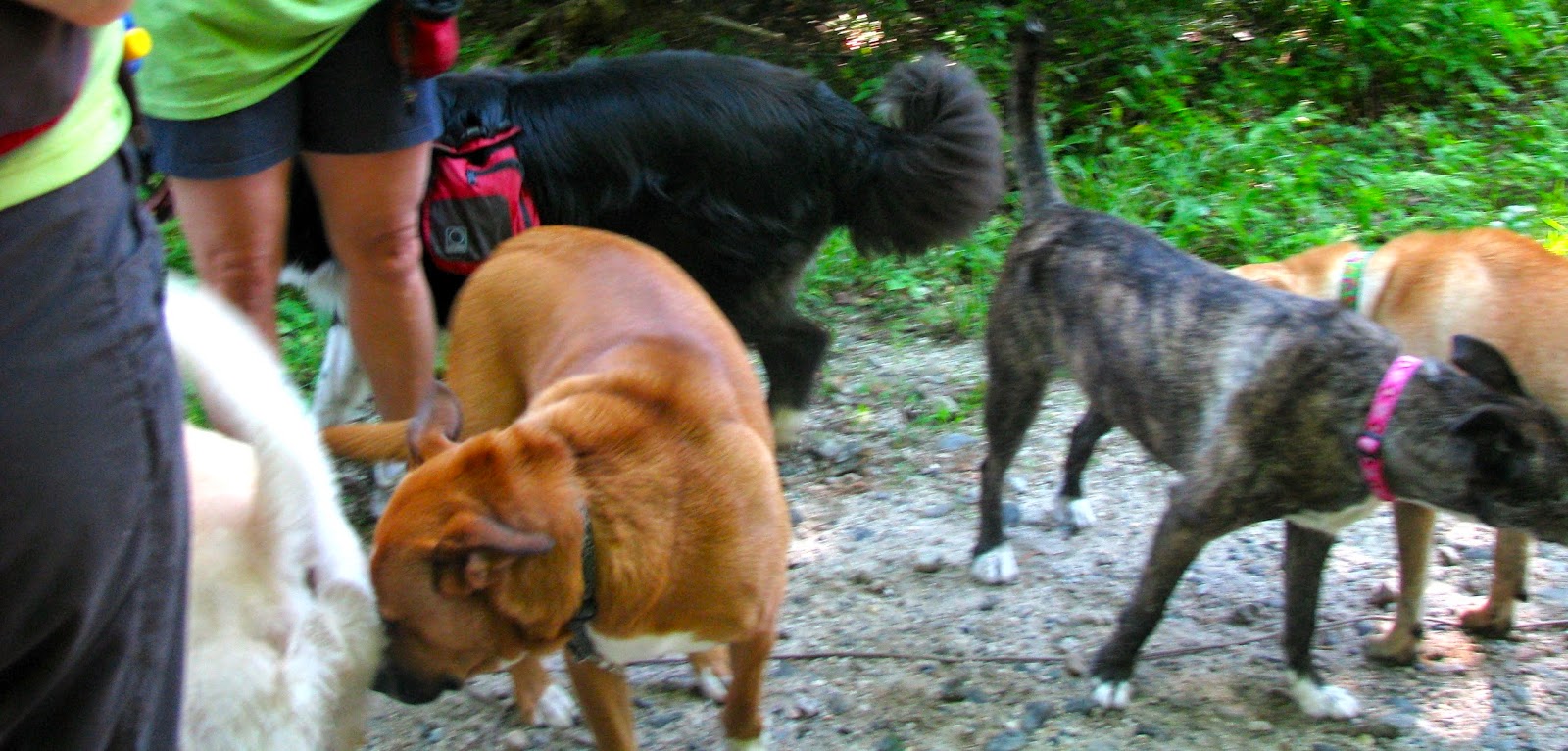
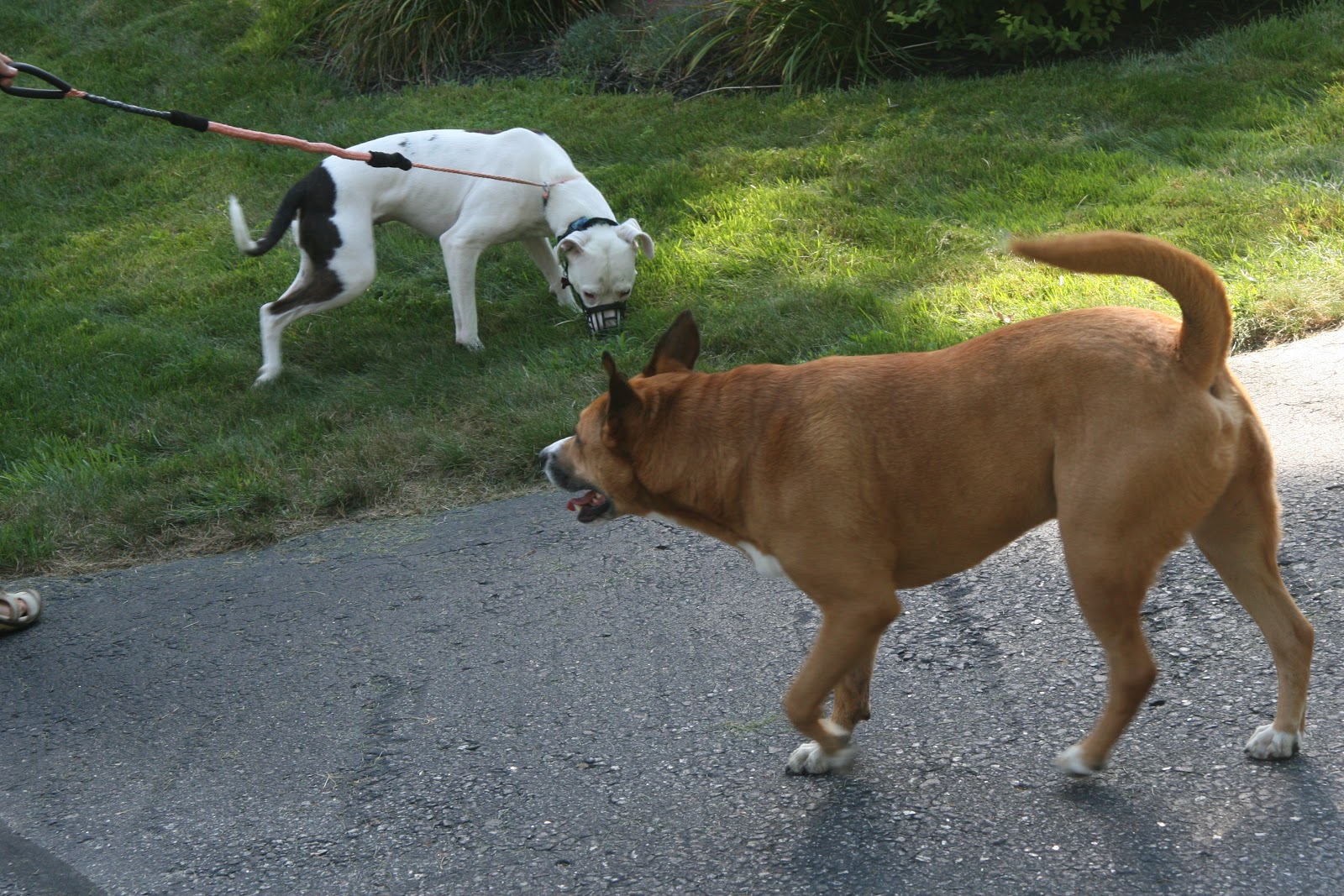
Helping your dog greet new dogs much slower will give your dog important and necessary information about the other dogs intentions.  To the left, you see the brown dog in the middle of this pack at a local park.  He is standing quite still with head lowered, visible tension in his jaw, mouth closed, low tail, ears back and a his hair beginning to stand up on his back.  He is very uncomfortable about being so close to a strange dog and was called away quickly to avoid any conflict.  This particular dog's behavior tells us humans that he needs a much slower greeting with new dogs.

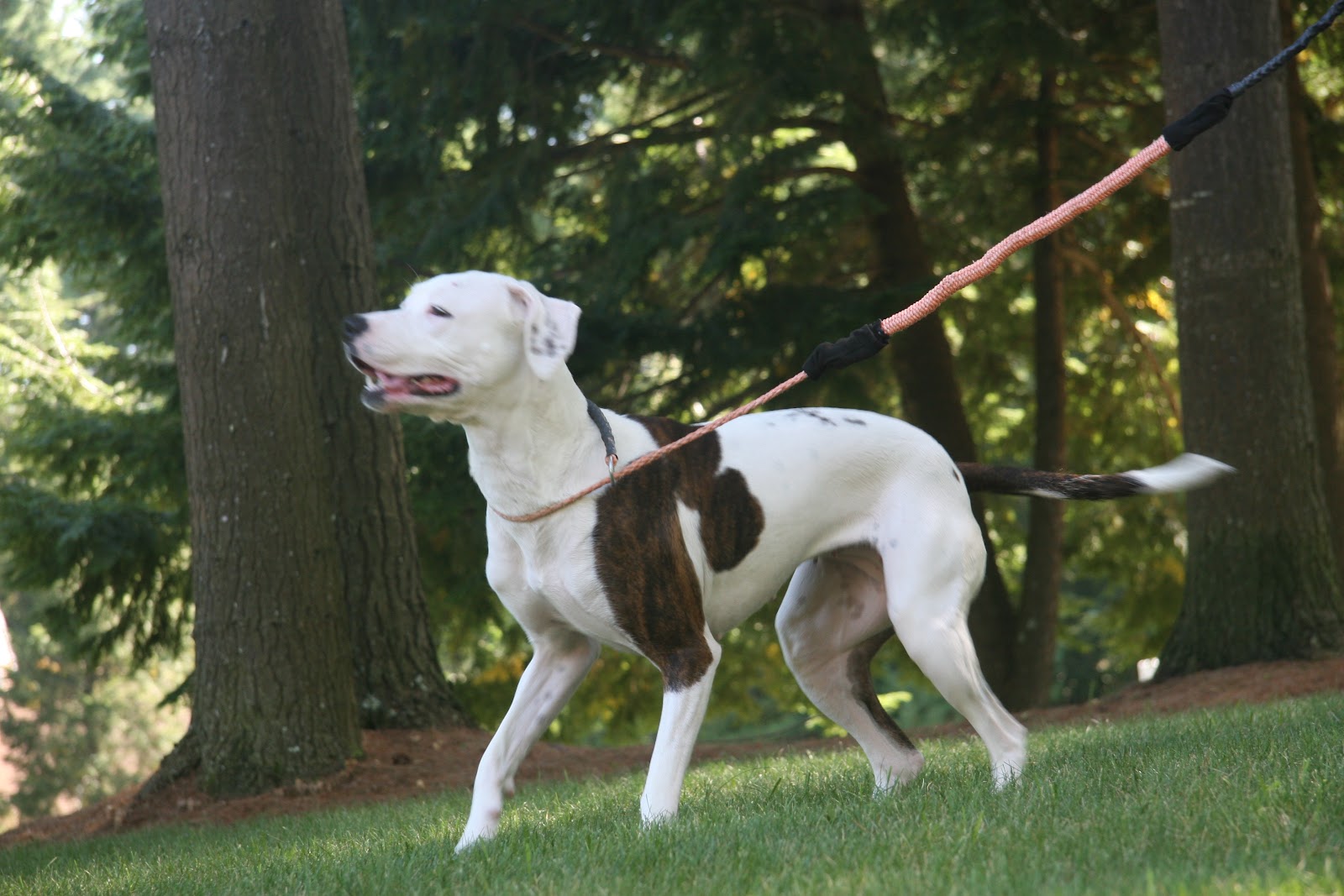
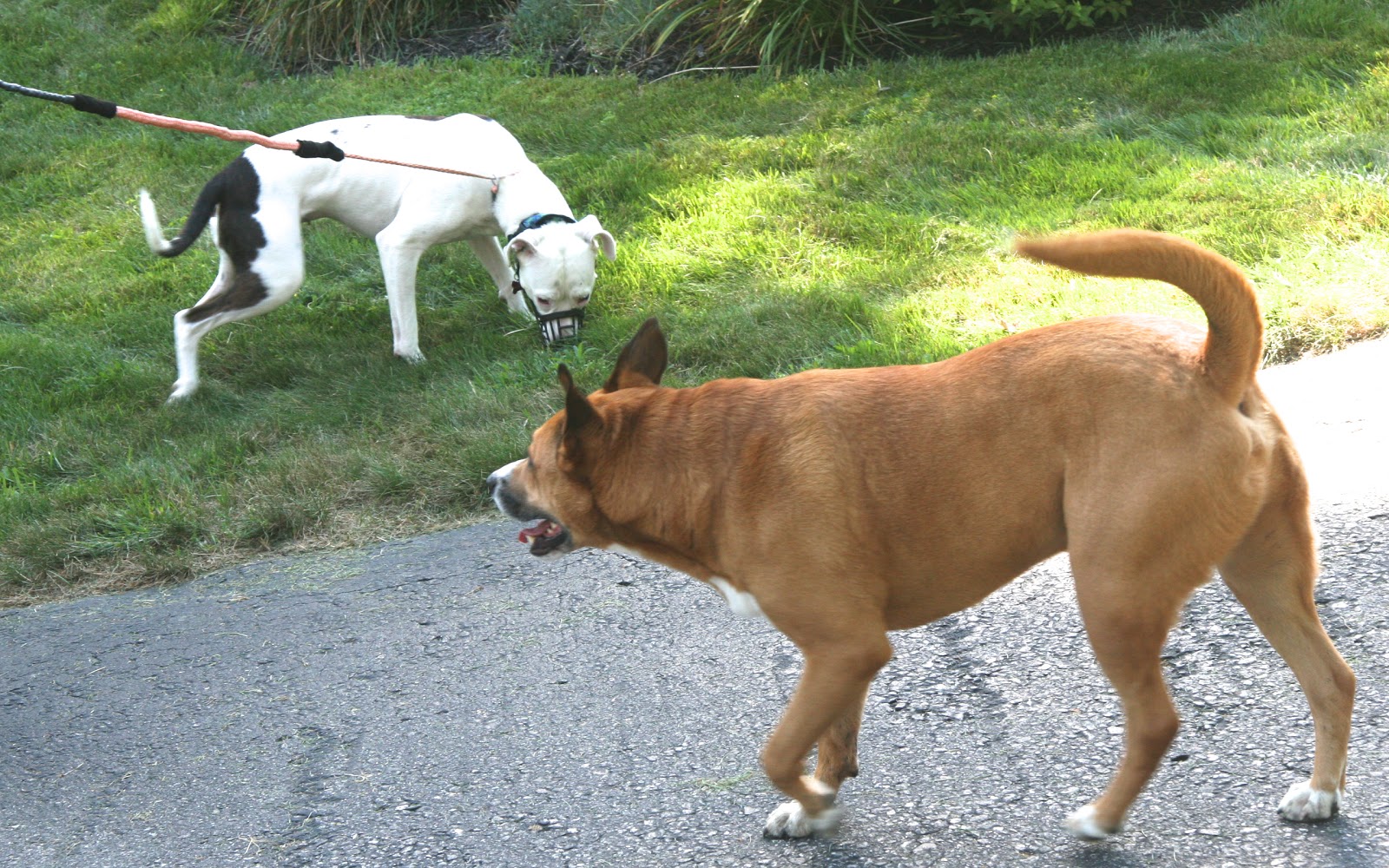
In this photo to the left , this beautiful girl has just seen a new dog and is reading the other dogs intentions and clearly expressing hers as well.  Note the open mouth and soft eyes, lowered tail which is in motion and she is beginning to offer a play bow.  While she is expressing intentions that she does want to greet the new dog, she is very excited and the other dog is a bit alarmed by her intense need to visit.  After about 30 minutes of walking near each other, this girl and the other dog became play mates as you will see in the video below. 
If you have a new puppy, please keep him/her safe and find nice friendly dogs to socialize with.  Your dogs friends will influence his/her behavior! Just like you were influenced by those you visited with as an adolescent.  So, know who your dogs friends are and watch for signs of fair play between the two and you let's try to prevent aggression from spreading.  

Friday, June 28, 2013

What Does Stress Look Like?

When I think of unwanted behavior, I think of stress as the two are often related.

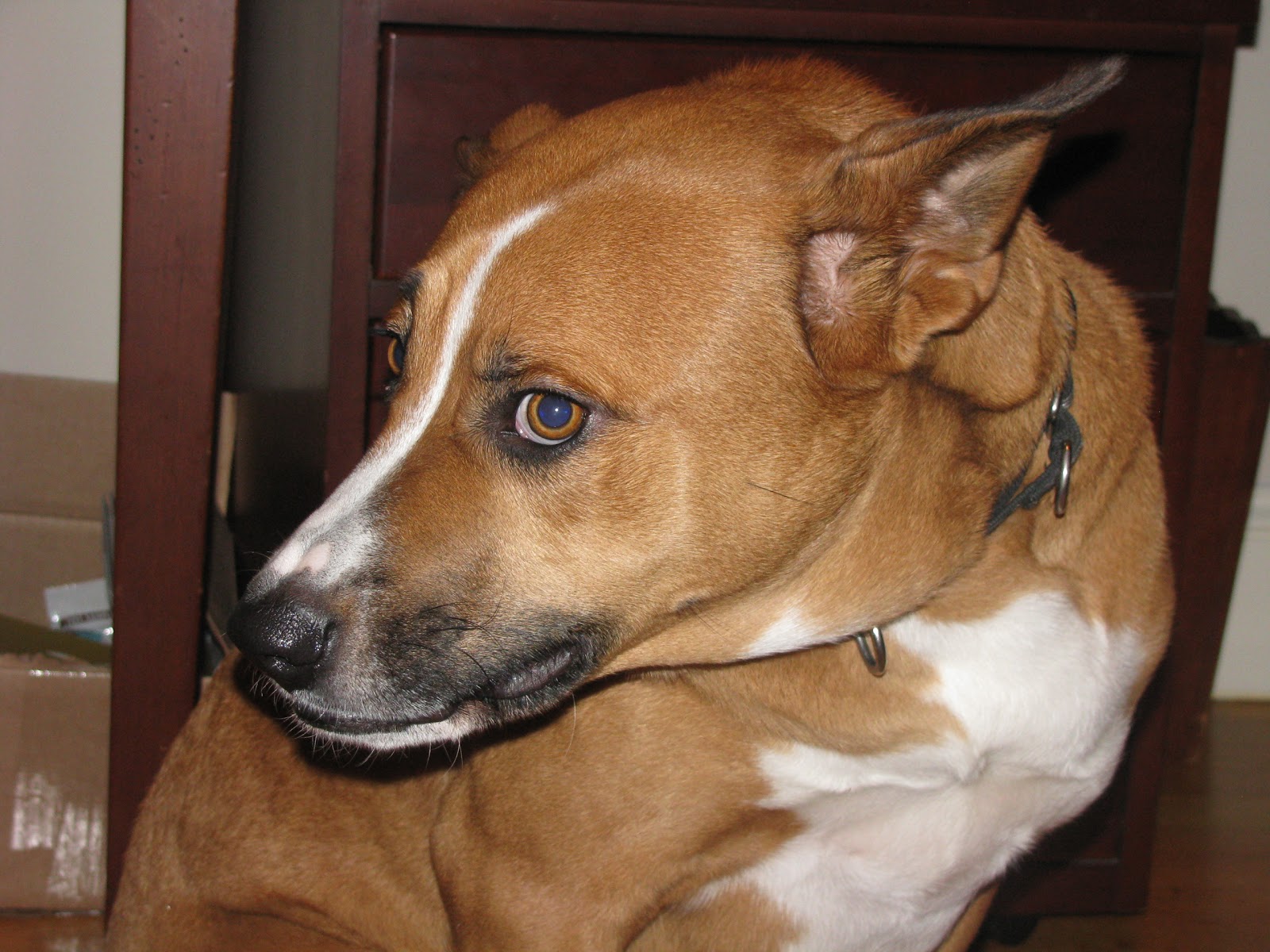
This dog is worried
Go Away!
My goal here is to help you identify your dogs stress signals so you can get them help before this stress causes unwanted behavior. Science clearly states that stress leads to health problems, negatively affect relationships with others and can also make us grumpy, irritable, less tolerant and even aggressive.

Is it true if we humans are stressed our dogs can sense it?  Yes, when we feel worried, anxious or angry, our dogs will certainly be effected in some way.  Different dogs will react differently to mental and physical pressures in their environment.

How many of us often turn to physical exercise to relieve stress or tension felt from our environment.  Is your dog able to go for a daily jog to relieve the stress he carries around or is he confined to run the fence line and bark in frustration becoming more and more aroused.  Does he destructively chew your furniture, pace wildly and mouth your arms and hands when you enter?  You may perceive this mouthy greeting as excitement, but it is stress.

An unfamiliar dog has approached to the
right, this mix is looking away to avoid conflict. 
Signs of Stress come in many different forms:

  • Does your dog ever bark rapidly, scan the environment for a threat, pace back and forth, tremble, chew in a ripping or destructive manner, pant when not tired, flatten his ears back, lower his head when approached (guilty appearance), cower or urinate when you or anyone else approaches, hide between your feet, growl, lick his lips when not eating,  yawn when not tired, turn his nose away from his favorite treat when in an unfamiliar environment.  Urinate or defecate when arriving at a new home, or training center.  
  • Young adolescent pups may playfully mount dogs or humans or do this as a sign of stress as is biting the leash and excessive mouthing of human hands. Exaggerated self grooming which can cause hair loss, sudden outbreak of dander can also be stress related. 
  • White dog is fearful and sniffs
      to avoid greeting
  • Does your dog often begin to sniff the ground when meeting new dogs, stop to scratch just as a greeting is about to occur, avoids the new dog completely?  We know stress can effect health, stress that continues over a period of time can cause a dogs immune system to become fragile due to increased cortisol in the system.  Have you ever considered that a dogs unpleasant body odor or bad breath can be the result of high stress. 

Environmental triggers are everywhere,  who is
Where is this dogs
weight shifted?
present, how many stimuli, if they are approaching slowly or quickly, how your dog feels at that moment, what smells are near, what he sees and hears are all triggers that can cause your dog stress and they are constantly effecting your dogs behavior.

Knowing the signs of stress in your dog is essential to keep him safe, happy and healthy.

For more information consider reading Stress in Dogs by Marina Scholz and Clarissa Von Reinhardt, well worth the time to read.


Sunday, March 24, 2013

My Dog is Fearful

Many dogs are afraid of other dogs, men, strangers, children, loud trucks, bikes, scooters, skate boards, odd scents, noises, and many more stimuli.   I have spent the last 10 years helping my own dogs and many others live happier, less stressful lives.  The first thing you need to realize is that you are not alone! Many many dog owners are feeling just as you are.  While we are all at different stages of conditioning our dogs to feel better about certain stimuli, we all have similar fears and stressors.  Staying positive is essential! Right now, think about all the behaviors your dog has learned recently.  You know your attitude effects your dog, so stay positive! And remember: you are not alone!

Here are a few things to consider:
  1. Seek out a Certified Trainer who has experience with insecure, anxious and fearful dogs, as they will have a better understanding of what you and your dog are feeling.  Find someone who has current testimonials or good references so you know they are using Positive methods.
  2. Avoid expecting a specific goal, or anxiety will creep in when you fear you may not reach this goal.
  3. Instead, set simple goals that you and your dog can meet together every moment, every day, week by week and be happy with these small steps.
  4. Be honest with yourself right now that your dog will never be the "perfect" dog. It is okay, you will still love and protect him or her because he needs you to.
  5. Think of the advantages of owning a shy or fearful dog:  
  • He gives you unconditional love because he is worried about others.
  • He only needs to be by your side to be content with life.
  • His love is without strings attached.
  • There are no pressures to earn titles, win ribbons or be the best.
  • You will never lose him, as he is too worried about going too far away. 
  • You will learn more about dog behavior than your neighbor.
  • He will not pull you to greet everyone.
These are just a few but there are many advantages to owning a shy or fearful dog.  Sure, it can be scary at times! Just remember your dog is not acting this way to make your life miserable. Rather, he is coping the best way he knows how and is begging for some help!

As an example of a positive training attitude,  the photo below shows a handsome dog to the far left that is fearful of people, yet he is able to give nice eye contact to his owner.  When we began with this boy, we were happy when he could simply offer a quick glance at his owner when strangers were near by. After months of positive conditioning, he is much more comfortable as you can see in this photo.

I can assure you that his owner was thrilled with each small progression he made at gaining confidence, and was happy to reward him for looking at her even for 1 second when 50 feet away!  We slowly progressed, and while he will never be a therapy dog, does that really matter?  What sets this owner apart?  Her expectations are reasonable, and, when not met, she is still okay with the outcome!  Why?  Because she knows when her dog does fall back into an old, unwanted behavior it is because we pushed him too far too fast.


So please, set your criteria such that you and your dog can succeed together! Otherwise you will be disappointed and your frustration will simply make your anxious dog even more stressed. Keep your training sessions relaxed, and positive. Don't push your dog beyond what he or she can handle comfortably, or else the negative experience will just set you both back. Stay patient, stay positive and celebrate all the small successes along the way. You and your dog will be much happier as a result!


Tuesday, March 19, 2013

Have a Plan When Changing Behavior


When a dog is repeatedly frightened by the same stimuli, and is not ever given a chance to think and feel differently about this stimuli, you will likely see the same reaction long term to this stimuli whenever it presents itself.

Pablo looks at me with dogs
in the distance
Systematic Desensitization and Counter Conditioning is the process of learning to think and feel differently about a particular stimuli.  Remember it is the feeling or emotion that is going to drive the behavior you see in your dog.  Stopping the behavior by a shock, will obviously make the dog stop the behavior to avoid the shock, but does nothing to help the dog feel any better about the scary stimuli and often times will make the dog react stronger the next time.

Have a plan!  Spring is a time when people and children will be out and about not only a lot more, but at predictable times.  Skate boards, bikes, scooters and motorcycles will all be zipping by very soon.  If these are things your dogs gets aroused and barks or lunges at, then let's make a plan!

Think about rewarding your dog for staying calm when he hears the trigger, be sure your dog is definitely going to practice a new behavior.  How?   Be far enough away from the stimuli and have high enough motivation that your dog can not fail!  Once you start getting a new behavior, you realize your dog can change his habits, he just needs you to set him up for success and be sure he can stay under threshold so his old habit does not appear.

When your dog is under threshold or far enough away from the scary stimuli that he is able to think about the stimuli and how he feels, you know you are making progress!

So, if given the chance, would your dog would run across the street and bark at the neighbor child on his scooter? If the answer is, "Yes", then start with your dog down the street each day at the optimal time, and reward your dog for looking or just alerting to the neighbor as he comes out.  Each day use high value rewards and get just five feet or so closer to the neighbor.  Over time, your dog will realize that the presence of the neighbor predicts him getting his treat; hence his emotion to the neighbor appearing will be very different in just a few training sessions.

Please do not try to get closer every day, but stay the same distance so your dog can feel safe.  Going too fast is a common problem and will most likely force your dog to use an old unwanted habit.

Finally, I recommend you always end on a good moment when things are calm and going smoothly so when you begin the next time, you and your dog will have a good feeling about training in this location. 

Monday, March 4, 2013

Changing Your Dogs Emotional Response


Simply wanting your dog to respond differently to sights and sounds is not enough.  In the last Blog, I talked about having a plan, going slow and being in a good emotional place yourself.

Please keep in mind, when your dog becomes afraid or anxious his emotional state is responding to one or more triggers in the environment, which will cause a physical response.  The better you can read your dogs body language the more success you will have in desensitizing him to his triggers.  What do I mean:  desensitization is defined as the diminished emotional responsiveness to a negative or aversive stimulus after repeated exposure to it. It also occurs when an emotional response is repeatedly evoked in situations in which the action tendency that is associated with the emotion proves irrelevant or unnecessary. Desensitization is a process primarily used to assist individuals unlearn phobias and anxieties. 
source: Wikipekia.org

For example, you may see your dog respond by barking and lunging at a trigger, however before this, look for signs of stiffness, body freeze, standing tall on toes, closed mouth with a hard stare, ear twitching, sniffing high in the air, whining, pacing or beginning to bark.  These are also, your dogs physical responses to his unsettled emotional state.  I believe with training you will get better at responding more quickly and thoughtfully to your dogs change in body language.

Now think simple, maybe even fun!

Two games you can use to desensitize your dog to a trigger:

1. Find it:  In this video you will see a slightly reactive Miniature Pincher playing a fun hunting game in the grass we call "find it", while a boy moves slowly in the distance.  To teach your dog to play find it, simply take a few pieces of your dogs kibble or treats, show him the food, say "find it" and toss the food near you on the floor.  Repeat in the quiet of your home where there are no distractions.  This Miniature Pincher knew how to play this game several weeks before we added the trigger of a child talking and moving about in the distance.

How do you measure success?  Notice the dog alerts to the child and the handler quickly continues the game.  The dog does not go over threshold with any barking or lunging. 

2. Fetch:  Many dogs love to play fetch with their owners and this game is often begun in the home or the dogs own back yard and is rewarded by lots of enthusiasm from the handler.  Taking this fun game and playing it with your dog at a distance from a trigger can be a great way to desensitize.

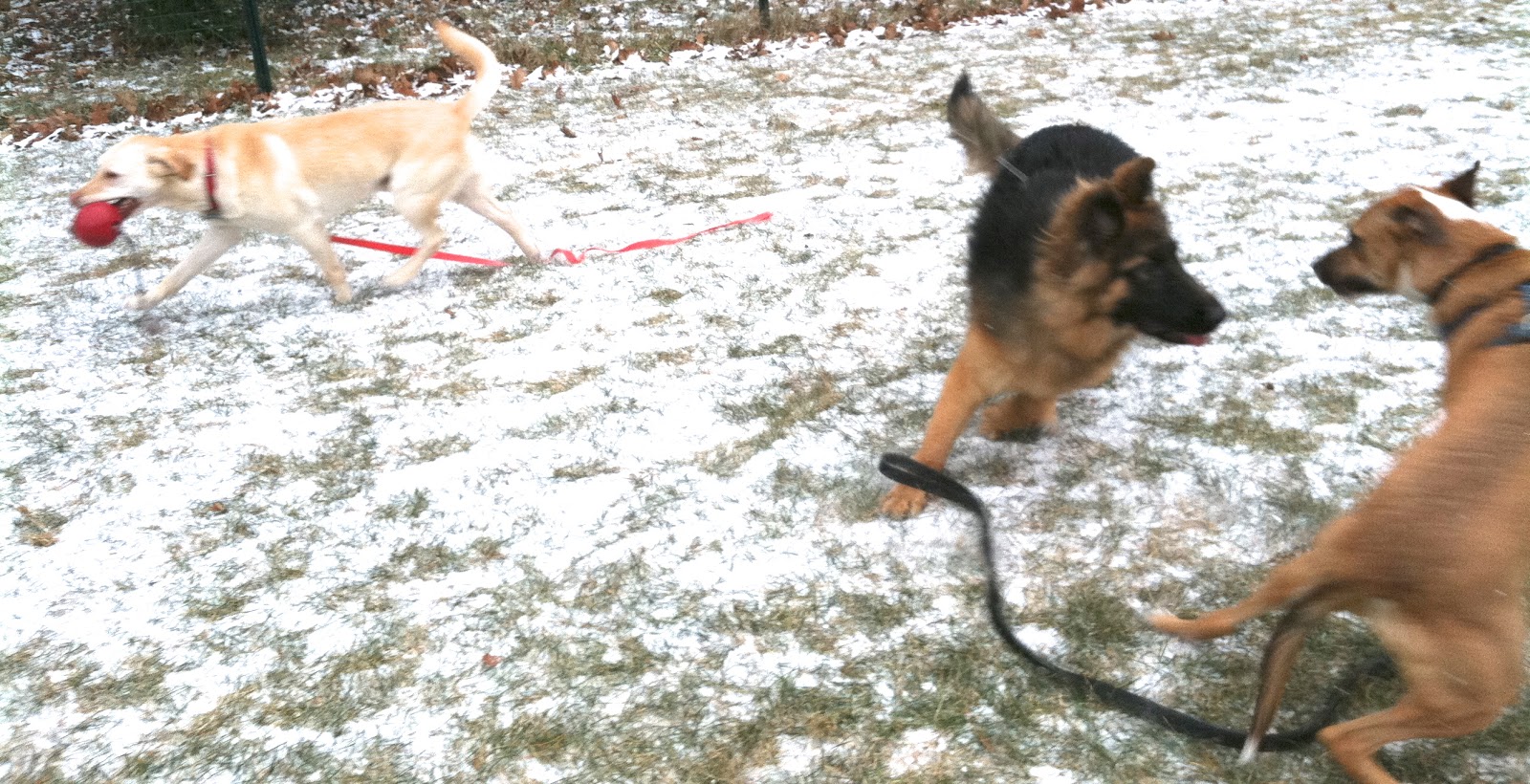
In this photo you see a yellow lab in the back ground playing a fun game of fetch with his owner while two other adolescent dogs are playing nearby.  While the proximity is quite close, this yellow lab has had a great deal of training and focus work.  Initially, you would begin at a distance from the trigger and be aware of your dogs body language so you can keep him engaged in the game as soon as he alerts to the trigger but before he actually reacts.

I hope this blog gives you some motivation to change your dogs behavior and not just shock it. I know there are many dog trainers who will happily take your money to stop unwanted behavior, however adding punishment to a stressed out dog is simply shattering his nervous system and breaking any relationship you thought you may have had with him.


Wednesday, February 27, 2013

Changing Behavior

When changing your dogs behavior or habits it is best to go slow and keep it simple.  Changing habits takes time and while the process may seem overwhelming at times, remember small successes are a big deal!
Steps to changing your dogs behavior: 
1. Make a plan, put it in writing, including specific detailed goals
2. Identify your dogs triggers and the alternative behavior you desire
3. Focus on asking your dog to do the alternative behavior or habit every single time the trigger happens at a distance, for several weeks.
4. Reward your dog generously for offering the alternative behavior
several reactive dogs changing their behavior
  • Reward even if the dog attempts the behavior.
  • Reward even if the dog takes one step or turns his head to consider the option of complying.
  • Avoid only rewarding when the dog completes the new behavior, but do reward the dog for even the slightest attempt of any new behavior.  This is called a "choice point",  it is to your advantage to reward any attempt in making the correct choice!  
  • Avoid this mistake:  if your dog is afraid of the mail carrier, then begin with all adults but avoid the mail carrier for now.  When your expectations are not real, you will be frustrated. Setting your dog up for success is best done when the triggers are very low and far away, this is a good plan for getting an alternative behavior started.
  • Even if the dog does it for one second!  When you begin to reward slight offerings of new behavior, your dog will more likely want to continue to play this new game!
Take it slow, breathe,  and relax as your dog is depending on you!  Setting your dog up for success also implies training when YOU are in a calm mental state.  If it helps, think of the many things your dog does right and build one small behavior at a time!

Next, I will offer specific games to play in specific locations to help you progress.


Monday, February 25, 2013

Aggression in Dogs

Canine aggression will always be an interesting topic discussed among dog lovers.  We know conflicts are normal and it is our job as humans to teach young children how to cope or resolve conflicts with other children and adults.

A Stressful Greeting
We humans are taught to resolve conflict by using our words at a young age, often through examples by our parents, teachers and grandparents.  Yet, many teenagers and adults have difficulty coping with conflict and may find themselves in a yelling or physical situation.  Having someone who loves them and are willing to help them change their behavior in very small steps is a blessing and a must for them to be successful.

If you find yourself the owner of a dog showing aggression, take a deep breath and first realize that changing behavior is difficult and will take time.  Many animals use whatever defensive mechanisms they have  to scare threatening intruders or scary stimuli away as a mechanism to feel safe.  Cows may only be able to kick at their aggressor, chickens may claw and use their beaks to peck or bite a scary stimuli.  Cats are known for their hissing, arched back and fast clawing as a way to say "back off."

Our furry canine friends also use what works for them which is often rapid barking, growling, show of teeth, lunging or snapping to scare off anything that they are afraid of.  If your dog is getting into scuffles at a park or daycare, please do not take him there anymore.  Aggression is a defensive mechanism that dogs will use to keep themselves safe or gain resources.  If your dog learns that aggression works, then he will continue to use it and even get good at it.

Now, avoid putting your dog in situations where he is showing even the smallest amount of aggression as you want to change this behavior right?  Then eliminate the possibility of practicing an unwanted behavior.

  • Make a list of the triggers that set him off, even those that put him into a heightened arousal or anxious state.  
  • Make a list of the alternative behavior you prefer your dog do.
  • Start slow and set your dog up for success.  For example if your dog barks at kids 20 feet away, then keep him 60 feet away for now.
  • Know what motivates your dog and be GENEROUS with the reward when he offers the alternative behavior.
This is just the beginning, breathe, really take a big breath as your tension is not helpful to your dog in any way while helping him feel safer.  Make your plan and remember your entire day is a series of habits or sequences of behavior just like your dog.  So, your plan should set your dog up for success just for today as we will be taking this one day at a time.  Stay tuned for more tips on changing your dogs behavior.


Wednesday, February 6, 2013

Control Unleashed Class

Control Unleashed Class was designed by Leslie McDevitt as a way of helping her own dog cope with the intense distractions at agility events. Not an easy task for a dog who was worried about strange dogs near and also afraid of noises.  The concept of CU is to create a focused and more confident dog!

Who needs Control Unleashed Classes?
  • Dogs that are uncomfortable or unable to work off lead around other dogs
  • Dogs that are easily distracted and have difficulty concentrating
  • Dogs that are reactive or easily aroused
  • Dogs that are anxious or stressed and often become shut down
  • Dogs that are unable to control their impulses when excited
Trainers agree this class structure offers a practical and positive approached to helping dogs who  struggle with environmental changes.    Understanding how to use desensitization and operant conditioning is presented in a clear scientific way so everyone can understand the steps.

Class structure is incredibly flexible to meet the individual dogs' temperaments and needs.  


CU involves exercising self-control through the use of default behaviors which are always a good thing, especially for dogs with poor focus or arousal issues.  It involves self-calming techniques, which is great for dogs that are shy or fearful or reactive or just aroused.  CU involves a highly predictable behavior that has them re-orient to their handler in times of conflict.  In short, this class provides highly predictable rule structure, valuable learning benefits, and  increased connection and teamwork between dog and person!
I highly recommend you try this class with a certified trainer, you will be so glad you did!

Tuesday, December 4, 2012

Learning How to Cope without Frustration

I find myself saying this to many clients, "your dog is barking because he is frustrated."  Many young pups and adolescent dogs become spoiled and then frustrated when they are not able to get to something or someone all the time.  You might think we could be discussing children, this emotion is very similar and difficult not to reward.

This behavior is apparent in many dog training classes, when an owner is playing with her dog using a toy, another dog will bark at them as if to say "I want that toy or I want to play too".  Motivating your dog to focus on you is a good place to start while in your own home where there are no distractions.

Leash Frustration
What about when a new dog enters the room?  Many dogs will bark and pull towards the new dog as if to say "I want to say hello."  If during the first 5 months of your puppies life you always let him pull you to new dogs you encounter, then your dog will be incredibly frustrated when you decide it is not a good idea to let him drag you around.  When a behavior has been rewarded repeatedly, then the reward is removed for the same behavior, frustration will certainly follow.

Picture a puppy that jumps on his owner then sits and is reward multiple times in his first few months of life.  When the puppy is about 45 lbs and is no longer rewarded for this jumping, the puppy will often jump higher or with more force, if this intense jumping does not work, then barking usually follows.  These puppies do not understand why their behavior suddenly is not working?  "I always get my owners attention by jumping and then get a cookie for sitting!"

Frustration enters the picture when punishment is applied or when he finds himself in a no win situation.  Asking any alternative behavior and rewarding it is so much better than just saying "no" which only increases the frustration.    Dogs can learn to cope with change and avoid frustration if they are rewarded for another behavior.

Helping your dog learn to live in a human world without becoming frustrated is a process, one that should begin the day you bring him home!


Monday, November 5, 2012

Canine Body Language Seminar


Mia greeting me with her back for safety.
Thank you to everyone who attended our Canine Body Language Seminar held at Poetic Gold Farm in Falmouth this past Sunday!  I believe, from all the positive feedback I have received, we accomplished our goal of helping everyone see that our dogs really do speak with their body movements.  When we take time to observe our dogs stance, their weight distribution, what their ears, eyes, tail, mouth, brows and tongue,  are doing as well as their over all body firmness, we can learn a great deal about our dogs emotional state.  With just a bit of practice we can understand what our dog is feeling given the situation they are in and how to help them if they are fearful or stressed.  As you can see in the above photo, Mia was not comfortable greeting me for the first time facing me, instead, each time turned and gave me her back, with ears down and back, tongue flicking up and out.  She clearly has a bit of hesitation when greeting someone new, but she did quickly warm up and roll on the ground in a relaxed goofy manner.

We certainly all agreed that when it comes to a dog greeting a strange person or new dog, the dog always has an opinion.  Rather than asking "can our dogs meet", we should all be asking "do our dog's want to meet" the strange dog or person.

Pablo is fearful of people and has begun to ground sniff.
Knowing how your dog is feeling in different situations will help you set him up for success.  Note in this photo, Pablo is sniffing the ground, he is uncomfortable with all the humans looking at him and has resorted to ground sniffing as it is comforting to him.  Knowing he was stressed I had my daughter play a game of "find it",  he happily ate the treats and kept a safe distance from the observers.

Bella is avoiding Pablo by sniffing in the grass.


As you can see from this photo taken a few weeks earlier, these two dogs having just met are not comfortable entering each other's space and therefore are demonstrating some avoidance.  Note Bella sniffing the grass and Pablo has a high tail and fairly stiff gate. This is the dogs way of keeping themselves safe, as neither dog invited the other dog into a friendly greeting, rather are clearly ignoring each other.
Bella greeting Buddy in a soft manner.


Here, you can clearly see how floppy Bella's body is in greeting Buddy.  Buddy began inviting her into his space by getting low and play bowing numerous times just after walking together for about 20 minutes. Their body's became soft, tails flat, joints soft with lots of movement, eyes were soft with no direct staring.   These two dogs played very well in a 50-50 manner having just met 30 minutes ago.

In summary, keep in mind that your dog will have an opinion about what he wants or needs to feel safe when faced with a new person, dog or environment.  Take it slow,  and practice understanding your dog when he is happy and relaxed and also when he is stressed or anxious.  Knowing how your dog is feeling will help you understand how to help him through situations when he needs you most!

Saturday, October 27, 2012

Dog Bites Mail Carrier

The human canine bond is incredibly special, and as canine lovers we bend all the rules to keep our own dog safe and out of trouble.  However, sometimes our dogs use their Hind Brain which controls their reactive, reflexive and poor impulse control which can get them into trouble.  If your dog is a thinking dog he is using his Front Brain more often and is more responsive, more conscious and has better impulse control.

Do you really know who your dog is?
Starting pups in classes creates a thinking dog.
If today, you opened your front door and are startled to see the mail carrier, will your dog bark, lunge, attack or wiggle?  Do you know why he behaves this way?  Are you comfortable helping him behave differently?

Helping your dog be a thinking dog can be a real lifestyle change.  You can start by washing your dogs bowl and putting it in storage.  Hand feeding your dog his meals as rewards for good behavior each day for behaviors both in and outside the home will help your dog be thinking more often.  Enroll your dog in private training lessons, basic obedience, rally, agility or tracking class to help him become a thinking dog rather than a reactive dog.  If you are not sure what your dog can handle, get a professional evaluation to set you and your dog up for success.  Helping your dog see a stimuli, including the mail carrier and think before he reacts is as rewarding for you as it is the dog.

Setting your dog up for success and helping him be a thinking dog instead of a reacting dog takes patience, good timing and daily practice.  When you see your dog go through a "switch over" and begin using his thinking skills when he sees certain stimuli, then you will know who your dog is becoming!


Thursday, July 26, 2012

Can The Dogs Meet?

As a dog owner you must here this question once in a while, can they meet?  The bigger question is do they want to meet?

I highly recommend you watch both dogs body language for this answer.  Many dogs are friendly however there are also many dogs who have not had good experiences or maybe no experience with strange dogs entering their personal space.   Yes, your dog has a personal bubble and may or may not want strangers in it.

When two dogs see each other, watch your dogs body language as well as the other dogs.  This may take 5 or more minutes as you and the other owner have your own greeting while remaining 10 feet apart.  If your dog is turning his back to the new dog, then he is saying, no thanks.  If your dog is looking away from the other dog, yawning, sniffing the ground, scratching, hiding between your legs, then you know your dog is not interested in this greeting.  If you proceed with the greeting, your dog will most likely growl as if to clarify "not interested!"

On the other hand, if both dogs are play bowing, getting low to the ground or trying to crawl to each other then you know you have two dogs who are both interested in greeting or playing.  Again, the slower greeting you have the better success you will have.

So, my suggesting is to not ask the owner anymore, but to ask your dog how he feels about the situation.

This sweet black dog below is encouraging the smaller puppy to engage in play, this greeting took several minutes before both dogs were jumping around in lovely, bouncy play.

This handsome yellow lab is not interested in visiting with the other dogs in class, he continues to have a wide mouth pant and looks away from the other dogs.  While many of us social beings would love for our dogs to love every dog they meet, the reality is we need to ask our dogs what they want in order to set them up for success.


Thursday, February 16, 2012

Leash Frustration


While many dogs enjoy playing with other dogs off leash, they may act frustrated, excited or even aggressive at the site of a dog when on leash.  It's unfortunate that the leash is a safety tool for us, yet can create what appears to be a Jekyll and Hyde reaction in our dogs. For obvious reasons, we must use a leash to protect our dogs and I am happy many of you do use them as they are the law in many places.
Why is this the case with some dogs? 

Dogs weren't born knowing how to be walked on a leash, and we humans weren't born knowing how to use them. Some of you may remember growing up with dogs in the neighborhood running around and greeting with no altercations.  That is because it is normal behavior for dogs to meet, greet, and/or sniff every other dog, person, or tree. It's nice to be that excited about everything, isn't it? 

This is where the term "barrier frustration" is often discussed in dog training. It's when something, in this case the leash, prevents a dog from getting to what he wants, over time this often results (inadvertently) into this frustrating or aggressive reaction. This lack of emotional control "I want it, I want it now! I must meet that other dog!" response inadvertently gets punished.  In many cases, dogs contained by invisible fences where there is a great deal of foot traffic will experience this heightened frustration.
Over time, with each on-leash walking episode, this frustration builds and builds and builds, and gets to the point where the mere sight of another dog triggers this frustrated reaction. Many dogs begin to associates other dogs with frustration. And we're all familiar with feelings of frustration - similar to going to the vending machine every day for months to get your favorite afternoon snack, only to have the machine eat your money and the snack get stuck as it is deposited.  Have you ever seen anyone hit, kick or even shake the machine?  Maybe you have felt this frustration.  Imagine if it happened every week!
Regardless of the "why", the solution is the same:  Teach Your Dog a Rewarding Incompatible Behavior.  Something that's fun, rewarding, and what will soon become the better, more desirable choice when out walking.
Two easy behaviors I find that work well are 1) "Auto Watch or Watch Me"—Your dog makes eye contact with you and he gets a treat.   2) "Find it"— where you toss a treat on the ground right in front of him, thus keeping his head focused somewhere else while having him "hunt", an activity many dogs enjoy. 
I suggest you take his meals on the road, but along with his regular kibble, add something he's more likely to be crazy for. This way your dog is more likely to pay attention to you, and not bark and lunge at the end of the leash.  Begin with these games in your home or yard where you have no distractions.  Then gradually expose your dog to a dog at a great distance and continue to play "find it" or say "watch me" when your dog simply looks at a dog.  Over time, your dog will look at a dog, then automatically look at you, hence the "auto watch" and be rewarded!  
With consistency, your dog will start to look at you as soon as he sees a new dog in anticipation of a fun game!  Be excited and generous with your rewards.

Tuesday, February 7, 2012

Barking at Strangers

Classical Conditioning is the process of making a new association.   Triggers can be something the dog sees, hears, smells, feels or even tastes, they are something that our dogs have associations with which may be scary or negative.
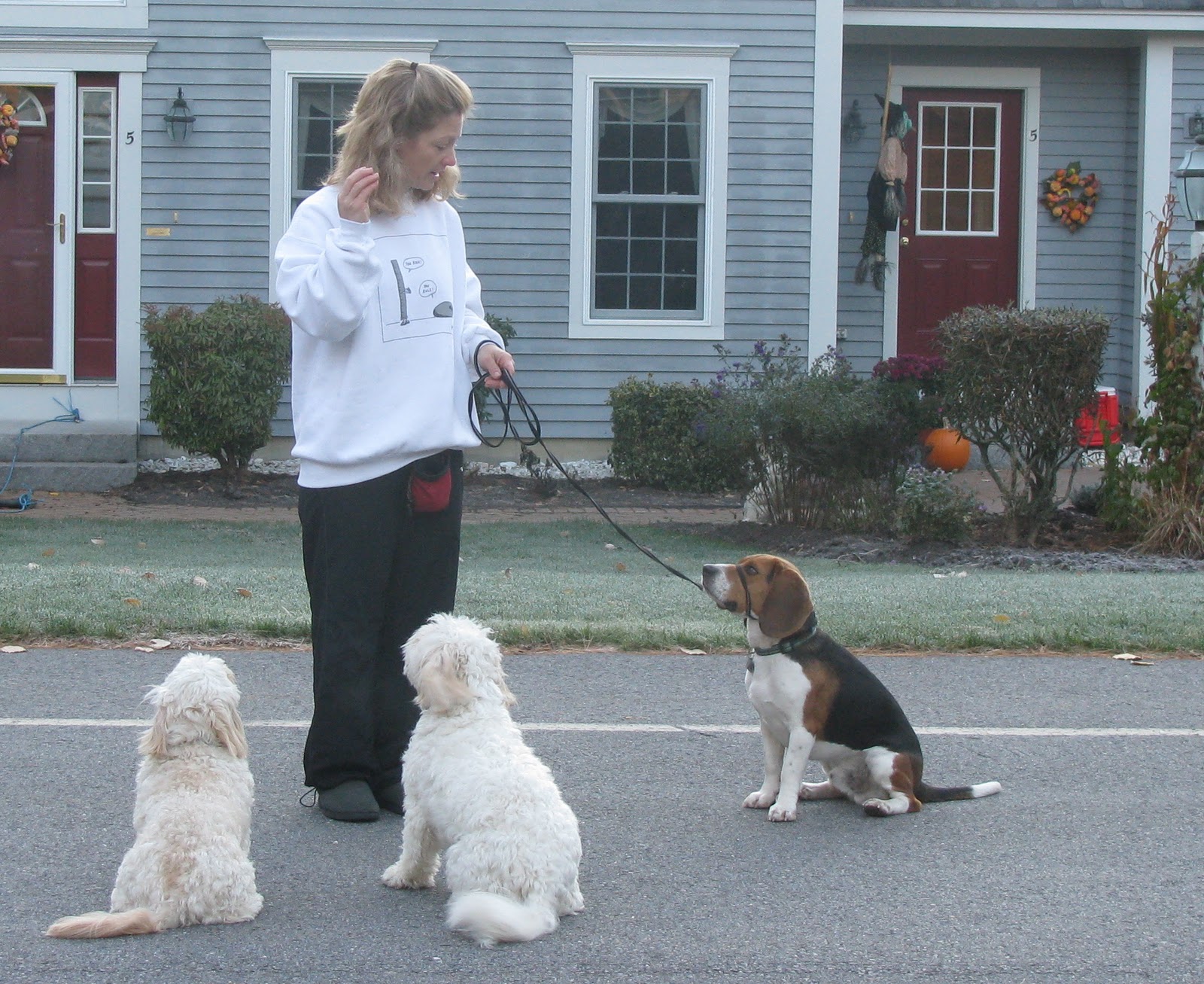
Reactive Beagle doing a sit stay in
the presence of new dogs.  I am using
hotdogs as a high value reward.
When we use classical conditioning we change an association or emotional response our dog has to a trigger.  For example, if our dog is currently afraid of strangers then Strangers = Yummy Food all the time!

The goal is to start having your dog make a positive association when he sees a stranger or a hand coming at him.  Even if he is growling, yes, you are changing his emotional state. Remember strangers or hands predict punishment or fear now, so let’s change it (classical conditioning). 
When he barks at a guest, ask the guest to toss him a treat or several treats.  If your dog approaches the guest, just let him sniff and ask your guest to not pet him as he is in training.  Try having a guest toss a treat behind your dog, I bet your dog comes closer to the guest each time for a new treat.  Then possibly progress to hand feeding from behind the stranger with no eye contact, then sideways, then touch and treat under the chin only.  Touching may take weeks, but eventually your dog will associate a hand coming at him as something good not scary!  
You will need to do this CC training in your home, front yard, side yard, driveway, street and any other place in your neighbor hood that your dog becomes worried.  You will need to continue this training in all new environments so your dog learns to generalize his new associations.
When we desensitize our dogs to their triggers we are lowering their reaction.  For example, if the knock at the door sets your dog in a high arousal mode say level 10, then knock as often as you think about it so her reaction is only a 3 when a real guest comes.  Lowering her arousal will help her control her emotions but you must be CALM for this to work.  When children are running around, or bikes are flying bye, take your dog far enough away that she sees or hears the trigger but can control her emotions, reward for an easy behavior like watch me, here cue or sit and stay.  Gradually move closer to the stimuli and reward for good emotional control. This is a progression and may take several weeks, but will work and is wonderful to see the dog gain confidence to the trigger.
Using the above methods will help your dog be calmer when scary stimuli are near. Practice many repetitions of having her hear or see the trigger and reward for calm behavior!  Remember if your dog is too aroused to think, move farther away!

Friday, February 3, 2012

Let Sleeping Dogs Lie

Why do so many of us feel the need to put our faces near a sleeping dog?

I have witnessed a child receive a warning scratch above and below the eye when startling a strange sleeping dog.  The dog cowered afterwards as if to ward off punishment as the child screamed.  This scream was enough punishment on the dog, I did not need to do anything except help both child and dog feel safer in each other presence after this incident.


How would you react if you were sound asleep and something startled you?  For a shy or fearful dog trying to sleep with a strange person or dog in the house can be very unsettling.  They may drift off, yet still be on guard.  This dogs first emotional response when startled is to protect him/her self with it's best defensive weapon, its teeth.  Unfortunately, many owners and sometimes guests are bitten when they startle a sleeping dog.  If a person is bitten by a dog, there is ALWAYS a reason, we just need to determine what that reason is and work to desensitize or modify it's behavior.

Success lies in determining if the dog was reacting out of fear, guarding a resource or being dominant and biting his owner.  Treating one will not fix another, so getting a good history is the key to preventing this incident from happening again.

Tuesday, January 31, 2012

Shock collars

Just because we can use this type of punishment, does not mean we should.
This dog stopped eating when
boarded with a male trainer.
I am once again called upon to help with a rescue dog that wants to attack humans.  Not just bite, I mean lunge, snarl and do what ever it needs to do to keep any man from coming near him.  


Ask your self why would a dog be so hostile and angry with a man coming near it?  Because we are now familiar with this dogs history, like many before, we again are faced with the unfortunate fact that a trainer, in this case a male tried to punish a fearful dog.


Please make sure that any "trainer" you employ is Certified with the Association Of Pet Dog Trainers and is able to provide you with a Positive Rewards Based Training Plan.


Why does Sheila not trust hands?
Sure you CAN shock your dog for barking at your neighbor each morning, but do not be surprised when your dog bites that man who he now associates with punishment.


There are reams of studies and stories from trainers, scientists and behaviorists that lead me to believe e-collars and/or remote collars have a great potential for misuse, whether intended or unintended.  So before you use this correction on your dog, I suggest you use it on yourself or even one of your children if you dare.  It is not pleasant, nor is it effective.

Tuesday, December 6, 2011

A Stranger in My House

Sophie with the stranger
Sophie, my scottie is clearly concerned about the presence of this stranger near her.  Her eye is on him, her tail is up, she is standing rigid and not moving.  I quickly asked him to stand still until I could reengage her in her ball.

As this worker moved about the house, I used play to desensitize her to his presence.  This Counter Conditioning process involves taking a fear provoking stimulus (stranger) and changing the association to one of signaling something (pleasant) in this case, a play session.

I began this process over 1 year ago with children and strangers on my street and in my yard, by using yummy treats or play to counter condition Sophie's emotional response when strangers were present.  This generalization stage is the phase of learning where the dog learns that the new association is relevant in a variety of circumstances and situations. Sophie now enjoys strangers entering our home as she associates them with something positive, but having this stranger disappear and reappear with no warning from inside is something very unsettling for her.

I am sure once I get this situation comfortable for Sophie, she will again alert me to something new with a guest or stranger that she is not comfortable with.  I believe I will always need a maintenance stage in which I incorporate repetitions from previous training stages to encourage the appropriate emotional response from her.

While many dogs can be counter conditioned quicker, I adopted Sophie at age 5, so her behaviors had been practiced for some time, but her progress is steady and improving with each play session!

Monday, December 5, 2011

Who is Training Who?

Have you ever thought about how your dog has 2 trainers in most situations?  It is true, both you and the environment are influencing your dogs behavior.  Any stimuli in the environment (sounds, smells, people, dogs, objects, etc.) can effect your dogs behavior.

Relaxed, Positive Energy 
Knowing how to use Classical and Operant Conditioning methods is the key to setting your dog up for success in many different environments. Classical Conditioning is how your dog feels about something and Operant gives your dog an alternate behavior to choose.

The key to remember is that your frustration can play a big role in how your dog feels about any given stimuli.  Patience, practice and a positive attitude will help you achieve success with your dog.

When you become the the primary means of delivering all rewards to your dog and learn to reinforce all of his good choices, then YOU become the most influential to your dog, not the environment. This is such a simple thought, but so important to helping any dog over come obstacles in the environment.