Tuesday, December 6, 2011

A Stranger in My House

Sophie with the stranger
Sophie, my scottie is clearly concerned about the presence of this stranger near her.  Her eye is on him, her tail is up, she is standing rigid and not moving.  I quickly asked him to stand still until I could reengage her in her ball.

As this worker moved about the house, I used play to desensitize her to his presence.  This Counter Conditioning process involves taking a fear provoking stimulus (stranger) and changing the association to one of signaling something (pleasant) in this case, a play session.

I began this process over 1 year ago with children and strangers on my street and in my yard, by using yummy treats or play to counter condition Sophie's emotional response when strangers were present.  This generalization stage is the phase of learning where the dog learns that the new association is relevant in a variety of circumstances and situations. Sophie now enjoys strangers entering our home as she associates them with something positive, but having this stranger disappear and reappear with no warning from inside is something very unsettling for her.

I am sure once I get this situation comfortable for Sophie, she will again alert me to something new with a guest or stranger that she is not comfortable with.  I believe I will always need a maintenance stage in which I incorporate repetitions from previous training stages to encourage the appropriate emotional response from her.

While many dogs can be counter conditioned quicker, I adopted Sophie at age 5, so her behaviors had been practiced for some time, but her progress is steady and improving with each play session!

Monday, December 5, 2011

Who is Training Who?

Have you ever thought about how your dog has 2 trainers in most situations?  It is true, both you and the environment are influencing your dogs behavior.  Any stimuli in the environment (sounds, smells, people, dogs, objects, etc.) can effect your dogs behavior.

Relaxed, Positive Energy 
Knowing how to use Classical and Operant Conditioning methods is the key to setting your dog up for success in many different environments. Classical Conditioning is how your dog feels about something and Operant gives your dog an alternate behavior to choose.

The key to remember is that your frustration can play a big role in how your dog feels about any given stimuli.  Patience, practice and a positive attitude will help you achieve success with your dog.

When you become the the primary means of delivering all rewards to your dog and learn to reinforce all of his good choices, then YOU become the most influential to your dog, not the environment. This is such a simple thought, but so important to helping any dog over come obstacles in the environment.

Wednesday, November 30, 2011

Looks are Deceiving

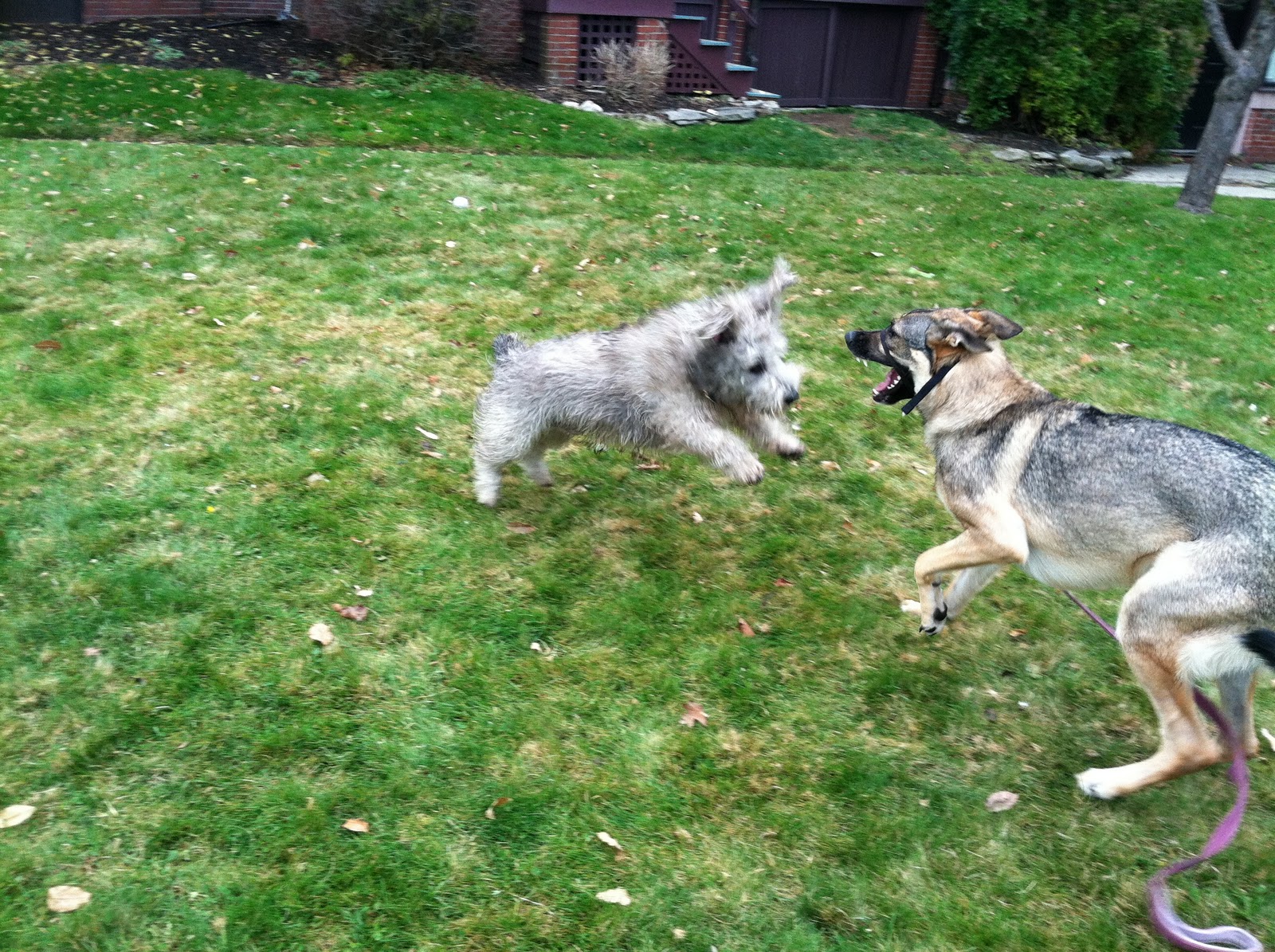
I love this photo! Not because the terrier is absolutely adorable when rushing at the Shepherd cross but because no one told him she was part "wolf".  He has no worries and simply wants to Play!  Both dogs are only one year old.

While it appears that a fight may begin, the terrier assures the larger female of his intentions by his lovely body skills and soft mouth.  Of the two, the terrier has more play experience than the larger dog.  If you had only seen this photo, you may have been alarmed, but I can assure you that play followed for some time.

The communication is endless from the female with ears back, soft eyes, lifted paw, leaning backwards, soft joints, open mouth with no teeth showing.  One vital piece of information for her is that the terrier is not looking in her eyes, yet off to the side which is non confrontational.

One friend is better than no friends!

Monday, November 14, 2011

Treat and Retreat

I am not sure who first came up with the phrase "treat and retreat", Ian Dunbar or possibly Suzanne Clothier but this concept really works!

If you are ever in a situation where you are face to face with a growly dog, it is wise not to try to dominate this kind of canine.  As trainers, we repeatedly discover that the dog doing the growling is as uncomfortable with the situation as the human is.  The best way to ease the tension is to communicate your friendly intentions as calmly and quickly as possible!

This is where the use of a treat can be tossed behind the dog, as the dog goes to check out the treat, you can retreat a bit for safety.  Having someone holding the dogs leash is always a smart idea as you proceed to toss treats behind the dog and watch him get the treat and come a bit closer to you each time.  You will quickly notice the dog has stopped growling as he is most likely interested in the treats and no longer wishes you to leave.  This does not mean you are buddies yet, but it does mean you have taken the first step in assuring this growly dog that you mean him no harm.

Bentley continues to get closer as he feels safer.
Making friends with a growly dog will make the dog feel better as it will you!  We often hear, "he is slow to warm up to people,"  dogs often bark at strangers, however refrain from barking when they have had a chance to feel safe with this new person.

Consider using the treat and retreat approach to make your own fearful or shy dog feel safe with new guests.  If you know of a friend with a growly dog, take special treats and toss them when you arrive, you may be surprised how much better you both feel.

This may take minutes or weeks, but will help your dog feel safer each time he is faced with a stranger.

Because I know Bentley this handsome Boxer, I begin by tossing treats, progress to hand feeding then touch and treat.  Only allow people your dog knows to use this progression in a single session.

Wednesday, November 9, 2011

Feisty Fidos - Leash Lungers

Many of you have seen or owned a dog that is reactive or barks at other dogs when on a leash.  This behavior often gets a dog surrendered to a rescue group because it is very difficult to walk.  Unfortunately, many clients have said "I wish I had met you sooner, then I would not have given up my last dog." As someone who works with many rescue groups, this breaks my heart as I know many pet owners are not aware of the training we do with reactive dogs.  

Below is a video of Eva, a pet dog who was very reactive on a leash when she saw a strange dog.  After one session of our Feisty Fido class, she is much calmer when she sees a dog.


Everyone has a specific goal in mind for their dog.   Maybe it is to earn a Canine Good Citizen Certification, or walk past a dog on the street, or be able to attend a class with other dogs.  What ever your goal know that changing behavior does not happen overnight, but we at CBC have the tools to help you change your dogs behavior in a positive successful manner!