Wednesday, November 26, 2014

5 Body Postures, A Dog is Asking For Space

If humans better understood dogs body language then we would have less dogs resorting to a bite when they feel stressed or threatened.  We see several cues that this scared boy does not want to be touched.  Signals that are asking for distance are often very subtle.

Level 1 distance Cues:
1. Dogs body is leaning away from the approaching hand.
2. Dogs paw is raised in a submissive manner.
3. Head is moving away asking for increased distance.
4. Eyes are avoiding the stranger
5. Mouth is closed, rather than open and relaxed.

Dogs often ask for distance in the only way they know how, but if the scary hand keeps coming, your dog may resort to a level 2 distance cue like a Growl, lip curl or show of teeth with a rigid body.  I HOPE your dog growls rather than bites. Hence, do not punish the growl as it is an effective distance cue.  When the dog is punished for growling, but is still afraid of that hand coming as it predicts pain, he may bite to protect himself.  

Have you heard of someone who was bitten by a dog in the face while they were attempting to pet him or rub his belly?  It is probable the dog used some distance cues before he resorted to a bite. Unfortunately, it is likely the human did not understand the signals and continued forward until the dog felt so threatened he did not have time to use a more moderate level one or level two response.

Dogs that are fearful or have been threatened by a previous human will be on guard and defensive.  Canine behaviors asking for distance are far better than an attack with a bite, so please do not punish them. Rather, simply remove the approaching stimuli. Can you teach a dog a level 1 distance cue like a look away? Absolutely, but it takes time and patience -- and it is well worth the effort!


Sunday, November 16, 2014

Fight or Flight?

On a recent trip, I found myself in a nice hotel lobby visiting friends.  I decided it was time for
It is easier to understand
human intentions.
"goodbyes" so I headed for the elevator.  When the door opened, there were three rather imposing-looking men standing along the back wall.  I froze for a second!  Do I get in and turn my back to them?  Do I step in and continue to face them? Do I walk away as if I forgot something?

Depending on our past life experiences we may all feel differently about being in this situation.  Many of you might say "Wow, you are overly sensitive" or "I would flee, for sure!"

At only 5'1" I often feel vulnerable when alone, but knowing I was in a nice hotel, I chose to step into the elevator, turn slightly sideways and push the appropriate button.  As the doors closed I felt an intense hot flash rush over my entire body. Feeling trapped with no flight path, I was over come with fear.  I decided I would fight if needed and looked into the nearest mans face and said "Hi." He smiled and nodded his head. I looked at the young man in the middle and he nodded before I could speak and looked quickly away at the ground. I looked straight at the third man and his head was resting on the back wall with his eyes closed.  With this information, I did not feel as threatened and was able to relax just a bit, although I was still on guard as the elevator took FOREVER to get to the 10th floor.  I waited until the door began to open and then quickly stepped out of the door in a sideways movement and looked behind me to see if anyone would follow. Thankfully the doors closed and I was free to hustle to my room. The feeling of being safe was oh so good!

Fight or Flight, also called the acute stress response are terms ethologist's and behavioral
psychologist use to describe the behavior of numerous species -- including humans.  If a stimulus is perceived as a threat, a more intense and prolonged discharge of locus ceruleus activates the sympathetic division of the nervous system. For a thorough understanding on how the body reacts, visit:  (Thase & Howland, 1995)
Am I clear? says the golden.  Good, I don't want to bite you.

We think of prey animals such as the horse, deer and other animals with wide set eyes to use flight as their way of staying safe.  Predators such as wolves,  cats & dogs will often choose flight if given the opportunity.

However, if a valued resource is worth fighting for, or if a predator is trapped and prevented from flight, then it will likely use a fight response to keep himself safe.

Back off, I am in fight mode as there is no flight accessible


Fight-or-flight responses are as normal in our canine friends as in our human friends.  When you see a dog use a fight response such as a growl with a specific stimulus, consider if the dog has a good reason to do so.  Is the dog trapped?  Is this dog given a chance to use flight?  Could this dog have good reason to not trust a particular stimuli?

I suggest if you have a dog that is using a fight behavior, consider first the dogs history.  Assess the situations, observe the dogs entire body, seek to understand before you consider how to proceed.  Do not immediately correct or punish, as this dog may have good reason to growl or snap. The dog may simply be afraid.  Help me prevent dogs from being punished for choosing fight when they are left with no other option. Dogs that have been punished for simply being afraid, are much harder to counter-condition later.


Sunday, October 12, 2014

Why Does My Dog Do That?

Do you ever wonder why your dog performs certain behaviors or motor patterns?  I sure have! For example: Why does my dog roll on smelly things?  Why does my dog shake his toy?  Should I be worried if my dog stalks his playmate?  Why does my dog guard his bones?

Specific behaviors that are unique to our dogs are called Phylogenetic behaviors.  These behaviors, or behavior patterns, have developed over many many generations and truly have evolutionary significance to maximize reproduction and survival.  Stalking and bouncing are examples of phylogenetic behavior, as is an innate fear of loud noises.
Hunting, for fun or survival?

When we think of our dogs behaviors we can summarize that all their behaviors come from three simple motivations:
1. Hunting/obtaining food
2. Safety/avoidance seeking
3. Sexual/reproductive behaviors

Behaviors observed in just the hunting motivations:   orient to sound or moving object, stare, freeze, creep, stalk, run, jump, grab, hold, shake, hold down, kill, eat, guard.

Can we change phylogenetic behaviors?  All behaviors can be modified to some degree with patience and a strong counter conditioning process.

Inherently genetic behaviors may be strong in your dog and low in my dog, as each dog has a different  genetic make up.  Such as rolling in feces, a yucky behavior to us humans, but many of our dogs do it!  Why? The science behind this behavior is that our dogs roll in animal feces or on a dead animal so they can mask their scent to better help them sneak up on their prey.  Does your dog need to stalk his prey for survival? Unlikely, but this behavior can be a strong genetic trait.

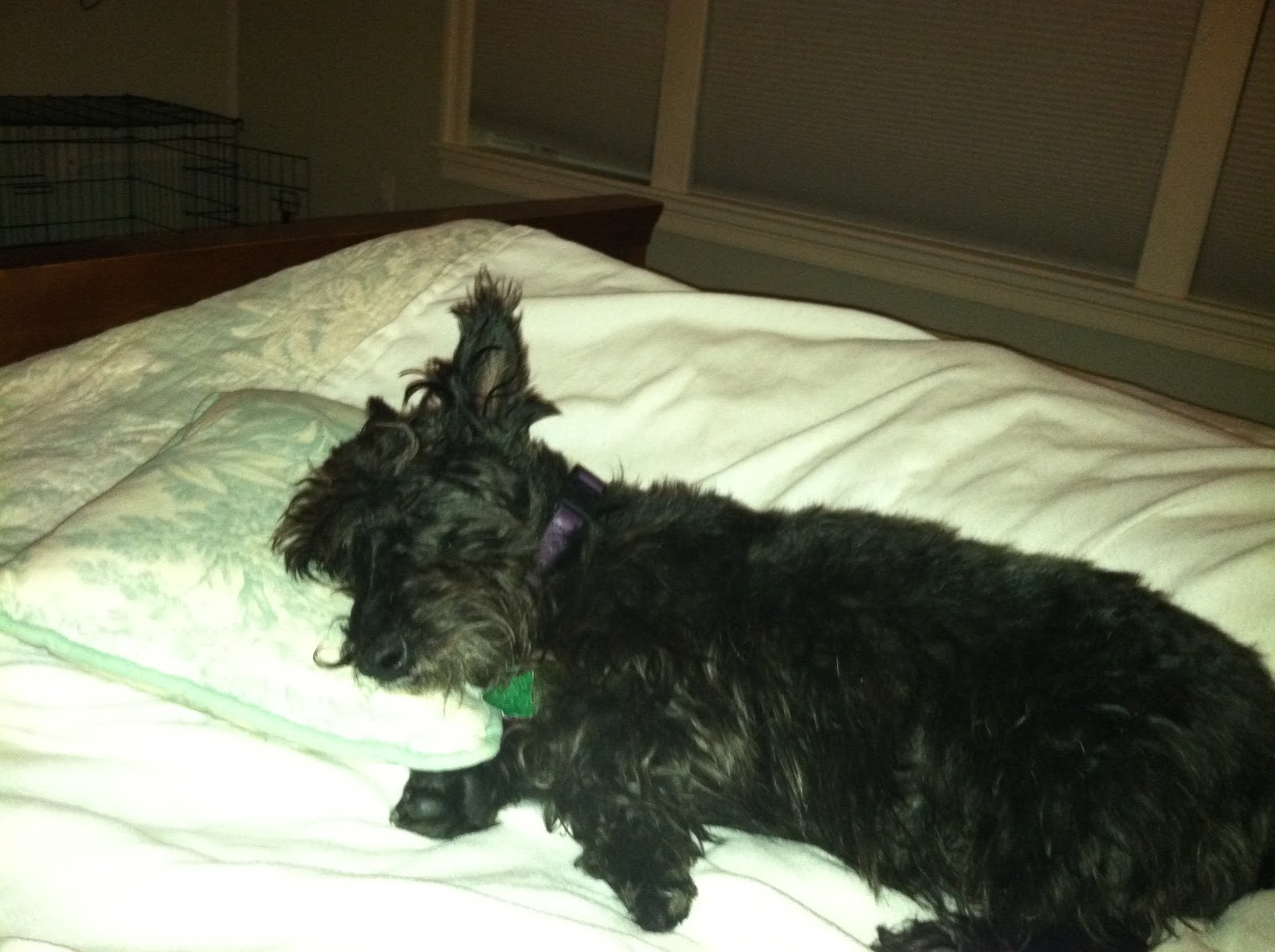
Resting for the next hunt.
We know some dogs learn to play fetch just by watching another dog play fetch. This is called Social Learning.  Other dogs perform behaviors for the reward, for example my female Scottie will frequent my neighbors back yard and scan for a squirrel to come down the bird feeder. She has been successful on two occasions and enjoyed eating them as well.  Does she need to hunt for survival?  No, but this behavior is both rewarding to her, and a strong genetic trait, therefore she will repeat it.

Many dogs use hunting behavior patterns in play, others will use sexual motor patterns like mounting and neck biting to initiate play.  The point is our dogs do many behavior patterns as a result of their genetic make up. If this behavior is followed by a reward, then this behavior will most likely continue to be practiced.


Wednesday, October 1, 2014

One Behavior You Must Teach Your Puppy?

To Sit?  That is a nice default behavior, but not the most important one to teach.

To Come?  Great behavior to have consistently for sure!

To Leave it?  Awesome behavior to have, great on walks both on and off leash!
hand feeding for good behavior

How about not to bite human flesh?  Sounds pretty important to me! Bite inhibition is the technical term for a dogs ability to control the pressure they use when biting. If you could only teach your puppy or new rescue dog one behavior, please remember to teach him a soft mouth -- aka bite inhibition.

How?  By giving your dog appropriate feedback.  Over several days with the following positive techniques, your puppy will learn this life saving skill.

1. Hand feeding daily meals, release the food when your puppy is gentle or licks.  If you feel teeth, wait until he softens, then reward.
Example:  Say your pups name and when he look at you, offer a piece of food.  Say your pups name and "come" offer a piece of food as a reward.  Reward your puppy for coming and sitting 10 times per meal and you will have a solid sit and a softer mouth!


Playing Tug can teach a soft mouth
2. Play tug, using the rules of tug you can quickly help your puppy learn that when you feel teeth on your skin, playing stops.  Remember, do not drop the toy or you could teach your puppy that biting is how they do get the toy.  Instead, ask for a sit to begin the game, then say "take it" and play "tug" keeping the toy low to the ground.  Next, put a treat to the pups nose and say "leave it" and
exchange with the food while putting the toy behind your back.  Repeat, sit, take it, tug, leave it.


flat pan cake hands are non threatening
3. Body handling your puppy with a soft, flat gentle hand.  If your puppy bites your hand, then let your hand go limp, dead like, and wait until the puppy removes his mouth from your hand.  Repeat slowly and gently as your pup learns that hands predict good gentle scratches and massaging.  Some puppies respond if you scream, but some thing you are simply playing, so this feedback may help and it may not as all puppies are different.


4. Allowing your puppy playtime with another friendly dog or in a puppy group.  Playing with other pups will surely help your puppy learn
Puppy play group
not to bite too hard, many pups learn to use a soft mouth when playing with their mother, however some pups miss out on this lesson and will therefore learn it while playing with other puppies and of course playing with you.

Teaching your puppy a soft mouth or  good bite inhibition is the ONE most important behavior you need to teach.  Remember, your pup will not stop using his mouth on you and your clothes in 1 day as he has been using it with his siblings for 8 weeks,  be patient and give your puppy the feedback he so needs to be able to live with humans.

What should you not do?  Scare your puppy or teach him that human hands are to be feared, as this tactic will most likely make him want to bite hands more.  Why?  Science has taught us that dogs who are handled in a physical or rough manner are more often to bite later in life.  Science has also taught us that aggression breeds more aggression.

If you do not want your puppy to use his mouth to resolve conflict, then please do not use your hands to resolve conflict.  Science has taught us that rough hands on a pup, will create unwanted behavior changes as the pup matures.  Example: Submissive peeing, over the top wiggly greetings, worse mouthy behavior, biting later as an adolescent dog, growly and avoidance behaviors.

For a reference on teaching a soft mouth, refer to Sophia Yin's Low Stress Handling techniques
Dr. Sophia Yin, Low Stress Handling.  Although Sophia passed away just yesterday, she will always be a source to reference because she educated those of us in the Pet Industry that the emotional well being of the animal is essential to avoiding unwanted behavior changes.


Wednesday, September 17, 2014

Why is my Dog Lunging on the Leash?

Do you own a dog that does not act "normal" when he sees another dog on leash? 
Learning good emotional control takes practice
Many dogs do not have good coping skills to greet another dog when confined by a leash.    
You may describe this type of dog as fearful, hyper vigilant, aggressive, reactive, out of control, barks all the time, rude, pushy, anxious or even clingy.  Dogs who exhibit these behaviors are cruelly labeled and often given up on, but the truth is that these behaviors are your dog's way of begging for some help.  If your dog is displaying these emotions he is clearly not a calm dog, and therefore not a balanced or content dog.  Unbalanced dogs are riddled with emotions they cannot control, which make them difficult to live with and own, but these are the dogs that need us the most.....


With effective behavior modification programs, these anxious reactive dogs can thrive in our homes and communities.  Having a plan to keep them safe, predictable exercise routines, desensitization tools, healthy nutrition, doggie Zen and possibly medication, these dogs will love us unconditionally.  Just look in there eyes and help them feel safe, always..

If you have taken on the task to raise a dog with fearful reactive behaviors, know you are not alone.  I personally have three dogs who each have different levels of fears and often use distance cues with humans and dogs.  I understand your stress of owning an unbalanced dog....  Even my family members have called them names, not truly understanding my dogs level of stress. I feel an enormous amount of empathy for these animals as I see in their body language how much more worried they are then other dogs.  I have spent hours counter condition their fears to various stimuli and I work very hard to have a plan each time I take them in public so I can set them up
Thinking through arousal...
for success.  I manage for safety, continually counter condition their fear emotions to positive ones so they know what to do in different situations and cherish each calm moment we have together.  My two females came to me with bite histories and have each received their Canine Good Citizen Certification from two different trainers.  One has gone on to be Therapy Dog International Certified, so do not lose hope and celebrate each small daily success!  


Using the right balance of tools, your dog will one day be able to think through his arousal so you can reward him and not be frustrated with him.