When training our dogs, we often expect them to read our minds. Well, they can’t! But you can help them by offering feedback to them. What is feedback? It is a way of helping your dog know when he is doing something acceptable or not.
Good dog handlers offer their dog feedback on their behavior throughout the day. When you see your dog laying calmly on the floor, let them know you are happy with this behavior! Say, “good dog, what a good dog”, in a sweet voice.
If you have a puppy, you should be giving him feedback constantly! I mean if you are with him an hour, then offer feedback 50-60 times! For Example, when in puppy class I am always encouraging my clients to reward their puppy when ever they allow another puppy near them or begin to play with another pup. I want puppies to know that I am thrilled when they play well with another dog.
What if we have a bully in the class? I follow that bully around and say, “good dog, yes, good girl, what a good girl”, when she is nice, so the second she gets to rough, I am there to say, “uhuh, take a break” in a lower tone, then again as she eyes another playmate, I am again letting her know, that she is a “good girl, nice play, gentle, what a good girl”, all in a sweet voice.
Remember puppies need to play rough to learn how to resolve problems so having a bully is not a problem, it just means they need more Feedback!
How about when teaching your dog a new cue? When you first say “Stay” your dog has no idea what you mean. But if you reinforce the stay cue by saying “stay, good stay, that is a good stay”, in a sweet voice then offer a quick reward of food or affection. Your dog will surely learn quicker when you talk sweetly and repeat the behavior that he is doing the right. This type of Positive Feedback quickens the learning process with your dog.
So be a Great Dog Owner and give your dog lots of feedback!!
Thursday, May 28, 2009


Wednesday, April 15, 2009
House Training

I recommend you keep your puppy close to you or in a crate and show him where he should potty every 2 hours to start. Then gradually increase the time between trips out doors. If your puppy does have an accident, don't react. Any punishment will be unproductive and could even encourage your puppy to eliminate more often as a submissive gesture to your reaction. You can take away your puppies water about 7 PM and replace it with a few ice cubes.
Approximate Overnight Holding Limit = 1½ times the Daytime Holding Limit
Example: 3 month puppy can hold for 1½ x 4 = 6 hours overnight
Whenever you are unable to supervise your puppy with 100% attention, you need to place her in either a short-term or long-term confinement area.
Your puppy can be placed in a short-term confinement area such as a crate if she will be there for less than her holding limit. The purpose of the crate is to keep her out of trouble while you are unable to supervise her, and to help you house train her. The crate should be just big enough for her to be able to lie down on her side with outstretched limbs, stand up, and turn around easily. It should not be so big that she thinks there is enough space for a bedroom and for a toilet area! When you let her out of her crate you can bring her straight outdoors and reward her for doing her business in the right place.
For longer confinement periods a bigger area, with non-absorbent flooring, such as a bathroom, kitchen, or utility room, is needed. The long-term confinement area should have a bed or open crate at one end, and a pile of newspaper, a puppy pad or a strip of sod at the opposite end. Your puppy will naturally want to eliminate as far as possible from her bed. If the space you use for long-term confinement happens to have a door that leads to the outdoors, then place the toilet area near that door. This way, your puppy’s toilet area is as close as possible to where she should ultimately be heading to do her business. Fresh water and stuffed chew toys should also be plentiful, and should be placed near her bed.
Your Puppy will naturally have the urge to eliminate after a nap, a meal, a drink, exercise, excitement, or time spent in confinement. Give your puppy the opportunity to do her business outdoors at these times. When your puppy does her business in the right place offer her a treat, plenty of praise, a game or a walk. This will speed up her house training habits.
Punishing a puppy for house soiling after it has happened is abuse, not training. If you wait more than a few seconds after your puppy has eliminated before expressing your disapproval, your puppy will not know why she is being punished. If you catch your puppy about to pee or poop in the wrong place you can clap your hands and say “Ah-ah”, and swiftly scoop her up to the outdoors to continue. Punishing her after the fact just makes her anxious for you to return the next time as she will assume you will be aggressive every time you come home.
If you would like your dog to poop promptly when you take her out, then teach your puppy that a prompt poop is her ticket to a walk around the block. This will encourage her to poop as soon as you let her out – and will allow you to leave the stinky poop bag at the house, rather than having to carry it around for much of the walk. If you do the opposite, take her for a walk, and ending her walk as soon as she does do her business, she will learn to delay pooping!
Also, you must be consistent! If you train your puppy to poop while on a leash M-F, then you cannot expect her to poop on Sat. in the back yard off the leash. Our puppies do not generalize information that well, so if she is having accidents, you must consider her schedule and what you have taught her.
House Training Options:
Considering the use of Puppy Pads?
- Advantage - Portable and indoors
• Disadvantage – Dog may view any paper lying on the floor as fair game. This process can eventually lead to training outside, but adds an extra step.
How about a Litter Box?
- Advantage – Portable, indoors, doesn’t require going outside and dog doesn’t have to wait for someone to let her outside.
• Disadvantage – Daily cleaning of litter box, not a good choice for medium or large dogs.
Advantages of Crate Training
- Keeps puppy safe when you can not watch your puppy.
• Teaches puppy to keep his area clean.
• Should never be used as punishment but
• Should be used as a safe haven for your pet.
• Begin when you first bring your puppy home. Start with just a short time and increase the time as your puppy feels comfortable.
• Do lure your puppy in and out with treats so he enters on his own. Do not shove your puppy in and shut the door right away.
• Keep the crate in a place where your puppy can hear you talk to him.
Saturday, March 7, 2009
Positive versus Negative Training
Unfortunately, there are a few really nasty Dog Trainers and Breeders out there. If at any point you happen to meet a dog trainer or breeder who asks you to do any of the following, please don’t!
These are adverse (negative) training methods of the stone age and will only cause fear, stress and possibly aggression in your dog! Not to mention your dog will not trust you unless you repair your relationship with him through counter conditioning.
The good news is there is a better way!! Positive Reinforcement Trainingis not only a beautiful way to motivate your dog to act as you would like him to, it is also the most effective. This type of motivational training will strengthen your relationship with your dog, and help him feel safe and satisfied at ALL times. And, it will be much more enjoyable for you -- and your dog!
Do you believe your dog feels excitement, curiosity, fear, exhaustion, sickness? Sort of like a child? Well, it’s true! That’s why we should really evaluate how we treat Mans Best Friend!
I have always enjoyed having a special relationship with the dogs and horses I spend time with and train. This relationship is not only built on trust, but in being aware of what the animal is trying to tell me. So I ask that you try to listen to what your pet is telling you. Is he fearful? In pain? I don’t believe animals are ever simply stubborn. Rather, I do believe they may lack motivation, do not feel safe or are physically uncomfortable with what we are asking of them.
So, do not always request, wait for a response and reward your pet, but request and listen to your pet! You might just learn something new about your Best Friend, and build a stronger relationship based on trust!
- Pinch your dogs ear
• Roll your dog over and hold him down
• Shake your dog
• Teach your dog the down cue by stepping on the leash near his collar
• Pick your dog up in the air by his collar
• Use a pinch collar as a correction
• Use a shock collar as a correction
• Scruff your dogs neck
• Make your dog submit to his fears
These are adverse (negative) training methods of the stone age and will only cause fear, stress and possibly aggression in your dog! Not to mention your dog will not trust you unless you repair your relationship with him through counter conditioning.
The good news is there is a better way!! Positive Reinforcement Trainingis not only a beautiful way to motivate your dog to act as you would like him to, it is also the most effective. This type of motivational training will strengthen your relationship with your dog, and help him feel safe and satisfied at ALL times. And, it will be much more enjoyable for you -- and your dog!
Do you believe your dog feels excitement, curiosity, fear, exhaustion, sickness? Sort of like a child? Well, it’s true! That’s why we should really evaluate how we treat Mans Best Friend!
I have always enjoyed having a special relationship with the dogs and horses I spend time with and train. This relationship is not only built on trust, but in being aware of what the animal is trying to tell me. So I ask that you try to listen to what your pet is telling you. Is he fearful? In pain? I don’t believe animals are ever simply stubborn. Rather, I do believe they may lack motivation, do not feel safe or are physically uncomfortable with what we are asking of them.
So, do not always request, wait for a response and reward your pet, but request and listen to your pet! You might just learn something new about your Best Friend, and build a stronger relationship based on trust!
Monday, February 16, 2009
Winter Walks

We are fortunate to live in an area where there are so many dog friendly beaches and dog parks! This is also a fun way to meet friends who are also crazy about their dog! In addition, dog parks are great places of high distractions, if you want to practice your dogs cues, this is a great place! Remember to focus on adding positive reinforcement to your training!
Here’s a great link with information on local “dog-friendly” parks:portlandonline.com
If however you share your life with a shy dog that sits between your legs or worse, growls and snaps at the other dogs while at the park, then the dog park is not for you. Hey, that is okay, not all dogs are social, that doesn’t make them a bad dog. There are many other options to exercise your dog than taking them to a dog park.
Walking our dogs in the winter takes a bit of extra effort for sure. I find it difficult to walk in the soft powder as I do not have snow shoes, but if you do and you have a medium to large dog, their is no better way than to earn your dogs love! Trail blazing on snow shoes or cross country skis is a fun way to exercise both you and your dog.
Another option, that I recommend is to find a snowmobile path. I love to head out on the snowmobile trails with my dogs as it makes for easy walking because the snow is packed down tight. Occasionally you will need a pair of spiked grips on your boots to help keep you from sliding, this is necessary when the temperature is below freezing. Because the trails are along the power lines, they are usually sheltered from the wind which makes the walk easier.
Going to the beach is a great way have fun with your dog. If your dog likes to fetch, you can walk along and play fetch for great exercise. If your dog is not as well trained as your would like and runs too far away from you, try using a long 30 to 50 foot light weight rope to keep your dog from wandering too far. If this makes your nervous, than consider taking my Outdoor Adventure Class!
Always keep in mind your dog’s needs such as wearing a sweater, booties and providing fresh water after your walks. Also, if you need to motivate your dog to stay near you, take two levels of reward with you. Either yummy treats or a favorite toy! Many dogs would rather play fetch with their owner than run off to smell another dog. This is normal and perfectly fine! Your dog is saying you are more fun and exciting than anyone else on the beach, how awesome is that!
Regardless of the location you choose, safety with your dog in the parking lot is a must! First use the leash to tether your dogs until you have them under voice control. Ask you dog to wait while you gather your belongings while your door is open. Practice will turn into habit for your dog and soon you will be able to leave the car door open with your dogs waiting nicely in side. Don’t take chances, always use a leash to be ultra safe when cars are nearby!
So I hope you are able to get out and enjoy the winter months with your dogs, they will love you for taking them with you! If you are just not a cold weather person, consider asking a neighbor or young teenager to walk your dog for you.
Until Spring have fun in the snow!
Thursday, January 29, 2009
AKC Canine Good Citizenship Evaluator
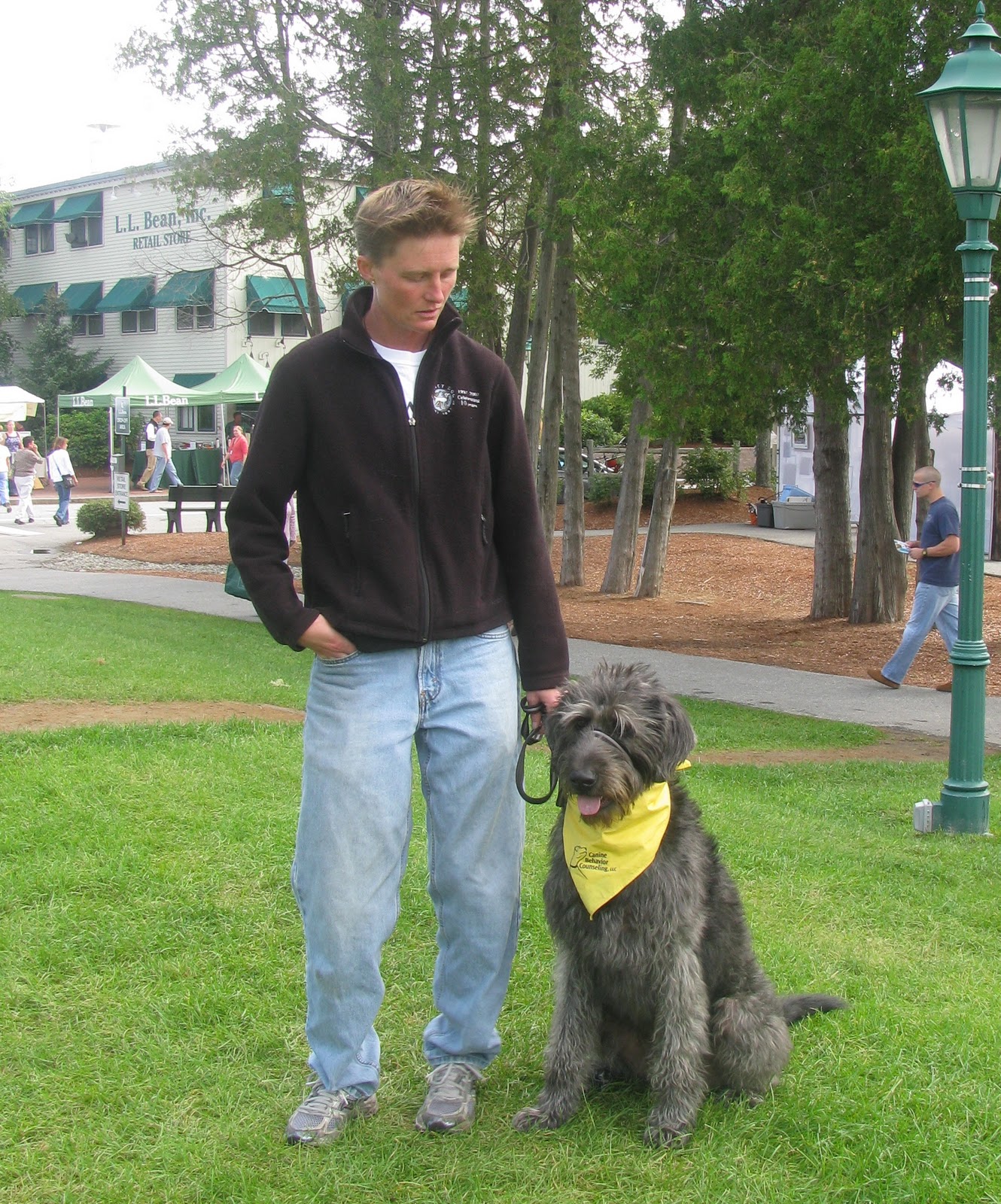
What is the American Kennel Club Canine Good Citizenship program?
This program focuses on teaching responsible dog ownership to owners, and certifies that their dogs have the training and behaviors needed to be reliable, well mannered members of our community. All dogs that have received their vaccinations are welcome to participate, regardless of their breed.
This Certificate is not a title and is non competitive, as dogs are not expected to perform with the same precision required in formal obedience. As part of the program, you are encouraged to communicate with your dog and praise him generously! Of course, you know I wouldn’t have it any other way!
The AKC Canine Good Citizen Test Requirements are as follows:
Test 1: Accepting a friendly stranger
Test 2: Sitting politely for petting
Test 3: Appearance and grooming
Test 4: Out for a walk (walking on a loose lead)
Test 5: Walking through a crowd
Test 6: Sit and down on command and Staying in place
Test 7: Coming when called
Test 8: Reaction to another dog
Test 9: Reaction to distraction
Test 10: Supervised separation
You can sign up and take the test without having previously taken the class, though it is encouraged. Either way, I am happy to help you and your dog earn this rewarding distinction! Call or E-mail me for details!
Subscribe to:
Posts (Atom)