Thursday, July 26, 2012

Can The Dogs Meet?

As a dog owner you must here this question once in a while, can they meet?  The bigger question is do they want to meet?

I highly recommend you watch both dogs body language for this answer.  Many dogs are friendly however there are also many dogs who have not had good experiences or maybe no experience with strange dogs entering their personal space.   Yes, your dog has a personal bubble and may or may not want strangers in it.

When two dogs see each other, watch your dogs body language as well as the other dogs.  This may take 5 or more minutes as you and the other owner have your own greeting while remaining 10 feet apart.  If your dog is turning his back to the new dog, then he is saying, no thanks.  If your dog is looking away from the other dog, yawning, sniffing the ground, scratching, hiding between your legs, then you know your dog is not interested in this greeting.  If you proceed with the greeting, your dog will most likely growl as if to clarify "not interested!"

On the other hand, if both dogs are play bowing, getting low to the ground or trying to crawl to each other then you know you have two dogs who are both interested in greeting or playing.  Again, the slower greeting you have the better success you will have.

So, my suggesting is to not ask the owner anymore, but to ask your dog how he feels about the situation.

This sweet black dog below is encouraging the smaller puppy to engage in play, this greeting took several minutes before both dogs were jumping around in lovely, bouncy play.


This handsome yellow lab is not interested in visiting with the other dogs in class, he continues to have a wide mouth pant and looks away from the other dogs.  While many of us social beings would love for our dogs to love every dog they meet, the reality is we need to ask our dogs what they want in order to set them up for success.





Sunday, June 24, 2012

Stress Free Playgroups

When introducing new dogs, you often only have one chance to make the best first impression.  This first impression is critical to the future success of a positive relationship between the two dogs.  What if you are meeting an entire group?

I believe there are several things you can do to set your doggie playgroup up for success before you remove the leash.  When my Outdoor Adventure Canines come together for some off leash play, we always take time to do several pass by's with each dog, so they can exchange greetings from a safe distance. 
Geting information about each other
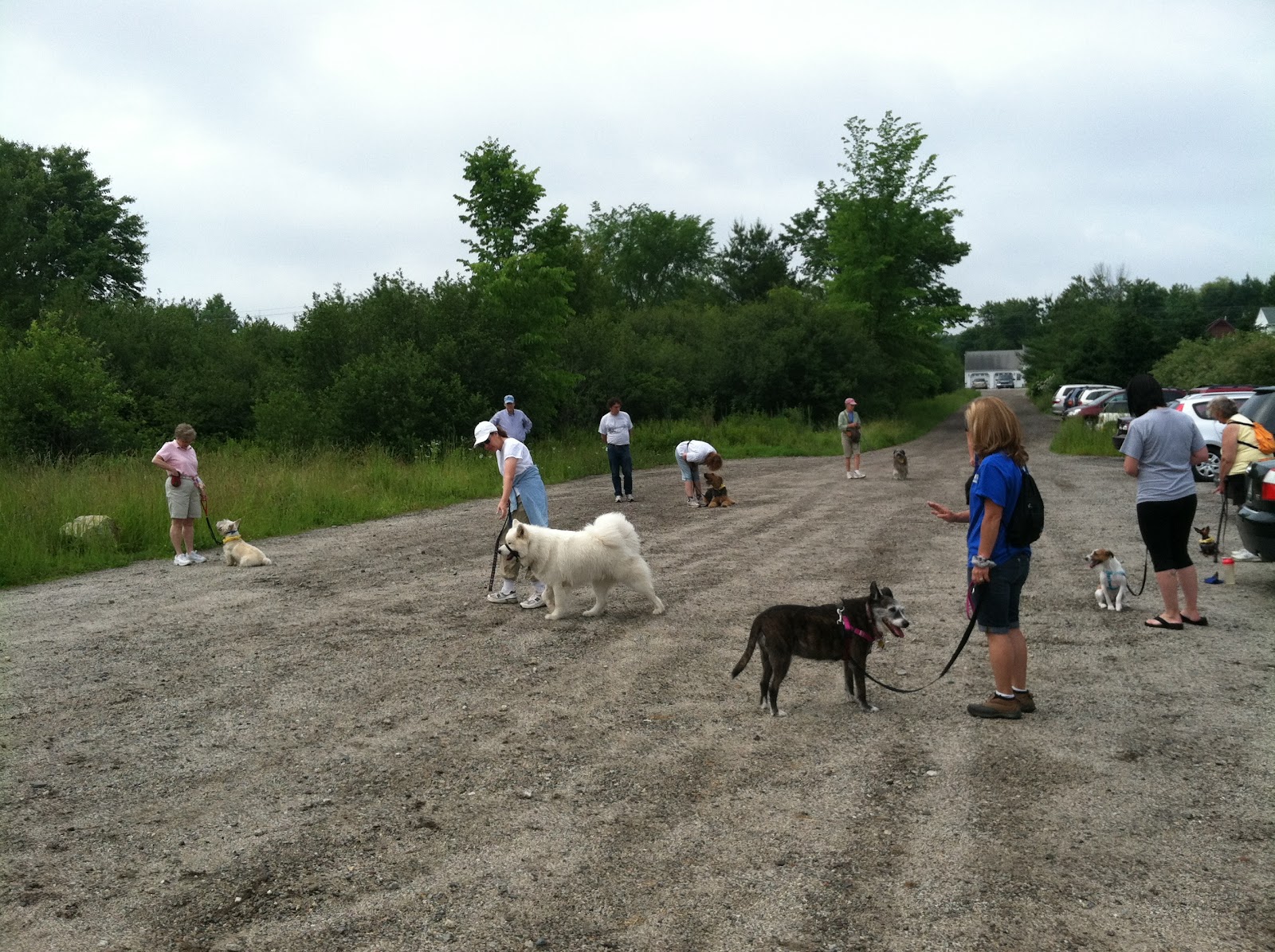
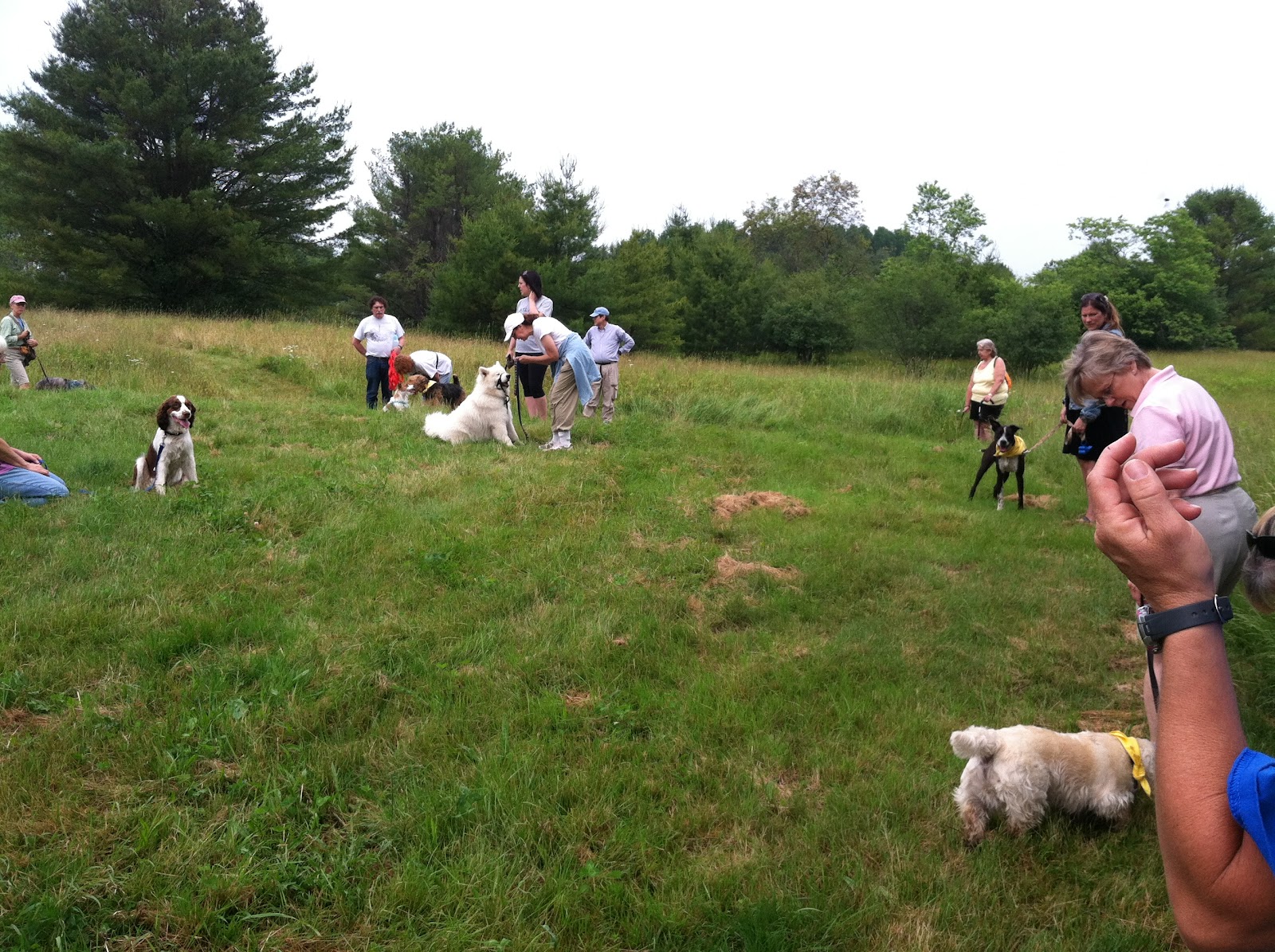
Puff, the handsome Samoyed above, calmly walks around the group, somewhat focused on his handler but also taking a few glances at the playmates near by. Harry, Lily, Caliber, Annie, Denver, Heidi, Sara, Topper, Sushi and Brady each take a look at the dog approaching.  Within this group, we noticed various calming signals from the dogs that were stationary.  Such as looking away, licking lips, blinking, sniffing the ground, yawning, sitting or even laying down.  After giving each dog a chance to walk through the group and get some information, we were ready to do some parallel walking together.


After parallel walking and playing follow the leader I could see each dog becoming more relaxed with their surroundings and their new pack.  


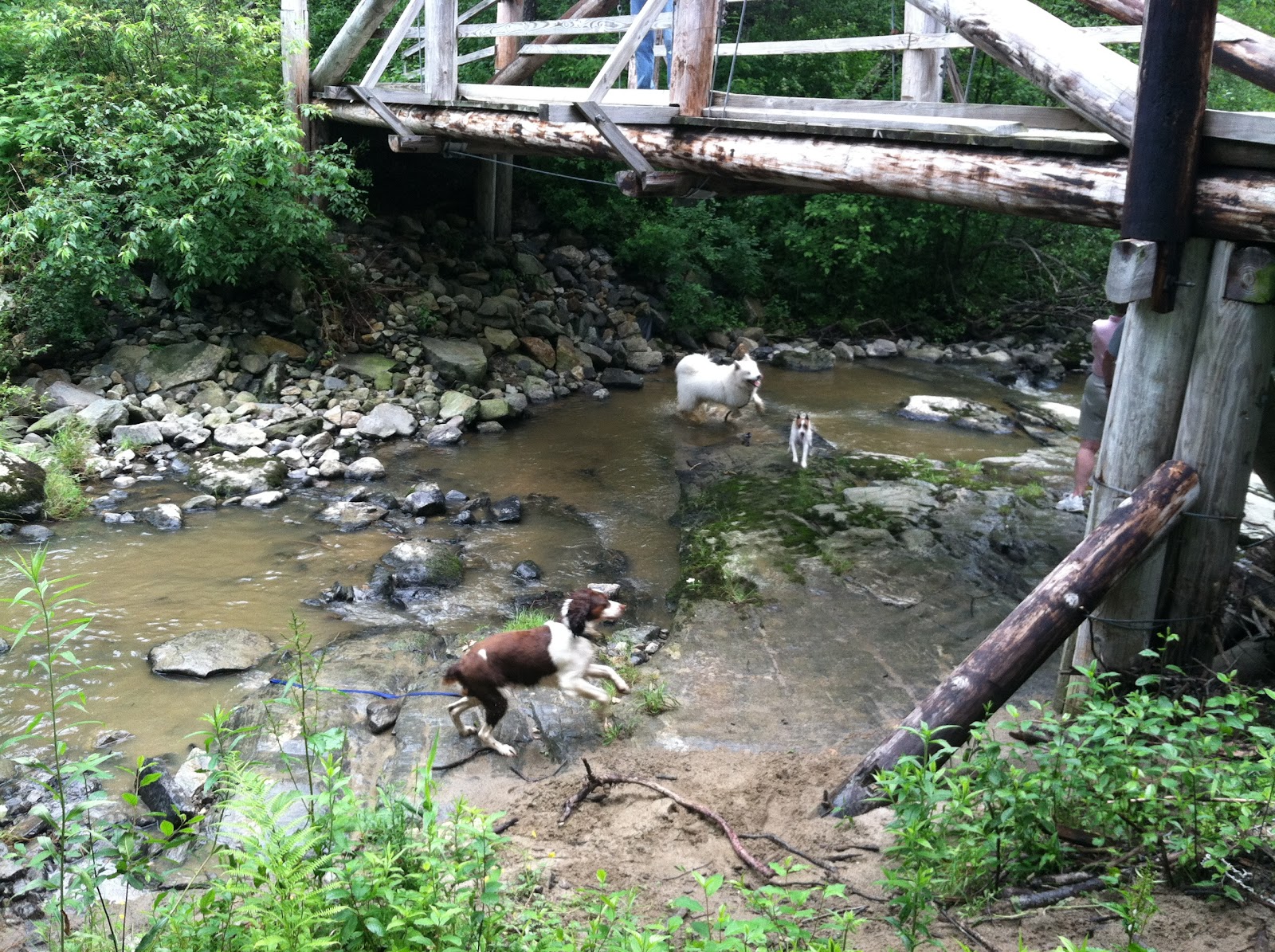
Brady the Scottish Terrier LOVED the water!
Once in the woods, we allowed the dogs off leash for some running, romping and playing.  While our focus was on reinforcing our recall, I was completely enjoying the relationships that developed as a result of a successful introduction.
Brady, the Scottie, was crazy about the water, jumping in and swimming with little hesitation.   What a treat to see him so happy!
Pairing up for a game of chase

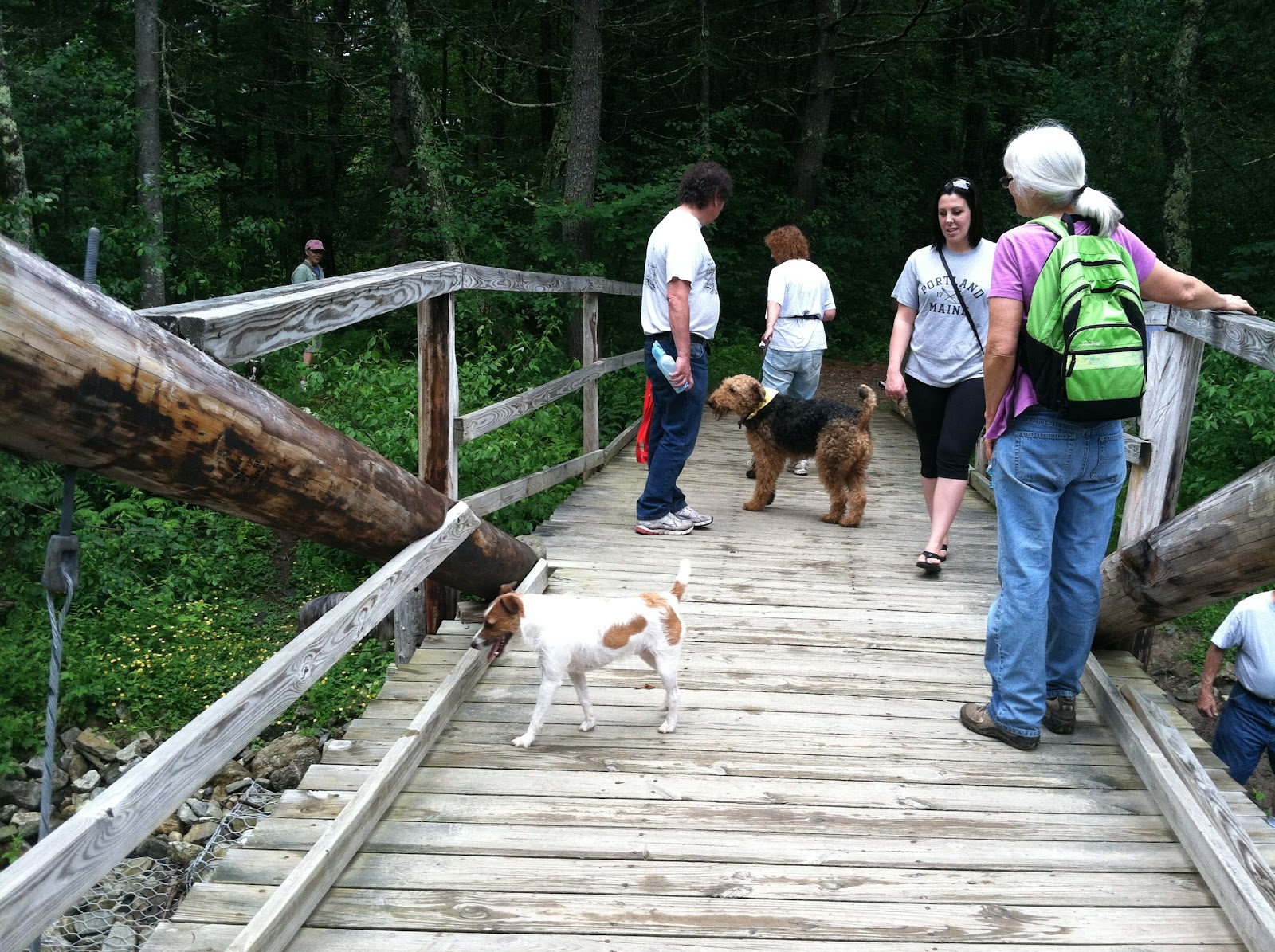
Puff quickly realized that Caliber is a playful pup and engaged in a game of chase.  Lily the springer dashed in and out of the water sometimes following Brady and sometimes chasing Puff.  Harry and Annie, the adult dogs of the group watched from the bridge as the adolescent dogs played using all nice communication skills!  
Topper and Caliber taking a break

First impressions are critical!  Teaching our dogs how to greet calmly sets them up for success, and taking time to build positive relationships is simply joyful! 

Saturday, June 9, 2012

A Scientific Approach

I realize most of us grew up with a dog or new a friend that had a dog.  I often had six or more dogs running around our horse farm as word spread that my mom worked in rescue.  Many different breeds past through my home, much like they do today.  While I currently own 3 dogs, I always have a foster dog or two.

However, growing up with dogs does not make me an expert in dog behavior.  The truth is most of what I thought I knew was very skewed into what I wanted to believe.  Only when I began serious, full-time study and work in the practice of canine behavior, and gained experience working with hundreds of dogs and their owners, did I become an effective trainer.

3 Territorial dogs in training
The fact is, that unless you study canine body language, follow current research, work closely with veterinarians, are open to the fact that a thorough history is essential to your success, you may be making matters worse.  If a doctor treats a patient for arthritis when they actually have a torn tendon, this patient will not get better.  Similarly, if you treat a dog for dominant aggression when he is actually territorial aggressive you will not have success.

I recently met a lady who had just put her chocolate labrador to sleep for aggression. When I asked her if she had tried some behavior modification, she replied "yes, we have spent 6 months with a trainer."  When I asked her if her dog had made any progress, she replied "well, he had some good days, but he was actually getting worse, that is why we had to euthanize him."

Through my experience I know that when dog training is based on a scientific approach it is much much more effective.  One dog is not a scientific experiment, so while your neighbors, family and friends are all well meaning, please consider that their knowledge is limited.

If something is not working then consider the fact that the history or diagnosis may be incorrect.


Friday, May 25, 2012

Teaching Your Dog Behaviors

Telling your dog he did something right and rewarding his behavior will help your dog know what it is you want from him.  Saying "yes" or marking the exact behavior with a clicker then following with a reward will help your dog learn faster.  
In this video, I am using a clicker to mark many different behaviors from my dog Pablo.  Once I have him performing the behavior reliably, then I put a cue word to it so I am able to ask for the behavior.
Many of these tricks took a series of sessions to teach and you will see some are still a work in progress!  The key is to make it fun for your dog!

Timing and repetition are very important as you want to click or say "yes" just as the behavior happens!  Practice several repetitions in a row so your dog understands what it is you are rewarding.  Practice using your dogs meal rather than feeding him out of a bowl, you will be amazed how smart your dog is!!

Tuesday, May 15, 2012

Nail Trimming can be Pleasant

Many owners take their dogs to the groomer or vet simply to have their nails trimmed.  If you have a little time to work with your dog, you might find that trimming your dogs nails can be easy and even an enjoyable event for you and your dog.

In this video, I am desensitizing Pablo to having his nails trimmed.  Like many dogs, he does not enjoy this, however he tolerates it because it predicts him getting food, which he loves!

Note how Pablo begins to offer me his paw as the trim actually predicts his reward coming.

Do you remember going to the dentist as a child?  Who did not stare at the Treasure Chest and wonder what new toys might be inside!  This reward of getting to pick a toy was all I could think about!  Hence it made the entire process of holding my mouth open so the dentist could poke around bearable for me!

It is helpful to go at your dogs pace and be consistent.  Always begin each session the same, tap, treat, tap, treat, trim, treat, and so on.  Progressing to fast will only make your dog more anxious as the unknown is scary and the known is safer.