Happy Easter!!
No classes April 21st through April 25th at Poetic Gold Farm or Tender Touch as many of my clients are out of town on Spring Break and visiting family.
See everyone back this Saturday April 26th.
Best,
Judy
Sunday, April 20, 2014


Wednesday, April 16, 2014
Positive Reinforcement Training is Best
| Interesting study reported in Psychology Today. I am not surprised by the findings — just further confirmation of my Training approach. Judy Moore |
The Effect of Training Method on Stress Levels in Dogs | Psychology Today |
The Effect of Training Method on Stress Levels in Dogs
Discipline-based training increases stress levels in dogs.
At a dog training seminar that I attended recently I found myself engaged in a familiar conversation, namely the effect of various types of dog training methods on the behavior of pet dogs. Nowadays the line seems to be drawn between two camps, one advocating "positive dog training" (which uses rewards such as food and play) versus "discipline-based training" (which incorporates slip collars and leash tugs and other physical interventions to enforce compliance).
Prior to the mid-1940s, most dog training was done using discipline-based training, since most of the early training models came from military dog trainers who had the idea that a dog should be trained using the same kind of discipline-based procedures that were used for human recruits. The change toward more positive training came about because of a series of books written by Blanche Saunders. Although by today's positive training standards she was still a bit harsh, she clearly recognized the value of rewards and was much softer on her canine students than most trainers before her. Over time, positive dog training has come to dominate the canine training scene, following much along the model of the techniques used by Ian Dunbar and others. However over the past few years, due to the influence of certain high profile dog trainers who have popular television series like Cesar Millan, discipline-based training has begun to gain in popularity.
One of the people in the group that I was speaking with insisted that discipline-based training procedures should not have been abandoned, and that no real proof exists showing negative effects on dogs. She complained that there was a bias among canine researchers, who she referred to as "foodies" since they usually reward the dogs with a stream of food treats. "Just because we live in a kinder and gentler world doesn't mean that we can't teach a dog that when he does something we don't like it has negative consequences," she said. "Properly applied, by people who know what they're doing, there's nothing wrong with negative reinforcement or a little bit of punishment. The problem is that most researchers and the people they get to train the dogs they test probably don't really believe in discipline-based training, and so they either overdo it, or don't work as hard at using it properly."
As luck would have it I had just finished going over an article that was recently accepted for publication in the Journal of Veterinary Behavior* that directly dealt with this issue. It was done by two French researchers, Stéphanie Deldalle and Florence Gaunet who wanted to test the effect of the two training styles. They wanted to use the most naturalistic setting that they could find, and to collect data based on observation rather than upon changes in blood chemistry or heart rate or other invasive procedures. What they did first was to attend a number of dog training classes in their vicinity and observe the training procedures that were used. In the end they selected one class which used positive dog training methods almost exclusively and contrasted it to another dog training class which used discipline-based methods (mostly negative reinforcement). They reasoned that the instructors in both of these classes were teaching their students using the method that they favored because, as trainers, they believed it was the most efficient system and would produce the best results.
Once the classes were selected, dog and owner pairs were brought in and tested on familiar exercises such as heeling and sitting on command. There were 26 dogs trained using discipline-based procedures and 24 using positive training. The researchers were not looking at actual learning performance, but rather were measuring the amount of stress that dogs appeared to show when performing their learned exercises. They used easily observable behaviors associated with stress, such as mouth licking, yawning, scratching, sniffing, shivering, whining, low posture, attempts to run away, and whether or not the dog avoided making eye contact with their handler.
The results were rather straightforward. If we simply look at whether a dog showed any of the stress related behaviors we find that 65% of the discipline-based trained dogs showed at least one such sign, as compared to only 8% of the positively train dogs. For some selected behaviors the differences were quite striking, such as in mouth licking (38% discipline; 8% positive), yawning (23% discipline; 0% positive), and low posture (46% discipline; 8% positive). One of the results which I found most interesting had to do with whether or not the dog looked at the owner's face. Both humans and dogs have a tendency to avoid looking at things that raise their stress levels or make them uncomfortable, so the fact that only 38% of the discipline trained dogs looked at their owners faces as compared to 88% of the positively trained dogs seems telling.
This is a small study, but because it is done using actual class trained pet dogs and instructors who believe in their particular training method, it is quite interesting. It seems to be just one more study that suggests that using punishment and negative reinforcement can produce potentially harmful and unwanted emotional changes in dogs. For additional findings on similar topics click here or click here.
Stanley Coren is the author of many books including: The Wisdom of Dogs; Do Dogs Dream? Born to Bark; The Modern Dog; Why Do Dogs Have Wet Noses? The Pawprints of History; How Dogs Think; How To Speak Dog; Why We Love the Dogs We Do; What Do Dogs Know? The Intelligence of Dogs; Why Does My Dog Act That Way? Understanding Dogs for Dummies; Sleep Thieves; The Left-hander Syndrome
Copyright SC Psychological Enterprises Ltd. May not be reprinted or reposted without permission
* Data from: Stéphanie Deldalle & Florence Gaunet (2014). Effects of 2 training methods on stress-related behaviors of the dog (Canis Familiaris) and on the dog-owner relationship. Journal of Veterinary Behavior, 9, 58 – 65.
Monday, March 3, 2014
How to Raise a Dog Friendly Puppy
This is an example of an email I receive from distressed puppy owners several times per month....
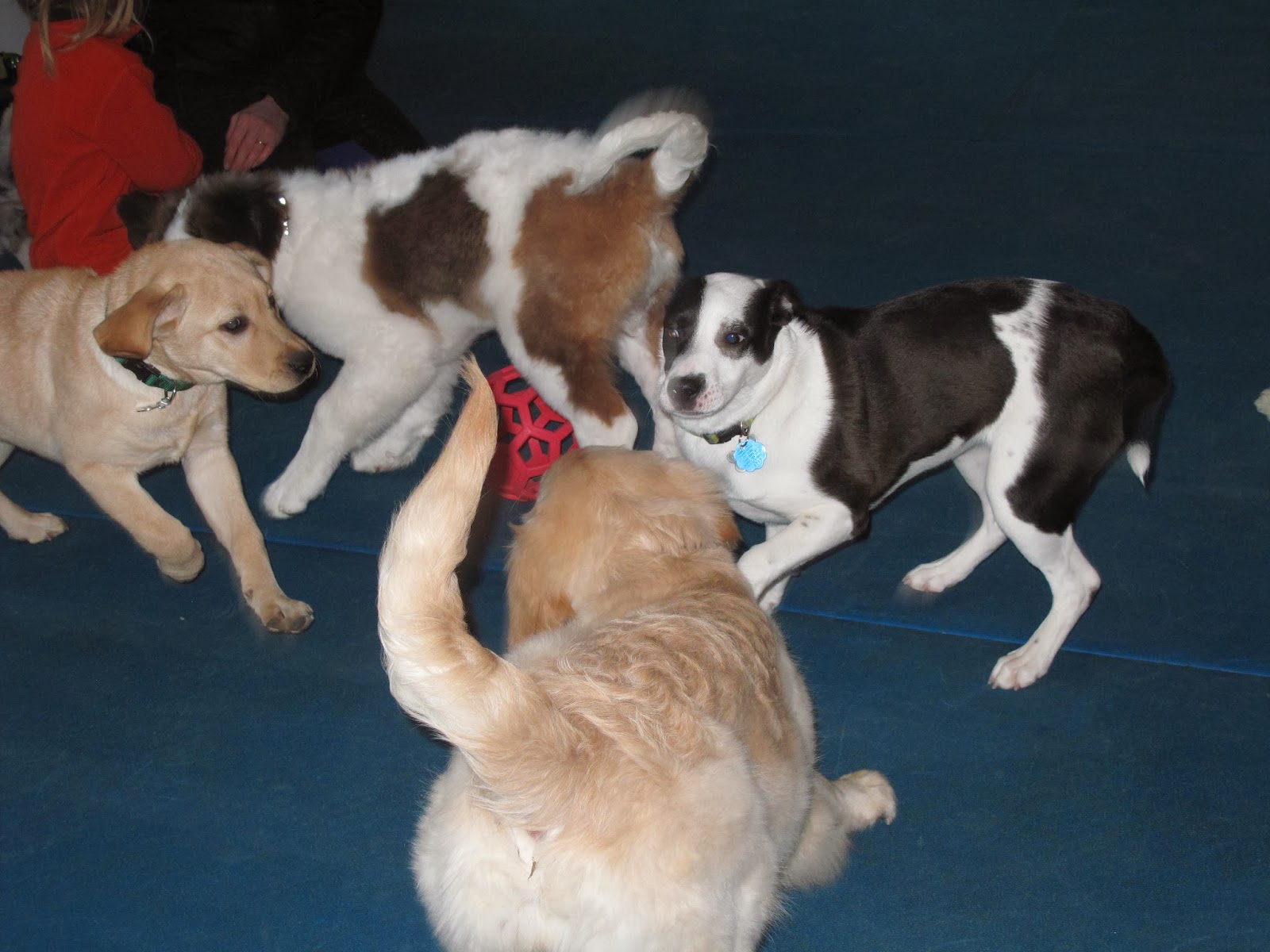 "My dog was taken to the dog park at least 6 times a month during the first 7 months of his/her life, in addition to daily interactions with dogs we let him play with all the dogs on the beach! Once he/she turned 10 months old he/she started becoming aggressive with large pushy dogs or any dog who challenged him/her. He/she can get along with some smaller dogs depending on that dog. My dog has two adult dogs that he/she has known since he/she was 8-10 weeks old that he/she gets along GREAT with."
Will your puppy be exposed to being pushed around by rough adolescent
dogs? Is it true aggression breeds more aggression? Do you know who your dog is playing with now and what that friend is teaching your dog? Is it true a puppy can be over socialized?
As a Certified Dog Behavior Consultant I am swamped with dog aggressive dogs who owners all report they were fine when they were puppies.
All of these dogs who were once dog friendly have one thing in common....they have experienced bully behavior through social learning.
Ask anyone who has raised a puppy and allowed that pup to play with other young puppies
in a supervised class or the neighbors friendly dog or their family members friendly dog and they will tell you that their dog has remained friendly. They have never encouraged their pup to play in large packs of rough adolescent canine play. As a bonus, these puppies leash manners are wonderful as they are not use to being able to pull their owners to every dog they see.
If I get a puppy next year which is a strong possibly, I will make sure I know who my pup is playing with and I will observe this play so my puppy does not become too confident and begin being a bully to other dogs. I will absolutely allow my dog the joy's of playing, however with only very friendly dogs that I know and if he/she begins to be too pushy, I will step in immediately to lower the arousal, even if I have to step in many times during the same play session so it does not become over the top or rough. Practiced behaviors become strong habits, let's make sure our dogs are practicing good habits each day so they remain dog friendly.
Seek out a friend with a very social dog and slowly introduce them by taking a 30 minute walk near each other. After this long walk, you should have a good idea if both dogs are interested in interacting or not. My Outdoor Adventure Class give owners a safe place to allow their dogs to play while being supervised. Often members of class exchange numbers and meet outside of class knowing that arranging play dates will keep their dogs play skills appropriate.
Will your puppy be exposed to being pushed around by rough adolescent
As a Certified Dog Behavior Consultant I am swamped with dog aggressive dogs who owners all report they were fine when they were puppies.
All of these dogs who were once dog friendly have one thing in common....they have experienced bully behavior through social learning.
Ask anyone who has raised a puppy and allowed that pup to play with other young puppies
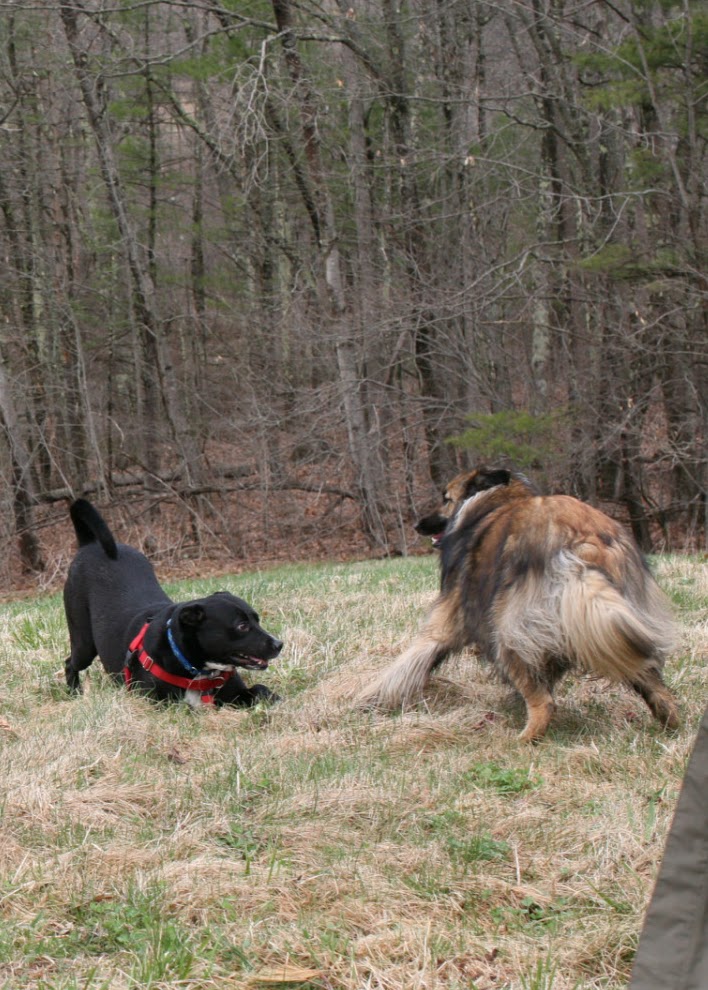 |
| Henry and Nell clearly express their intentions to engage in mutual play. |
If I get a puppy next year which is a strong possibly, I will make sure I know who my pup is playing with and I will observe this play so my puppy does not become too confident and begin being a bully to other dogs. I will absolutely allow my dog the joy's of playing, however with only very friendly dogs that I know and if he/she begins to be too pushy, I will step in immediately to lower the arousal, even if I have to step in many times during the same play session so it does not become over the top or rough. Practiced behaviors become strong habits, let's make sure our dogs are practicing good habits each day so they remain dog friendly.
Seek out a friend with a very social dog and slowly introduce them by taking a 30 minute walk near each other. After this long walk, you should have a good idea if both dogs are interested in interacting or not. My Outdoor Adventure Class give owners a safe place to allow their dogs to play while being supervised. Often members of class exchange numbers and meet outside of class knowing that arranging play dates will keep their dogs play skills appropriate.
Thursday, January 30, 2014
Preventing Dog to Dog Aggression
Protect your dog from becoming aggressive by knowing where he is and who his playmates are. The topic of leash aggression arises so often, I feel the need to address it often in my blogs. For dog trainers it is very clear why we do not let our dogs greet unknown dogs while on leash. I want my dogs attention on ME when I have him on a leash. I prefer he not pull my shoulder off my body when on leash, so I never let him greet other dogs when on leash and guess what? He does not ask anymore because he knows the rule structure. In my opinion, the BEST reason to avoid letting your dog greet unknown dogs while on leash is to keep him or her safe. Once your dog gets into a scuffle while on leash, just the site of a dog while on leash can become very scary for your pup.
 |
| tight leash is nearly un avoidable. |
 |
| Social dogs can relax in the presence of other dogs even while being on a leash. |
I do understand your dog needs daily exercise to get him through his adolescence. If your dog plays well with the neighbors dog, then your dog is already social! Walking on-leash together is a great way to learn leash manners around other dogs. Or, hire a dog-walker who only brings one dog to your session and watch how your dog interacts with that dog. Your dog-walker will help him learn leash manners and prevent any unwanted behaviors from being reinforced. Many dogs are surrendered because they can no longer cope with being on a leash in society. Who's to blame? These dogs were not born dog-aggressive. Rather, it is learned by putting them in environments that are out of control and scary. So please know who your dog is playing with, and if the play is appropriate. We can all agree that aggression breeds more aggression, so please know
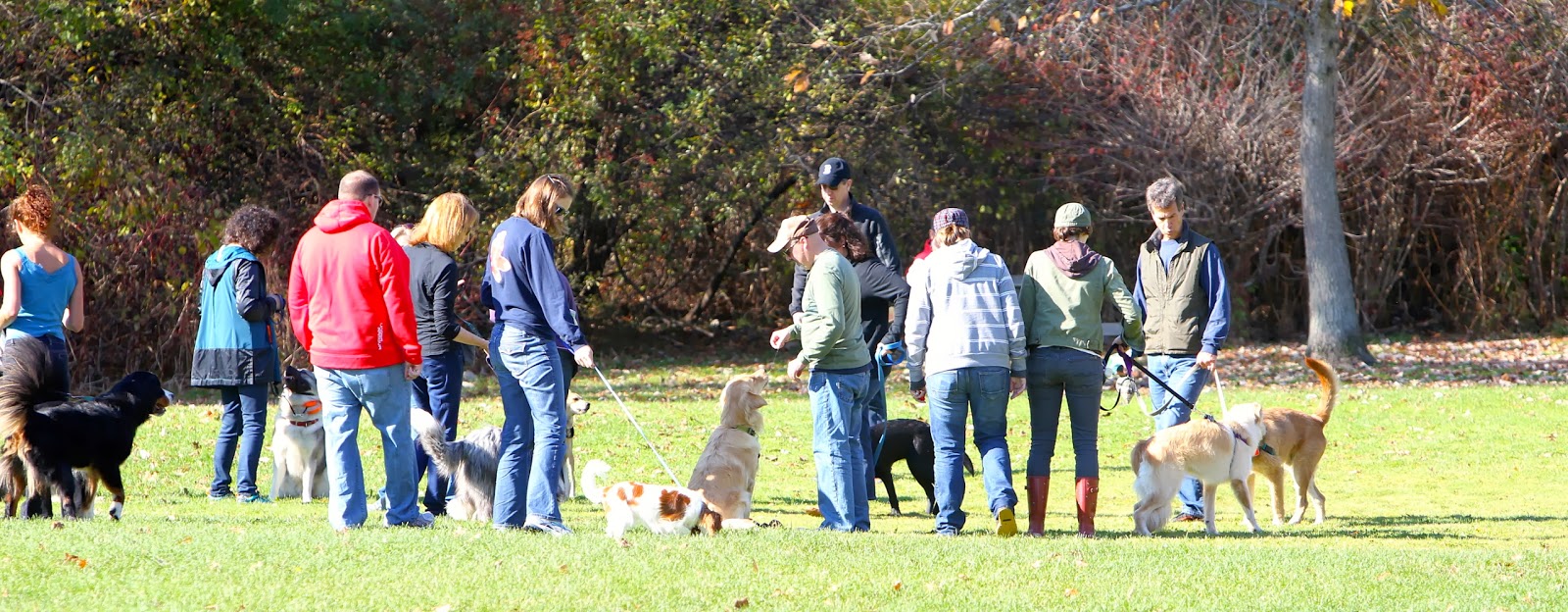
In the photo to the right, my Outdoor Adventure Class is open to dog friendly dogs. Dogs that have good emotional control, dogs that can sit and watch a dog go by without demanding to get to it, and dogs that are not overly pushy. If your dog is demanding to say "hello" to every dog that goes by, think about why that behavior is developing and where it is being reinforced. I hope to see you and your dog in a training class, while on-leash and enjoying each other's calm company!
Sunday, January 26, 2014
A growl is better than a bite!
I am often called to a home where a dog has nipped or bitten a child. I realize many think that a dog should NEVER use his teeth to resolve conflict with a human, and I agree in a perfect world, humans should NEVER hit a dog with their hand to resolve conflict either.
When there is a language barrier between two species, communication is often misunderstood and
conflict can easily follow. A three year old running at a dog with an object in his hand can be scary. How many times does your dog have to get up and move away to keep himself out of trouble before someone slows down the noisy moving child?
If by noon, the dog has looked away three times, offered a few tongue flicks, turned his head away five times and gotten up from his resting place four times to avoid conflict with the little tornado, then on the twelth time he may give a growl. I can not tell you how tolerant a dog should be, but I can tell you that they all have a threshold or a breaking point just like we humans do. I hope you recognize the growl as a low level warning that your dog is asking for space, and please do NOT punish the warning growl. In the future, I guarantee you would prefer your dog growl as a distance cue rather than use his teeth!
What other pet animal is so tolerant of children? Bunnies will squeek a warning and nip, cats will hiss and claw out, hamsters have also learned that nipping gets them safely back in their cage.
I am happy to report that many moms have asked me to speak to their children as a way to educate the child on how the dog is "feeling" when they are near. While some dogs enjoy having kids around, clearly others do not. Our responsibility is to step in and help our dogs feel safe so they do not have to resolve the conflict alone.
If you live or work with children, it is especially helpful for you to know your dogs signals that he or she may be feeling worried. That way you can intervene so that your dog never has to growl or nip, or reach his or her threshold point.
I am certain that the dogs in the above photo, who are being fed by the young girl in the stroller, are feeling pretty good being fed by a child that is not running around. However, if she were to get out of the stroller and run at these dogs, they would not feel the same way and one of them would need to be removed to keep him from hitting his threshold. With lots of positive associations and yummy treats, both these dogs can learn to enjoy children running around them.
So please, if you observe a dog feeling worried about a child moving nearby, remove either the child or the dog so that the dog is feeling safe and the dog does not get into trouble. An ounce of knowledge can go along way to helping both dogs and children grow up together in a positive way.
When there is a language barrier between two species, communication is often misunderstood and
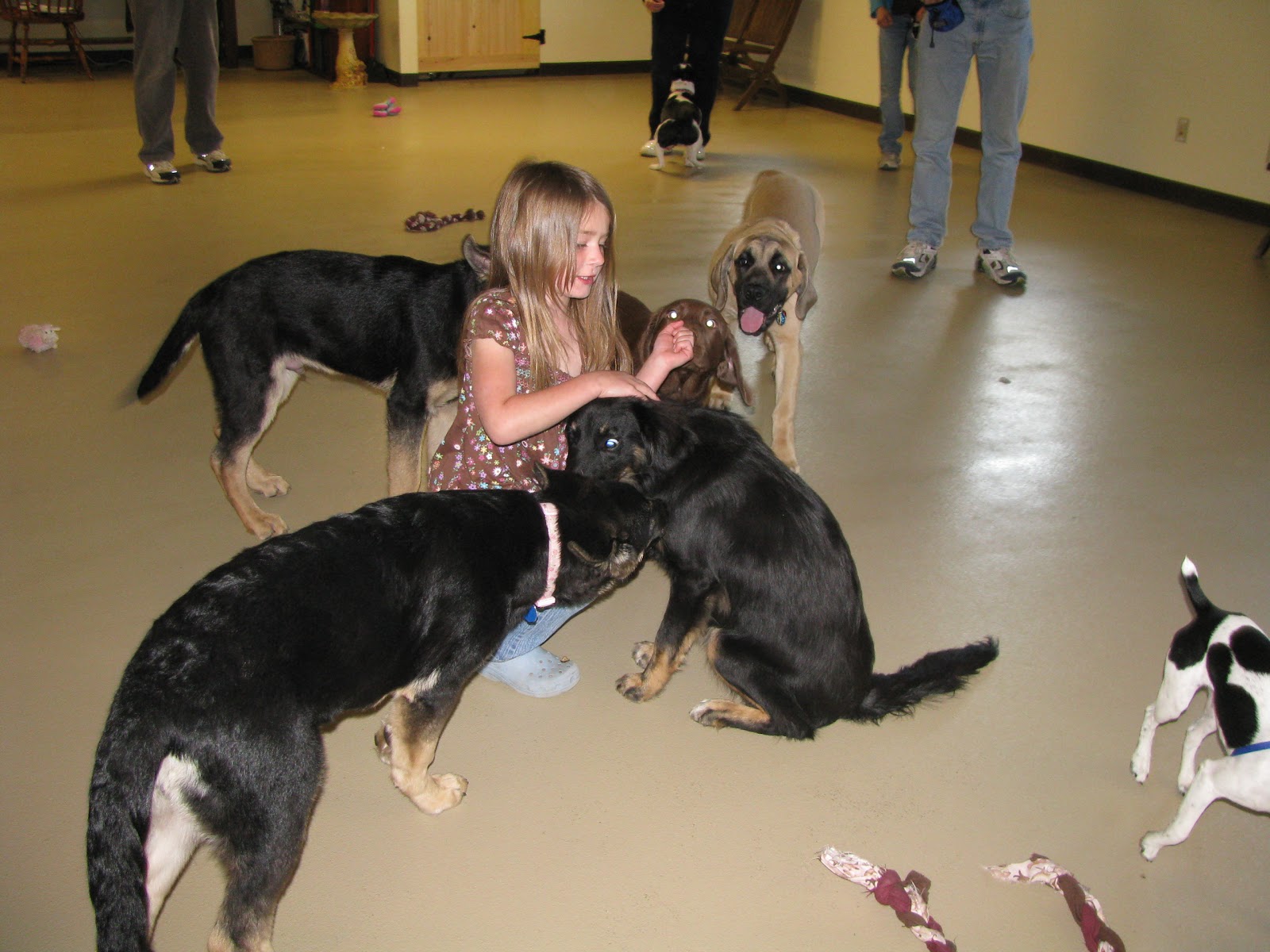 |
| Socializing pups with calm children is essential. |
If by noon, the dog has looked away three times, offered a few tongue flicks, turned his head away five times and gotten up from his resting place four times to avoid conflict with the little tornado, then on the twelth time he may give a growl. I can not tell you how tolerant a dog should be, but I can tell you that they all have a threshold or a breaking point just like we humans do. I hope you recognize the growl as a low level warning that your dog is asking for space, and please do NOT punish the warning growl. In the future, I guarantee you would prefer your dog growl as a distance cue rather than use his teeth!
What other pet animal is so tolerant of children? Bunnies will squeek a warning and nip, cats will hiss and claw out, hamsters have also learned that nipping gets them safely back in their cage.
 |
| I like this child, she is not moving and she feeds me! |
If you live or work with children, it is especially helpful for you to know your dogs signals that he or she may be feeling worried. That way you can intervene so that your dog never has to growl or nip, or reach his or her threshold point.
I am certain that the dogs in the above photo, who are being fed by the young girl in the stroller, are feeling pretty good being fed by a child that is not running around. However, if she were to get out of the stroller and run at these dogs, they would not feel the same way and one of them would need to be removed to keep him from hitting his threshold. With lots of positive associations and yummy treats, both these dogs can learn to enjoy children running around them.
So please, if you observe a dog feeling worried about a child moving nearby, remove either the child or the dog so that the dog is feeling safe and the dog does not get into trouble. An ounce of knowledge can go along way to helping both dogs and children grow up together in a positive way.
Subscribe to:
Posts (Atom)